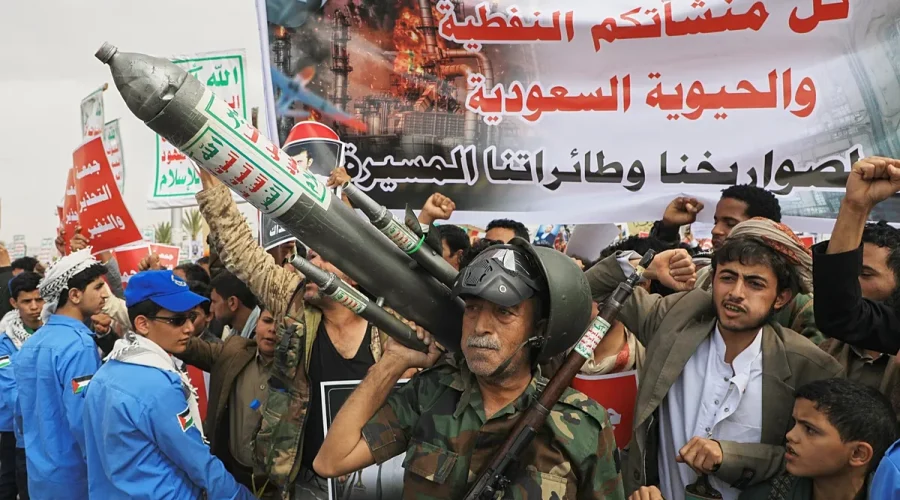
Saudi Tanker Set Ablaze in Red Sea as Houthi Maritime Blockade Intensifies
Usagevpn.com – The Red Sea corridor, one of the world’s most consequential shipping arteries, grew markedly more perilous on Monday when Yemen’s Houthi movement announced it had struck a Saudi oil tanker with a ballistic missile. The claim, issued by the Iran-aligned group, marks the latest escalation in its sustained campaign to choke off maritime traffic through the Bab el-Mandeb strait and underscores how rapidly the region’s shipping landscape is deteriorating.
The Strike and Its Immediate Aftermath
In a statement released shortly after the incident, the Houthis described the engagement as precise and direct, saying the missile impact ignited a fire aboard the tanker and sent nearby vessels scattering from the target zone.
“The strike was accurate and direct, resulting in a fire breaking out aboard the vessel and causing a number of other ships that were present in the target area to flee.”
The group framed the attack as an enforcement action tied to its broader maritime policy. It stated that the targeting was part of implementing the Armed Forces’ decision to prohibit navigation by what it called “the Saudi enemy,” a designation that has become standard in Houthi communications since the blockade was declared last month.
Independent Confirmation from Maritime Watchers
Hours before the Houthi announcement, the United Kingdom Maritime Trade Operations (UKMTO), the British agency that monitors commercial shipping in the region, logged a tanker hit by an “unknown projectile” off Saudi Arabia’s western coast. The agency’s report confirmed a fire on the vessel’s main deck while noting that all crew members were accounted for and that no environmental damage had been detected.
“The Company Security Officer reported a tanker has been struck by (an) unknown projectile causing a fire to the vessel on the main deck. All crew are safe and accounted for and no environmental impact has been reported.”
UKMTO placed the incident 63 nautical miles west of the Saudi port city of Yanbu, a location hundreds of kilometres north of Yemen’s borders. British maritime security firm Vanguard Tech independently corroborated the event, stating that a Saudi-flagged vessel had been hit by a missile and caught fire. The convergence of these reports lends substantial weight to the Houthi claim.
Why Bab el-Mandeb Matters
The Bab el-Mandeb strait, the narrow waterway linking the southern Red Sea to the Gulf of Aden and onward to the Indian Ocean, carries roughly 12 percent of global maritime trade. For years it has served as a critical shortcut between Europe and Asia, allowing tankers and container ships to avoid the longer route around Africa’s southern tip. The Houthis first disrupted the passage severely during the Israel-Hamas war in Gaza, launching a campaign against vessels they deemed linked to Israel and framing their actions as solidarity with Palestinians. That earlier disruption already reshaped global shipping patterns and pushed freight rates to multi-year highs.
Now the group is turning its attention squarely on Saudi Arabia’s vessels, a shift that narrows the strait’s effective capacity even further and raises insurance premiums for any operator transiting the area.
A Wider Regional Squeeze
The Bab el-Mandeb campaign unfolds at a moment when the Strait of Hormuz, the Gulf’s other indispensable chokepoint, remains under blockade following the continuation of the US-Iran war after the collapse of the interim deal between the two sides. With both chokepoints simultaneously constrained, global energy and commodity flows face compounding pressure. Reports indicate the Houthis have held discussions with Tehran about instituting a toll on cargo ships transiting Bab el-Mandeb, mirroring the fee structure Iran is contemplating for Hormuz. If implemented, such a levy would represent a formalized extraction of revenue from international trade and would signal a deeper institutionalization of the blockade.
How the Current Round of Fighting Began
Hostilities between the Houthis and Saudi Arabia erupted in July after the group welcomed an Iranian aircraft into Yemen’s capital, Sana’a, an act Riyadh treated as a provocation. That episode triggered a cascade of tit-for-tat strikes. Since then, the Houthis have hit Saudi tankers in the Red Sea, attacked Yemeni government forces, and repeatedly targeted Saudi oil infrastructure and airports. In response, Riyadh has launched air strikes against Houthi military positions and infrastructure in Hodeidah, Yemen’s principal Red Sea port.
The blockade now threatens Saudi Arabia’s capacity to export millions of barrels of crude oil per day, a vulnerability that has prompted the kingdom to seek multilateral security guarantees. On 31 July, Riyadh announced a new multinational maritime defence coalition. Fourteen countries, including Pakistan, Turkey, and Egypt, signed a founding statement committing to the protection of Red Sea shipping.
Yemen’s Role in a Broader Conflict
Embroiled in more than a decade of its own civil war, Yemen became the latest country drawn into the wider Iran war last month, when the Houthis upended a 2022 truce with the internationally recognised government. The group, formally known as Ansar Allah, seized power in late 2014 after storming Sana’a, taking the presidential palace and key military installations, and forcing the recognised government into exile. It operates within Tehran’s so-called Axis of Resistance, a loose network of militant organisations spanning Lebanon’s Hezbollah, Gaza’s Hamas, and various Iraqi militias, all backed, trained, and equipped to varying degrees by the Islamic Revolutionary Guard Corps.
Notably, the Houthis do not control the stretch of Yemen’s coastline that borders Bab el-Mandeb itself. They hold territory less than 100 kilometres from the strait, yet their missile and drone reach, combined with their control of coastal launch sites, gives them effective leverage over the waterway. That geographic asymmetry — projecting power over a corridor they do not directly administer — remains one of the defining features of the current maritime standoff.
Related Reading
Frequently Asked Questions
What is Houthis claim strike on Saudi tanker?
Houthis claim strike on Saudi tanker is the main topic of this guide. The article explains the context, practical details, and next steps readers should understand.
Why does Houthis claim strike on Saudi tanker matter?
Houthis claim strike on Saudi tanker matters because readers are looking for a useful answer, not just a short summary. Good content should match search intent and help them decide what to do next.