When Internet Memes Become Street Sports: Inside the “Aura Farming” Craze Sweeping Latin America
Usagevpn.com – A circle of phones rises above a packed crowd. Two young people lock eyes at the centre of the ring, shoulders squared, waiting for the beat to drop. There is no boxing glove, no microphone for freestyle rap, no choreographed dance routine. What unfolds next is something stranger: a rapid-fire sequence of exaggerated poses, jaw-tensing gestures, and half-recognisable callbacks to viral clips that only make sense if you have spent the last few years scrolling TikTok at two in the morning.
This is “aura farming” — or, in the Spanish-speaking world where the trend has taken root, “farmear aura” — and it has migrated from comment sections to city plazas across Mexico, Argentina, Brazil, Peru, Bolivia, and most recently Spain. The participants skew between roughly 14 and 20 years old, and the rules are as loose as the internet culture they draw from: outdo your opponent by projecting more charisma, style, and unearned coolness than they can muster.
Decoding the Vocabulary
The phrase fuses two unrelated registers. On platforms like TikTok and Instagram, “aura” has become shorthand for the intangible package of swagger, attractiveness, and effortless confidence a person seems to radiate. Telling a friend they are running at “100% aura” is a compliment on their ability to look effortlessly magnetic.
“Farmear,” meanwhile, borrows from video-game parlance. In gaming, “farming” means grinding — repeating a low-stakes action over and over to accumulate points, currency, or experience. Layer the two terms together and you get a compact definition: perform or display something that symbolically banks you points for popularity, style, or sheer audacity.
What started as a caption convention has hardened into a spectator event with crowds, judges, and prize money.
A Night in Mexico City
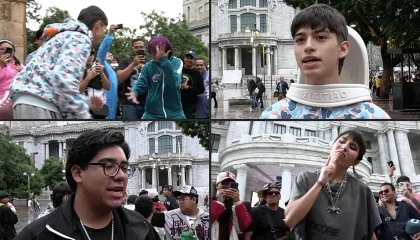
At a recent contest staged in front of the Palace of Fine Arts in Mexico City, competitors pulled from an encyclopaedia of internet lore to try to outshine one another. Carlos Irving Quintana, a 14-year-old with vividly purple hair, drew a roar from the onlookers by replicating Cristiano Ronaldo’s trademark “Siuuu” goal celebration — the leap, the mid-air spin, the arms flung wide. He pivoted mid-routine into “mewing,” the TikTok trend in which a participant tenses the jaw, tilts the chin, and points a single finger at the profile line as though presenting a sculpted marble bust.
His opponent answered with the “6-7” gesture, a meme that circulates among young users without any fixed semantic content but has nonetheless become as instantly readable as a thumbs-up. Around them, spectators craned in, phones recording, while a soundtrack that mimics a video-game boss-battle theme pulsed from a portable speaker.
The underlying logic is simple: the more recognisable viral references a contestant can thread into a single uninterrupted routine, the stronger their claim to the crowd’s approval.
Attitude Over Accuracy
Knowing the memes, organisers stress, is only half the equation. Delivery matters more. Aldhir Gonzalez, a 22-year-old who coordinates the Mexico City events, put it plainly when speaking to AFP:
“Whoever looks better, shows off more, gets more we laughs and has more confidence wins.”
That emphasis on performance over precision explains why the contests reward theatricality. The eventual victor of the Mexican contest, Kaled Rosales Salazar, arrived wearing trousers patterned after Lightning McQueen — the anthropomorphic race car from Pixar’s Cars — paired with wooden clogs. During one duel he brandished an oversized white sandal as a prop, mimed lassoing his rival, and led the imaginary horse away down the “street.” The bit landed. Rosales collected the 3,000-peso purse, roughly 177 US dollars, and walked off to a standing ovation.
From Prize Money to Bragging Rights
Not every arena offers cash. In Argentina, the “prize” is purely reputational: the winner earns the right to declare they possess “infinite aura” for the remainder of the evening. The distinction underscores how the activity functions less as sport and more as a social ritual — a structured way to perform belonging to a particular generational in-group.
The trend has also bled into professional football. Argentine club Boca Juniors posted on X a photo of midfielder Santiago Ascacibar celebrating a goal, captioned with a joke that his aura was “unbeatable.” When a top-flight football club leans into the vocabulary, the phenomenon has crossed from bedroom-phone culture into mainstream visibility.
Generational Friction and Political Backlash
Not every observer is charmed. An organiser of an upcoming Buenos Aires battle described the phenomenon as a lifestyle that “almost nobody understands,” a remark that captures the generational gap at the trend’s core. To a teenager, the jaw-tense and the “6-7” are dense with meaning; to a parent or grandparent watching from the back of the circle, they can look like random posturing stripped of context.
The friction has escalated beyond polite confusion. A mayor in Honduras has formally banned the street battles and, in the same breath, floated the idea of compulsory military service as a corrective to what he perceives as cultural decay. Whether that conflation signals genuine policy concern or performative outrage is debatable, but it marks the first time “aura farming” has entered municipal governance.
What Psychologists See
Academic voices are more measured. Venezuelan psychologist María Eugenia Tovar has argued that the trend carries positive dimensions — offering young people a low-stakes arena for creative self-expression, social bonding, and the rehearsal of confidence in front of peers. In a culture where formal outlets for adolescent performance are scarce, a plaza full of teenagers miming lasso-lassos and jaw-tenses may be less absurd than it first appears.
Whether “aura farming” calcifies into a lasting subculture or burns out like the thousands of micro-trends that precede it remains open. What is clear is that, for now, the streets of at least six countries have become arenas where the grammar of the internet is spoken aloud, performed in real time, and judged by whoever is close enough to clap.
Related Reading
Frequently Asked Questions
What is What is aura farming TikTok s strange?
What is aura farming TikTok s strange is the main topic of this guide. The article explains the context, practical details, and next steps readers should understand.
Why does What is aura farming TikTok s strange matter?
What is aura farming TikTok s strange matters because readers are looking for a useful answer, not just a short summary. Good content should match search intent and help them decide what to do next.