Scorching Heat Across Europe Flips Open a Century of Buried War
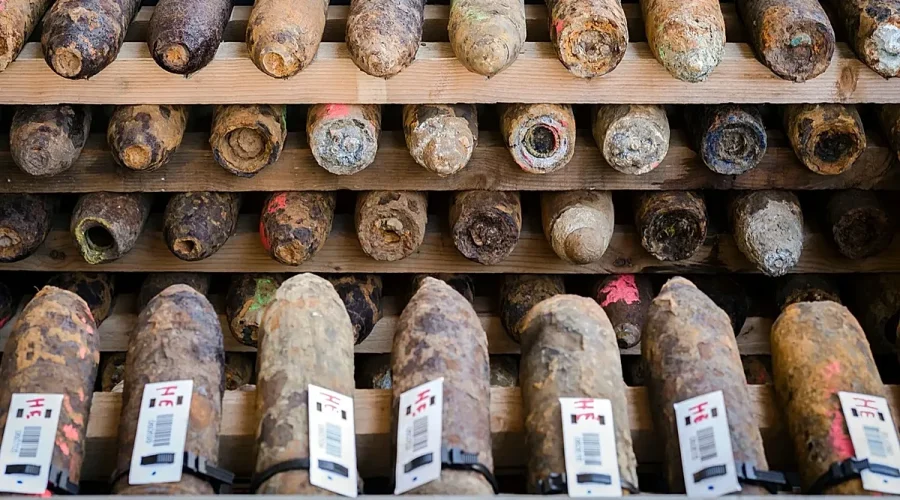
Usagevpn.com – As blistering heatwaves and prolonged droughts have set vast stretches of western European countryside ablaze this summer, firefighters have confronted an enemy older than any modern conflict: shells, bombs, and munitions left in the ground since the two World Wars. What began as a season of record-breaking temperatures and water shortages has quietly become a slow-motion archaeological excavation of the twentieth century’s most destructive era, with each advancing front of flame threatening to ignite what lay dormant beneath the soil for decades.
The phenomenon is not confined to a single nation. Detonations have been logged in France, Germany, Belgium, and the Netherlands over recent weeks, forcing crews to adjust tactics mid-incident and, in some cases, to pull personnel back from active fire lines while ordnance teams assess the blast radius. The coincidence of extreme weather and unstable explosives buried under dry, desiccated earth has turned routine wildfire suppression into a high-stakes operation where a single spark from a buried shell can send shockwaves through a firefighting team.
The Climate Mechanism
The connection between warming temperatures and buried ordnance is not speculative. Sarah Njeri, a peace and conflict scholar based at London’s School of Oriental and African Studies, framed the issue plainly:
“Climate change is now doing the work of unburying and reactivating what was previously stable.”
In practical terms, sustained drought strips moisture from topsoil, weakening the clay and silt that once sealed metal casings against corrosion and mechanical shock. As the ground dries and contracts, casings shift, corrode faster, and become more susceptible to the thermal stress of a nearby fire. What sat inert for seventy or eighty years can, in a matter of hours, become a live explosive device triggered by heat, vibration, or the simple pressure change of collapsing earth.
Specific Incidents: Bordeaux and the High Fens
Near Bordeaux in southwestern France, a fire that consumed surrounding woodland and scrubland exposed what investigators believe is a cache of Second World War-era ammunition. The discovery prompted a temporary evacuation of nearby residents and a coordinated sweep by military ordnance specialists before crews could safely resume suppression work.
In eastern Belgium, the province of Liège has endured one of the most intense fires of the season in the High Fens (Hautes Fagnes), a peatland region that straddles the border into Germany. Local governor Hervé Jamar confirmed that emergency services had modified their operational protocols to account for munitions known to be buried within the fire perimeter. He noted that “a few sporadic detonations” had been heard in recent days, underscoring that the threat was active rather than theoretical.
Why the High Fens: A Battlefield Revisited
The concentration of ordnance in the High Fens is no accident of geography. The area was the stage for the Battle of the Bulge, among the bloodiest engagements of the Second World War. On 16 December 1944, German forces launched a surprise offensive against Allied positions in the region, catching American units off guard and achieving initial territorial gains. The advance, however, stalled by the close of that month as Allied reinforcements arrived in force and German fuel, ammunition, and manpower reserves were exhausted. The fighting left the peat bogs and surrounding forests littered with unexploded shells, mines, and artillery rounds that were never fully cleared in the decades following the war.
For local communities, the High Fens have long carried an informal warning: dig carefully, walk known paths, and respect the old markers. Now that fire has begun to do the digging, that informal caution has become an operational imperative.
A Wider Pattern: Rivers, Vehicles, and Forgotten Hardware
The ordnance issue is only one facet of a broader trend. Shrinking river levels across Europe have exposed German warships that had lain submerged since the 1940s, a Wehrmacht-era motorbike pulled from silt, and at least one intact bomb recovered from a riverbed. Each discovery is a small, tangible reminder that the material residue of total war remains distributed across the continent’s landscape in quantities that postwar clearance operations never fully addressed.
Christina Greene, a researcher at the University of Arizona, described the cumulative effect of these findings:
“The legacy of war keeps creeping up.”
She added that communities in affected regions are “reliving the legacies of war and conflict in a way that we haven’t had to deal with in a while in certain places,” pointing to a psychological and logistical burden that falls disproportionately on rural populations who have lived beside these buried hazards for generations without ever needing to think about them.
Implications and What Comes Next
For fire services across western Europe, the coming seasons will likely demand updated training modules, closer liaison with national ordnance-disposal units, and revised risk-assessment protocols for every wildfire that touches former front-line terrain. Municipalities in affected provinces may face pressure to accelerate long-deferred clearance programmes, a task complicated by the sheer volume of unlocated munitions and the cost of surveying peatlands, forests, and riverbanks systematically.
The broader implication is that climate-driven environmental change is not merely an abstract temperature curve. It is a physical force that rearranges the landscape, and in doing so it reactivates hazards that were assumed to be permanently neutralised. For the communities of the High Fens, the banks of the Garonne, and the forests of northern France and the Low Countries, the lesson of this summer is stark: the wars ended, but their hardware did not, and the heat is now the hand that turns the key.
Related Reading
Frequently Asked Questions
What is Europe s devastating wildfires unveil deadly?
Europe s devastating wildfires unveil deadly is the main topic of this guide. The article explains the context, practical details, and next steps readers should understand.
Why does Europe s devastating wildfires unveil deadly matter?
Europe s devastating wildfires unveil deadly matters because readers are looking for a useful answer, not just a short summary. Good content should match search intent and help them decide what to do next.