Muslim World League launches plan for West Africa peace
Usagevpn.com – Ten years of insurgent violence across the Sahel have displaced millions and killed thousands, leaving deep communal wounds between Muslim and Christian populations. In direct response, the Muslim World League launches plan to counter extremist narratives and promote peace in West Africa — a coordinated programme pairing interfaith dialogue with structured educational outreach and media engagement. Its stated aim is to dismantle the ideological infrastructure that radical groups depend on for recruitment and for deepening suspicion between faith communities.
The Abuja Framework and Its Institutional Architecture
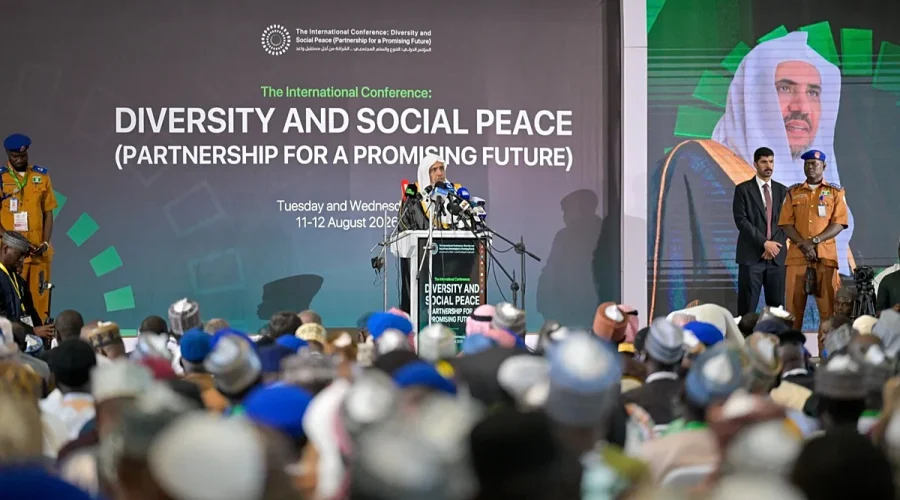
The strategy was formally unveiled in Abuja, Nigeria, at an international gathering convened under the patronage of President Bola Ahmed Tinubu. The summit, titled “Diversity and Social Peace: A Partnership for a Promising Future,” brought together Muslim and Christian clergy, government ministers, civil-society advocates, and international religious representatives with a single objective: converting goodwill into enforceable, structured action against radicalisation.
Delegates adopted the Abuja Declaration by consensus. The document binds government institutions, religious authorities, and civil-society organisations to collaborate on conflict prevention and to intercept extremist narratives at the point where they first take root in local communities. It authorises the expansion of educational curricula, leadership-training programmes, and media campaigns anchored to the Makkah Charter, a pre-existing framework for interfaith religious cooperation.
Equally significant is the creation of a permanent institutional mechanism: the Coordinating Body for Religious and Civil Leaders and Institutions in West Africa. This body will oversee implementation, synchronise programmes across national borders, and conduct regular progress assessments to ensure commitments do not dissolve into ceremonial signatures.
Four Memoranda of Understanding and Regional Context
At a follow-up session, four memoranda of understanding were executed between Muslim and Christian organisations. The first links the Muslim World League itself with Nigeria’s Interfaith Mediation Centre. The second pairs Jamaat Izalat al-Bid’a wa Iqamat as-Sunna with the Council of Christian Religious Leaders in Northern Nigeria. The third connects Jamaat Nasr al-Islam to the Christian Youth Initiative for Peace and Development. The fourth binds the Union of Ahl al-Sunna Organisations with the Alliance of Progressive Pastors.
The timing is acute. Jama’a Nusrat ul-Islam wa al-Muslimin (JNIM) and the Islamic State in the Greater Sahara (ISGS) have sustained campaigns of violence across the Sahel, while in Nigeria the insurgency waged by Boko Haram and its successor faction, ISWAP, has been ongoing since 2009, repeatedly attempting to widen the divide between Muslim-majority and Christian-majority communities in the north-east and north-central zones. By institutionalising interfaith dialogue and tying it to concrete educational and media outputs, the Abuja framework seeks to interrupt the cycle in which communal grievance is harvested by extremist recruiters and converted into sustained violence.
Sheikh Mohammed bin Abdul Karim Al-Issa, secretary-general of the Muslim World League, framed the initiative as a response to root causes rather than symptoms.
“The initiative was designed to address the root causes of extremist ideas through binding agreements between the parties,” Al-Issa stated, emphasising that voluntary goodwill alone had proven insufficient without structured, accountable commitments.
On the sidelines of the conference, President Tinubu received Al-Issa at the presidential palace and confirmed full governmental backing for the declaration and its implementing programmes, including periodic evaluations of progress. The meeting signalled that the Nigerian state intends to treat the interfaith framework as a component of national security strategy rather than a peripheral civil-society exercise.
Frequently Asked Questions
What exactly does the Muslim World League launches plan cover? It encompasses interfaith dialogue structures, expanded educational curricula, leadership-training programmes, and media campaigns across West Africa, all coordinated through the newly created Coordinating Body for Religious and Civil Leaders and Institutions.
Where and when was the plan announced? The framework was unveiled in Abuja, Nigeria, at a summit convened under President Tinubu’s patronage. Four memoranda of understanding were signed at a follow-up session of the same gathering.
How will implementation be monitored? The Coordinating Body will oversee execution of all four memoranda, synchronise cross-border programmes, and conduct regular progress assessments. President Tinubu’s office has committed to periodic governmental evaluations of outcomes.
Which organisations are directly bound by the agreements? The four memoranda link the Muslim World League with Nigeria’s Interfaith Mediation Centre; Jamaat Izalat al-Bid’a wa Iqamat as-Sunna with the Council of Christian Religious Leaders in Northern Nigeria; Jamaat Nasr al-Islam with the Christian Youth Initiative for Peace and Development; and the Union of Ahl al-Sunna Organisations with the Alliance of Progressive Pastors.