Ukraine Sanctions Target Masha and the Bear
Usagevpn.com – In a move that extends wartime economic measures into children’s entertainment, Ukraine sanctions Masha and the Bear by placing the animation studio, its leadership, and distribution partners behind the globally popular series onto a new sanctions list. The decision sits inside a broader package signed by President Volodymyr Zelenskyy that also reaches into Russia’s defence sector and senior government ranks. Five Russian nationals and four organisations connected to the show’s production and worldwide distribution are named.
Kyiv’s stated justification centres on what officials describe as embedded pro-Kremlin messaging delivered to preschool-age audiences through the familiar packaging of lighthearted animation. Zelenskyy’s office characterised the series as a direct threat to national security, arguing that its enormous global footprint makes it an instrument of soft-power influence that warrants formal countermeasures.
“The programme spreads pro-Russian narratives disguised as children’s content,” the presidential office said when explaining why the cartoon’s creators were included on the list.
What the Measures Require in Practice
The package goes well beyond symbolic condemnation. Listed individuals and entities face asset freezes within Ukraine, restrictions on commercial activity in the country, and curbs on the use and distribution of copyrighted material tied to the series. In concrete terms, Ukrainian regulators gain a legal basis to demand that episodes be removed from YouTube, streaming platforms, and other services operating in or accessible from Ukrainian territory.
Animaccord, the Moscow-based studio that has produced the show since its inception, is among the named organisations. Its founder and chief executive, along with several principal creative staff responsible for scripting, character design, and animation direction, are individually listed.
From Folklore to Geopolitical Flashpoint
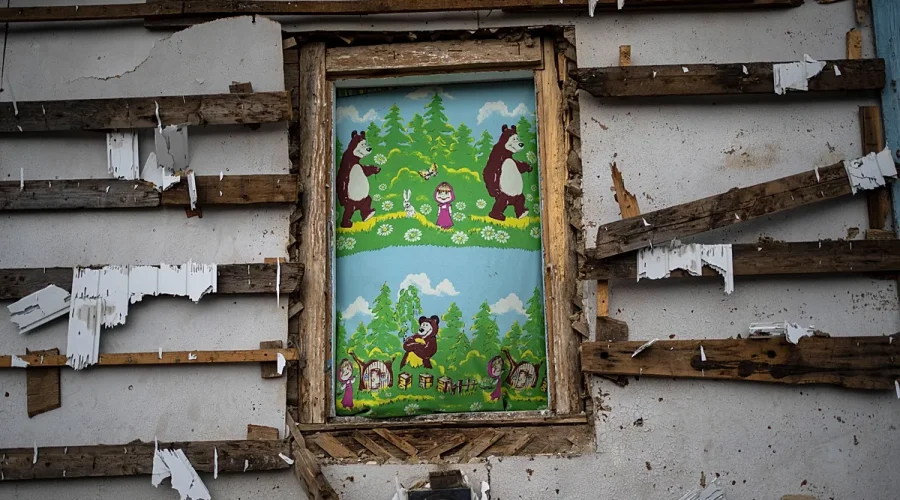
The series’ origins are unremarkable. Loosely adapted from a Russian folk tale, it follows the misadventures of a small, endlessly curious girl and a retired circus bear sharing a woodland home. Launched in 2009, it rapidly outgrew its domestic audience. Translated into dozens of languages, the show now reaches viewers in more than 100 countries, and its YouTube catalogue has accumulated billions of cumulative views.
No single episode illustrates that scale more starkly than one titled “Recipe for Disaster,” which has surpassed 4.6 billion views — placing it among the most-watched videos ever uploaded to the platform. For a children’s property, the figure is extraordinary, and it is precisely this ubiquity that drew the scrutiny now formalised in the sanctions package.
Critics in Kyiv point to specific visual choices within individual episodes. In one, the titular character dons a cap associated with the NKVD — the Soviet-era secret police and security apparatus that, under Joseph Stalin, oversaw a vast campaign of political repression and administered the gulag labour-camp system. In another, she appears in what viewers identify as a tank-crew hat paired with a Soviet-era military uniform.
Ukrainian officials have long argued that embedding such symbols in content aimed at toddlers normalises Russian and Soviet iconography in minds that may never encounter the historical context. The concern predates Russia’s full-scale invasion of February 2022. As early as 2017, a commission within Ukraine’s State Film Agency weighed a formal request to ban the cartoon on grounds that it carried embedded propaganda narratives. The issue resurfaced with renewed force in the latter half of 2025: in August, the show topped rankings as the most popular children’s YouTube channel among Ukrainian viewers, and two months later the National Police publicly called for sanctions against its makers.
Moscow’s Reaction
The Kremlin responded swiftly. On the Friday following the announcement, spokesperson Dmitry Peskov dismissed the decision as an embarrassment for Kyiv.
“It shows the ugliness of the Kyiv regime,” Peskov said, referring to the targeting of a children’s programme.
The remark underscored how each side frames the dispute. For Moscow, sanctioning a beloved cartoon is an act of petty vindictiveness; for Kyiv, it is a necessary step to shield young audiences from what it considers ideological manipulation.
Frequently Asked Questions
Will Masha and the Bear episodes disappear from YouTube globally? The sanctions apply within Ukraine and to entities operating there. They give Ukrainian regulators authority to demand removal from platforms accessible from Ukrainian territory, but they do not impose a worldwide takedown.
When did the sanctions take effect? They were enacted as part of a broader package signed by President Zelenskyy in August 2026, following months of public debate and a formal police recommendation in October 2025.
Is this the first time a children’s cartoon has been sanctioned? While unusual, the measure follows a pattern of wartime economic tools being applied to cultural and media entities. What distinguishes this case is the target’s audience: preschool and early-elementary children across more than 100 countries.