A Sunken German Motorcycle Resurfaces in the Danube, Reopening a Chapter of Budapest’s Siege
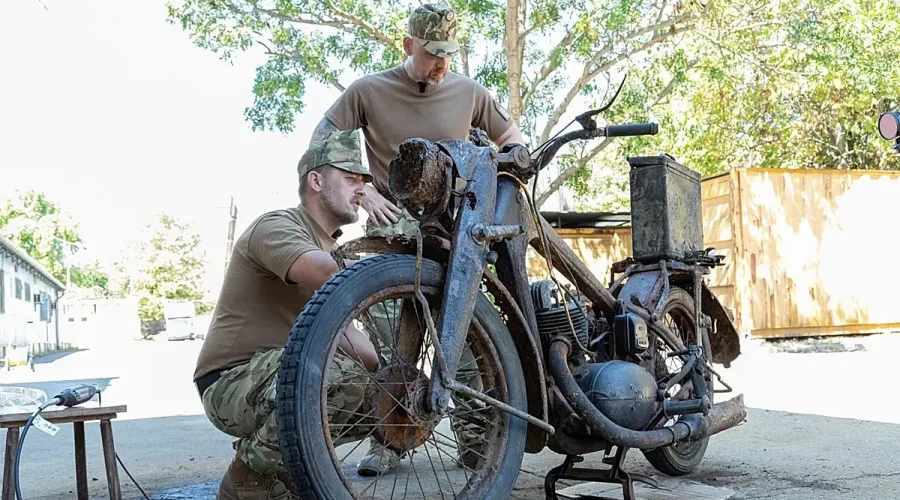
Usagevpn.com – In early August, divers working in the Danube near Batthyány Square — a landmark square in the very centre of Budapest — pulled from the riverbed a German DKW NZ-350-1 motorcycle dating to the Second World War. The find has sent ripples through archaeological circles, military-history scholarship, and the broader public, largely because the vehicle emerged from decades of submersion in remarkably intact condition. Few relics of comparable age and completeness have ever been recovered from any waterway in the world, making this discovery a singular event for researchers studying the final months of the European theatre.
The motorcycle’s appearance in the capital’s waters immediately evokes one of the most devastating episodes of the war: the siege of Budapest, during which roughly 100,000 German and Hungarian soldiers were killed, wounded, or captured as Nazi Germany attempted to buy time against the advancing Soviet forces. The bike’s presence in the river is a tangible fragment of that desperate, ultimately futile stand.
How Hungary Became a Battlefield
For most of the war, Hungary had remained outside the direct path of combat. The front had not yet reached its borders, and Allied strategic bombing campaigns had not yet targeted Hungarian cities systematically. That changed abruptly on 19 March 1944, when Wehrmacht forces crossed into the country and assumed control of its government and military infrastructure. The occupation brought catastrophe to Hungary’s Jewish population and to civilians at large, but it also committed enormous numbers of soldiers — Hungarian and German alike — to a theatre where Hitler’s strategic calculations demanded their presence, often their destruction.
Tracing the Motorcycle to Its Unit
Research conducted by the Military History Archive at the Military History Institute and Museum (HM HIM) in Budapest has narrowed the bike’s provenance to one of the most significant formations trapped inside the encircled capital. Norbert Számvéber, a lieutenant colonel and director of that archive, identified the vehicle’s likely parent unit as the Feldherrnhalle armoured division, commonly shortened to FHH.
“This was the armoured division Feldherrnhalle (commonly abbreviated to FHH), which had an armoured pioneer battalion bearing the same name,” Számvéber explained. “The motorcycle may have entered the inventory of this unit, then in the process of being re-formed, in September 1944, when it was still called Pionier-Bataillon (mot.) Feldherrnhalle. At the end of that month, or at the latest in early October 1944, it was renamed Panzer-Pionier-Bataillon Feldherrnhalle. The motorcycle and the vehicles that had already been marked with the unit insignia were not repainted one by one, perhaps for lack of time.”
The reasoning is straightforward: in the chaos of late-1944 reorganisation, vehicles already bearing the old designation were simply left as-is rather than stripped and repainted. The bike’s markings, therefore, reflect an earlier administrative identity even though it served under the later name.
Two Soldiers and a Scatter of Ordnance
The recovery did not yield only the motorcycle. Anti-tank mines, loose ammunition, and the skeletal remains of two German soldiers were located in the immediate vicinity of the vehicle. Számvéber notes that after the fall of the Pest bridgehead on 18 January 1945, the shattered remnants of the German 22nd SS Volunteer Cavalry Division held the Buda-side embankment of the Danube in a last-ditch defence. Identity tags — the everyday equivalent of dog tags — recovered from the two sets of bones identified them as members of that SS formation, meaning they were almost certainly not the riders or operators of the motorcycle itself.
“Here they may have fallen in combat, or they may have been executed on the spot by the Soviets. The latter was by no means uncommon in the case of SS members, but since the Soviets typically removed identity tags before executions, the former scenario is more likely,” Számvéber observed.
What the Mechanics Tell Us
Technical examination of the recovered vehicle revealed that its gearbox was locked in second gear, or at least jammed in that position. Curators at the HM HIM confirmed the motorcycle had been involved in a crash roughly 81 years before its recovery, though they could not establish whether the impact occurred at the precise moment the bike slipped into the river or whether it had already been damaged before entering the water.
“At this stage it is impossible to reconstruct reliably how the vehicle and the bodies of the two SS soldiers found beside it ended up there. I rule out the possibility that a ferry may have been crossing the Danube and was sunk by the Soviets, because neither the tactical situation nor the heavily iced river would have allowed that during the siege of Budapest,” the historian stated.
Számvéber’s working hypothesis is that the motorcycle, employed primarily for liaison duties — carrying dispatches, orders, and reports between command posts — was lost near the riverbank while on such a mission. It may have remained on the bank or in shallow water until post-siege debris-clearing operations, conducted after Soviet forces consolidated their hold on the city, finally pushed it into the current.
A Production Line That Crossed Borders
The DKW NZ-350-1 was not a rare prototype. Approximately 12,000 units of this model rolled off German assembly lines during 1944 and 1945, already fitted with grey cast-iron engine blocks because wartime shortages had made aluminium scarce. After the war ended, Soviet occupation authorities dismantled the entire production line and transported it to the city of Izhevsk in the Urals as part of reparations. There, through 1951, a further 127,000 motorcycles were built under the Soviet designation Izs-350. Of the original German-produced machines, only a handful have survived to the present day, making the Batthyány Square find all the more extraordinary.
A Note on Hungarian Cinema
The discovery also prompted a small but pointed correction in popular memory. In the 1965 Hungarian film A tizedes meg a többiek (The Corporal and the Others), a landmark of domestic cinema depicting ordinary Hungarian conscripts caught between German and Soviet armies and forced to switch allegiances, actor Imre Sinkovits is shown astride a motorcycle. That bike, however, was a Soviet-built copy of a BMW, not a DKW of the type now resting in a museum case. The distinction, while minor to most viewers, matters to military historians and model-makers who track the precise equipment of each side.
For Budapest, the find is more than a curiosity. It is a physical artefact that anchors an abstract statistic — one hundred thousand casualties — to a specific machine, a specific unit, a specific stretch of riverbank where the war’s final European chapter played out in ice, steel, and silence. The motorcycle now sits under conservation care at the HM HIM, where its story continues to be pieced together one rivet and one document at a time.
Related Reading
Frequently Asked Questions
What is Wehrmacht motorbike from the Danube brings?
Wehrmacht motorbike from the Danube brings is the main topic of this guide. The article explains the context, practical details, and next steps readers should understand.
Why does Wehrmacht motorbike from the Danube brings matter?
Wehrmacht motorbike from the Danube brings matters because readers are looking for a useful answer, not just a short summary. Good content should match search intent and help them decide what to do next.