Emirati Economy Cuts Ties with Tehran as Missile Strikes Rattle the Gulf
Usagevpn.com – Abu Dhabi has moved to freeze every channel of commerce and finance linking the United Arab Emirates to its western neighbour, a decision announced in the immediate aftermath of two ballistic missiles that landed in waters near the Emirati coast. The sweeping suspension, effective until further notice, marks the most decisive economic rupture yet between the two states since hostilities erupted in late February.
The move lands against a backdrop of escalating military confrontation. Iran has been conducting daily missile and drone barrages against targets across neighbouring countries since the war ignited on 28 February, following joint US and Israeli strikes on Iranian territory. For a Gulf state that hosts a large resident Iranian community and had long served as a vital commercial lifeline for a Tehran economy under heavy sanctions, the severance carries weight well beyond its headline.
What the Freeze Actually Covers
The announcement, delivered by Afra Al Hameli, Director of the Strategic Communications Department at the UAE Ministry of Foreign Affairs, stops all trade, commercial exchanges, and financial transactions between the two countries. Al Hameli framed the decision as a measure to protect the integrity of the international financial system, citing international law and what she described as the highest global standards.
“In light of regional escalations … all trade, commercial exchanges, and financial transactions with Iran have been halted until further notice.”
She also pushed back against characterisations of the bilateral economic relationship, restating Abu Dhabi’s stated commitment to dialogue, cooperation, and regional integration. Notably, the suspension addresses direct dealings between the two states. It does not clarify whether funds routed through intermediary jurisdictions remain untouched — a gap that matters considerably given the architecture of Iranian financial networks operating abroad.
The Missile Incident and Tehran’s Denial
Earlier on the day of the announcement, Abu Dhabi reported that Iran had launched two ballistic missiles toward the country. A subsequent clarification specified that the salvo was aimed at shipping rather than at Emirati territory itself. Both projectiles struck the sea; one fell within Emirati territorial waters.
Tehran disputed the account. Iranian foreign ministry spokesman Esmail Baghaei dismissed the Emirati claim outright:
“[Iran] categorically rejected the United Arab Emirates’ claim that Iran had launched a missile towards that country.”
The disagreement over whether the missiles were aimed at the UAE or at vessels transiting nearby waters underscores how thin the line has become between commercial shipping lanes and sovereign airspace in the current conflict.
From Trading Partner to Economic Quarantine
Before the war, the UAE occupied a singular position in Iran’s external economy. Sanctions had squeezed Tehran’s access to conventional banking corridors, and Emirati free-trade zones — particularly those in Dubai and Abu Dhabi — had become conduits through which Iranian actors moved goods and capital. In June 2025, the US Treasury’s Financial Crimes Enforcement Network issued guidance to banks warning that Iranian networks routinely established front companies in third countries, frequently exploiting free-trade zones with permissive incorporation rules. FinCEN noted that Iranian actors commonly registered general trading companies in UAE commercial free zones and operated through Hong Kong entities banking in China via non-resident accounts, with trading counterparties concentrated in Singapore and Hong Kong.
That architecture means the Emirati freeze, while symbolically potent, may not fully isolate Iranian financial flows that already route around direct bilateral channels. Whether Abu Dhabi will extend scrutiny to such indirect pathways remains an open question.
The economic quarantine is the latest in a series of Emirati steps taken since the war began. The UAE ambassador was recalled early in the conflict. Schools and a hospital with Iranian affiliations were shuttered. Each measure tightened the noose around a relationship that, before February, had been one of the most commercially active in the region.
Military Friction Across the Gulf
Hours after the trade freeze was announced, Iran’s armed forces chief of staff Ali Abdollahi issued a pointed warning to Gulf states. Speaking through the Mehr news agency, he cautioned that any logistical or operational assistance rendered to the United States military would be treated as participation in American military operations.
“Any assistance or facilitation provided to the aggressor US military amounts to participation in the US military operation.”
The Gulf hosts a dense web of American military installations, some permanent, some rotational, including facilities inside the UAE itself. Numerous Middle Eastern governments had publicly pledged since the war’s outset that they would not permit US forces to use their territory as a launchpad. Abdollahi cast doubt on those assurances, observing that the sheer volume of aircraft — particularly aerial refuelling tankers — stationed at regional bases made it improbable that host nations were unaware of their presence.
“It seems unlikely that such a large number of military aircraft, particularly refuelling aircraft, could be present at regional bases without knowledge of host countries.”
He added that Gulf states “should know that we are fully aware of the situation,” a remark that read less as reassurance and more as a reminder of Tehran’s surveillance reach.
Separately, media reports have suggested that Saudi Arabia, the UAE, Kuwait, and Bahrain have each struck targets inside Iranian territory in retaliation for attacks on Gulf shipping and infrastructure. The governments concerned have largely denied involvement, though the ambiguity itself has become a feature of the conflict’s fog.
The Strait of Hormuz: Chokepoint Under Siege
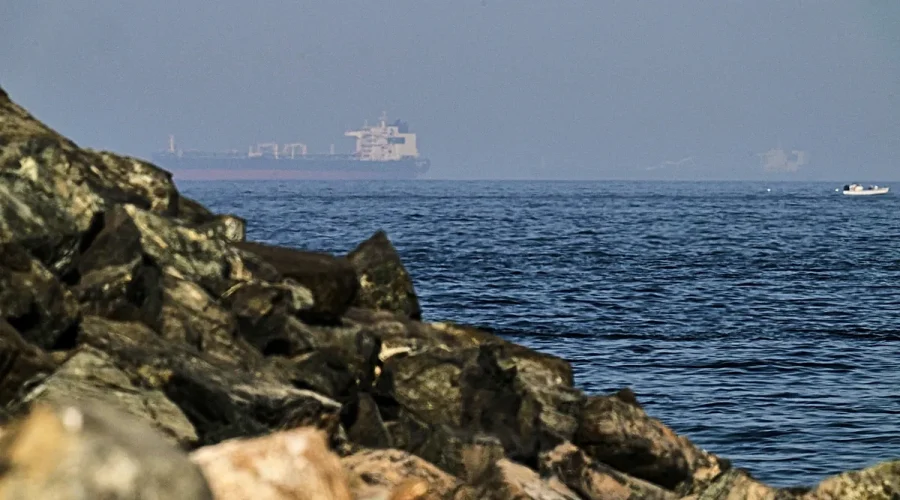
The economic stakes of the confrontation are concentrated in one narrow waterway. The Strait of Hormuz, through which vessels departing most UAE ports must pass, has been effectively blockaded by Iran. A framework agreement between Washington and Tehran aimed at reopening the corridor has collapsed, leaving the strait in a state of contested navigation.
ADNOC, the Emirati state oil company, has borne repeated brunt of the disruption. On 8 August, the foreign ministry confirmed that a missile had struck an ADNOC carrier transiting the strait. On 14 August, two additional ADNOC vessels were targeted during separate transits. No casualties were reported in either incident.
In both statements, Abu Dhabi labelled the attacks a “flagrant violation” of the UN Security Council resolution governing freedom of navigation. The ministry went further, characterising the strikes as:
“targeting commercial shipping and using the Strait of Hormuz as a tool of economic coercion or blackmail represents acts of piracy by Iran’s Revolutionary Guard Corps.”
Abu Dhabi demanded that Tehran cease the attacks, commit to an immediate halt to hostilities, and reopen the strait completely and unconditionally.
Diplomatic Threads Still Being Pulled
Even as economic ties are frozen and military posturing intensifies, a narrow diplomatic channel appears to persist. On Monday, Jared Kushner — son-in-law of US President Donald Trump and his designated envoy on the Iran file — stated that Washington and Tehran were engaged in “very positive and active conversations.” Whether those talks can survive the cumulative weight of missile strikes, shipping seizures, and now a full trade embargo between two neighbours remains the central question of the coming weeks.
For the UAE, the calculus is stark. Its ports, its free-trade zones, its resident Iranian population, and its role as a regional financial hub all make it simultaneously a target of Iranian grievance and a node in the very networks Tehran depends upon. Cutting the bilateral link is a statement of principle as much as a practical measure — and one that will test whether the Gulf’s economic architecture can absorb the shock of a neighbour’s complete commercial exclusion.
Related Reading
Frequently Asked Questions
What is UAE halts all trade and financial?
UAE halts all trade and financial is the main topic of this guide. The article explains the context, practical details, and next steps readers should understand.
Why does UAE halts all trade and financial matter?
UAE halts all trade and financial matters because readers are looking for a useful answer, not just a short summary. Good content should match search intent and help them decide what to do next.