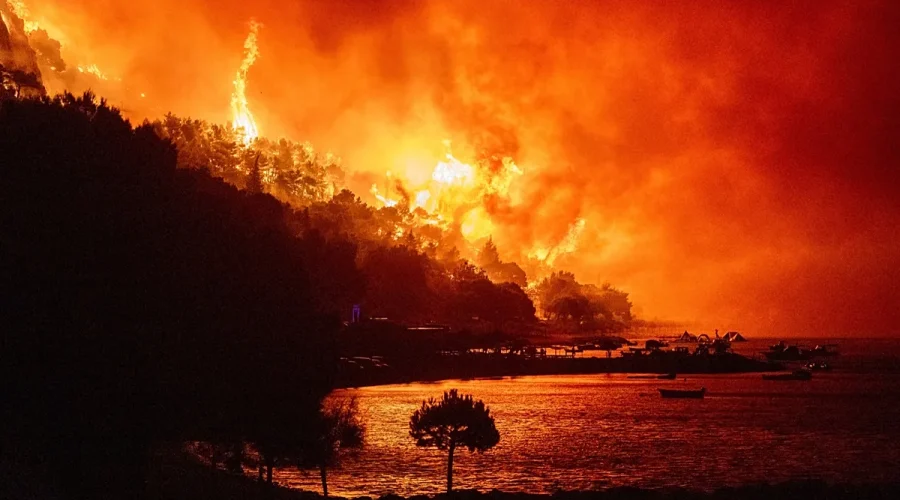
Wildfire Fronts Shift Across Europe as France’s Landes Blaze Is Brought Under Control
Usagevpn.com – A three-day aerial and ground campaign in southwestern France has finally stabilised a wildfire that consumed roughly 1,700 hectares of forest in the Landes department. The fire, which erupted on Thursday amid temperatures near 40 °C, was declared contained after crews worked around the clock from both the air and the forest floor. Local prefect Gilles Clavreul described the situation as evolving
“favourably,”
noting that afternoon temperatures had fallen to around 28 °C and relative humidity had climbed, conditions that dramatically reduce the risk of reignition. Of the 650 residents who had been ordered out of their homes when the blaze first spread, a first cohort was permitted to return on Sunday evening. The Landes region, one of France’s largest contiguous pine-forest zones, has historically been vulnerable to fast-moving crown fires in summer, and the scale of this event underscores how quickly a single ignition can escalate under extreme heat.
Belgium’s High Fens Fire and the German Border Response
While France moved past its worst phase, Belgium faced its own crisis. Rain began falling over the country on Monday, offering a natural ally in what officials have called the largest wildfire in the nation’s modern history. The blaze has scorred approximately 3,000 hectares—roughly 30 square kilometres—of the High Fens (Hoge Venen) nature park, a vast peatland and mixed-forest area straddling the Belgian-German border. Around 500 firefighters and military personnel were engaged in suppression work, while a dense plume of black smoke drifted southward into Germany and westward toward France.
Germany’s defence ministry confirmed that two military helicopters equipped for water-bombing would be dispatched to assist Belgian crews. Closer to home, the border town of Monschau ordered the evacuation of nearly 30 residents living along two streets adjacent to the frontier. Belgium had just endured another stretch of intense heat and drought; Friday saw temperatures peak at 37 °C in several districts, creating precisely the fuel-drying conditions that turn a small ignition into a regional emergency.
Greece: Deaths and Mass Evacuations on Salamis
On the Greek island of Salamis, just off the Athens coastline, two separate fires forced the evacuation of hundreds of beachgoers and claimed two lives, the national fire service confirmed. Coastguard vessels, including patrol boats and auxiliary craft, carried people to safety.
“Over 570 people were evacuated on coast guard patrol boats and other vessels,”
a coastguard spokesperson stated. Greece, which had largely avoided the worst of the continental heatwave earlier in the summer, has been struck by a succession of major wildfires since late July, many intensified by strong winds. In the 24 hours preceding Monday’s bulletin, the fire department logged 36 separate ignitions across the country—a figure that reflects both the intensity of the dry spell and the difficulty of suppressing fires once they gain momentum in pine and shrubland.
Iberian Peninsula: Injuries in Portugal, a Fatality in Aragon
Portugal’s firefighting services were stretched across multiple fronts near the Spanish frontier. Near the small village of Dine, five firefighters sustained minor injuries when their support vehicle caught fire, local media noted. Additional blazes were active at Boticas and Chavez, also close to the border, according to the civil-protection agency ANEPC. Hundreds of crews were deployed across the region simultaneously.
In Spain’s Aragon region, a soldier lost his life on Sunday while assisting suppression operations on a major wildfire. The regional government announced that it had mobilised the largest firefighting arsenal in the area’s recorded history, and French reinforcements were scheduled to arrive to help contain the blaze. The fire, which broke out on Monday, has threatened a monastery dating back roughly a millennium—a reminder that wildfire risk in the Iberian interior is not merely an ecological concern but also a cultural-heritage one.
Croatia: Four Arrested Over Adriatic Coast Fires
Croatian police announced the arrest of four individuals suspected of deliberately starting several of the wildfires that have swept sections of the Adriatic coast in recent days. The suspects are believed to have ignited fires that scorched pine forests and olive groves as the country contends with a wave of blazes driven by drought and sustained high temperatures. Arson investigations of this kind are increasingly common across southern Europe, where prolonged dry spells make even small, human-caused ignitions capable of growing into multi-hectare emergencies.
The Broader Climate Backdrop
The simultaneous outbreaks across Belgium, Greece, Portugal, Spain, Croatia, and France are not isolated incidents. Scientists attribute the rising frequency and severity of European heatwaves to human-driven climate change, which is pushing summer temperatures beyond historical norms and extending the dry season. A historically hot summer has already contributed to thousands of heat-related deaths across the continent, and each additional degree of warming lengthens the window in which tinder-dry vegetation can ignite and spread with little natural restraint. For the millions of Europeans living near forested or semi-arid landscapes, the practical implication is clear: the wildfire season is arriving earlier, lasting longer, and demanding larger coordinated responses than previous decades required.
Related Reading
Frequently Asked Questions
What is Europe wildfires?
Europe wildfires is the main topic of this guide. The article explains the context, practical details, and next steps readers should understand.
Why does Europe wildfires matter?
Europe wildfires matters because readers are looking for a useful answer, not just a short summary. Good content should match search intent and help them decide what to do next.