Guillaume Legros, Known as Saype, Transforms Swiss Mountain Landscape with Living Art
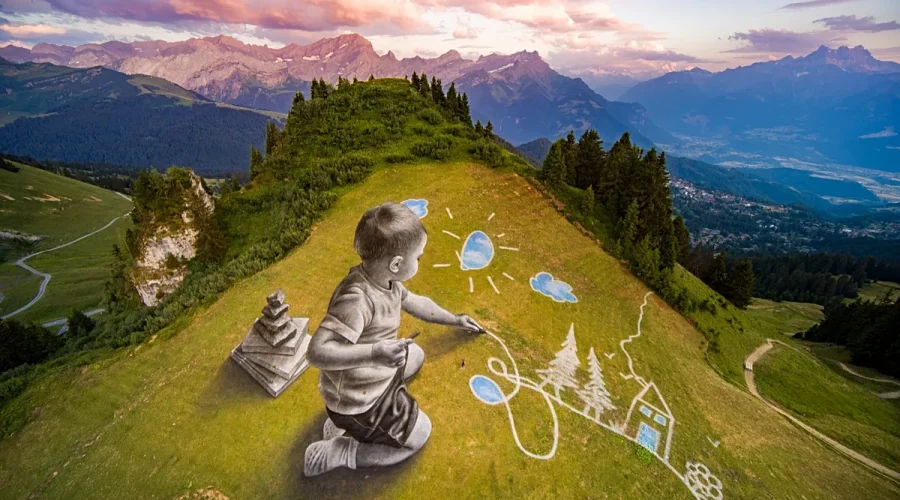
Usagevpn.com – In the heart of the Swiss Alps, where jagged peaks meet rolling meadows, a remarkable transformation is underway. French artist Guillaume Legros, better known by his stage name Saype, has unveiled a series of monumental ephemeral frescoes across the Villars-Gryon-Diablerets ski resort. These living artworks, painted directly onto the natural terrain using environmentally-conscious materials, represent the latest chapter in an ongoing creative journey that began four years ago in this very location.
What makes Saype’s work particularly compelling is its foundation in childhood wonder. While much of his artistic practice centers on themes of play and imagination, the complexity beneath the surface belies any notion of simplicity. The artist views childhood not merely as a phase but as a continuous adventure—a period during which individuals become “the author of his own destiny.” This philosophy permeates every stroke of chalk and charcoal that defines his outdoor masterpieces.
A Story Unfolding Across Years
The Villars-Gryon-Diablerets exhibition is far from a standalone event. Saype has been developing a narrative that spans multiple years, with local children serving as both inspiration and co-creators. “This is the kind of artwork I create all over the world,” the artist explained. “It’s part of a series that began four years ago in Villars, where I’ve been crafting a story that spans several years—and it’s usually the children who, year after year, develop or create the story themselves.”
This collaborative approach transforms the landscape into a canvas where young minds contribute to the artistic vision. The children’s observations of their surroundings, their dreams about the cosmos, and their experiences with adventure all find expression in Saype’s growing body of work. Each year brings new elements to the evolving narrative, creating a living archive of youthful imagination.
Nature as Both Canvas and Critic
The ephemeral nature of Saype’s frescoes serves a dual purpose. Visually, the works command attention with their sheer scale and intricate detail. Philosophically, they embody the fragility of both the environment and the artwork itself. The artist faces considerable challenges in bringing these pieces to life. “The challenge is twofold,” he noted. “It’s physical because there’s a bit of a slope…and there’s the weather, I had to deal with thunderstorms, wind, rain, so that’s always what makes it complicated for me.”
These environmental factors do more than complicate the creative process—they become integral to the artwork’s meaning. The temporary nature of the frescoes mirrors the transient beauty of the alpine landscape itself. Rain, wind, and sun gradually reclaim what the artist has created, turning the passage of time into an active participant in the artistic experience.
Color Enters the Cosmos
The current exhibition marks a significant evolution in Saype’s artistic vocabulary. For the first time, the artist has incorporated color into his drawings, a decision inspired by the children’s own creative explorations. “Kids have been inspired by the cosmos, by adventures, and by their observations—and for the first time, they’re putting that into drawings, and the drawings come to life,” Saype observed. “That’s why I added colour—it feels as though the sky is reflected in the drawings, and my idea is to convey that the cosmos acts as a kind of window onto the world.”
The second fresco, positioned at the Bretaye pass, captures this new direction beautifully. It depicts a child drawing the sun and clouds, forming part of a diptych with another piece located further down in the resort. This introduction of color transforms the monochromatic tradition of chalk and charcoal work, adding vibrancy that echoes the celestial themes running through the artist’s vision.
Global Reach, Local Impact
Saype’s artistic footprint extends far beyond the Swiss mountains. From New York to Nairobi, his creations have graced diverse surfaces including grass, earth, sand, and snow. Each piece carries the same deliberate intention: to slowly disappear, thereby emphasizing the challenges facing contemporary societies and humanity at large. The ephemeral quality of the work serves as a metaphor for the fleeting nature of environmental stability and social progress.
Currently, time is of the essence for those wishing to witness these living masterpieces. Switzerland’s exceptionally dry conditions have resulted in minimal grass growth, potentially extending the visibility of the frescoes. However, forecasted wet weather and storms promise to accelerate the natural reclamation process. “I love that moment because, ultimately, it’s when nature reclaims what I’ve created,” Saype reflected. “But basically, I think it’ll be visible until the end of August without too many problems.”
For visitors to the region, Saype’s frescoes offer more than visual spectacle. They present an opportunity to engage with art that breathes, changes, and ultimately returns to the earth—a reminder that beauty, like childhood itself, is both precious and temporary.
Related Reading
Frequently Asked Questions
What is Child s play?
Child s play is the main topic of this guide. The article explains the context, practical details, and next steps readers should understand.
Why does Child s play matter?
Child s play matters because readers are looking for a useful answer, not just a short summary. Good content should match search intent and help them decide what to do next.