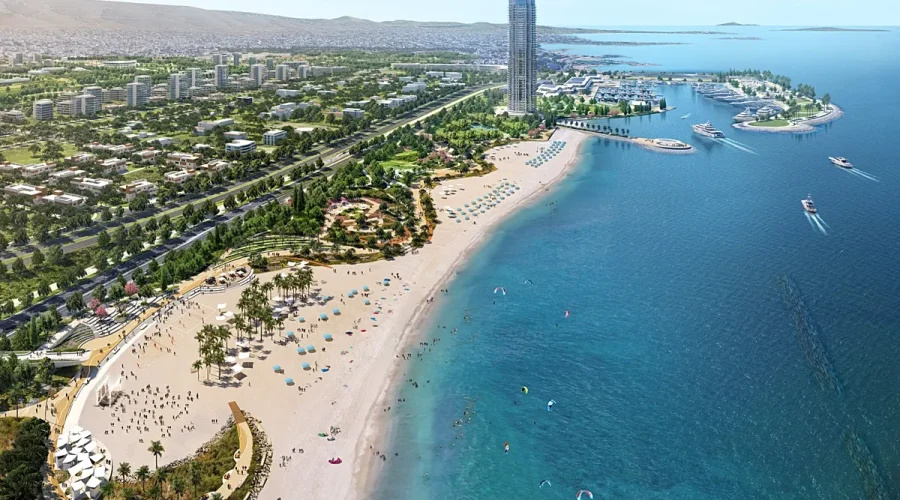
Athens’ Former Airport Becomes Europe’s Greenest Urban Oasis
Usagevpn.com – One of the Mediterranean’s most ambitious ecological transformations is underway in the southern suburbs of Athens. The Ellinikon Park, rising from the ruins of a decommissioned airport, is being reshaped into a sprawling 200-hectare urban sanctuary that will soon rank among Europe’s largest green spaces. By the time the park opens its gates to the public in early 2027, visitors will encounter a landscape dominated by more than 30,000 trees and approximately three million shrubs, with greenery blanketing roughly 70 percent of the entire area.
This ambitious project represents far more than a simple landscaping effort. It is a comprehensive reimagining of how urban spaces can function as living infrastructure, capable of addressing the escalating environmental pressures facing modern cities. From advanced climate control systems to sophisticated water management networks, every element of the park has been designed with resilience in mind.
Climate Control Through Smart Design
At the heart of the park’s innovation is a network of “cool routes” strategically positioned throughout the landscape. These pathways leverage digital simulations to create corridors where temperatures can drop by as much as four degrees Celsius compared to surrounding asphalted zones. Computational Fluid Dynamics (CFD) and thermal mapping were employed to understand how air flows through the space, allowing designers to position vegetation and structures to maximize natural cooling effects.
Rest areas within the park feature a shading ratio exceeding 60 percent, ensuring visitors remain comfortable even during intense summer heat. This shading is achieved not only through tree canopies but also through carefully placed architectural elements. Vegetation plays a dual role, enhancing evapotranspiration—the process by which plants release water vapor into the atmosphere—to further improve thermal comfort conditions across the park.
Water features are woven throughout the composition, including channels, misting systems, and low-consumption basins. These elements do more than provide aesthetic appeal; they actively contribute to evaporative cooling, helping to lower ambient temperatures in their immediate vicinity. The park’s path network follows the natural terrain, creating a unified and accessible system that offers continuous shading while individual paths remain embedded within vegetation, forming pockets of microclimatic protection.
Water Security and Smart Irrigation
Water management forms another critical pillar of the park’s sustainability strategy. A tertiary wastewater treatment unit will produce up to 7,000 cubic meters of treated water daily, supplying all permitted non-potable uses including irrigation. This capacity is complemented by a dedicated storage tank holding 10,000 cubic meters, ensuring reliable water availability during peak demand periods.
The park’s smart irrigation system represents a significant leap forward in resource efficiency. By drawing data from weather and soil sensors, the system adjusts water volumes with precision, matching supply to the actual needs of the vegetation rather than relying on fixed schedules. According to research documentation, this approach can achieve water savings of up to 90 percent compared to conventional irrigation methods.
Rainwater management operates on a closed-loop principle, with green and blue infrastructure designed to handle 100 percent of rainfall on-site. The restoration of the Trachones stream serves a dual purpose, functioning both as a natural waterway and as flood-protection infrastructure. Continuous monitoring of air temperature, relative humidity, solar radiation, soil moisture, and shading levels enables park managers to optimize irrigation and maintenance routines in real time.
Materials and Biodiversity
The park’s surfaces and pavements showcase Greek natural materials selected for both durability and thermal performance. Kavala marble, white Dionysos-Penteli marble, Karystos slate, and Mandras sandstone create a visual harmony with the Attic landscape while contributing to thermal comfort. Notably, materials from the former airport are being reintegrated rather than discarded—concrete slabs form retaining walls and plinths, while crushed aggregates fill gabions and backfills, significantly reducing the construction’s environmental footprint.
Biodiversity targets are equally ambitious. The park aims to host more than 520 plant species, with approximately three-quarters consisting of native or suitably adapted varieties. This botanical diversity supports local ecosystems while ensuring the landscape remains resilient to changing climate conditions.
A Model for Sustainable Urban Planning
The Ellinikon Park has become the subject of a comprehensive guide to designing and operating sustainable green spaces, authored by landscape architect Dimitra Theochari and Lenio Myrivili, UNEP Global Chief Heat Officer and Special Advisor for Climate Resilience. The study documents international best practices for modern urban park design and operation, using Ellinikon as a living case study.
The research framework brings together the design and management of microclimate, water systems, vegetation, materials, and circulation routes into a cohesive approach. Rather than treating the park as merely a leisure destination, the guide positions it as integrated urban infrastructure capable of responding dynamically to environmental challenges.
While the initial public opening is scheduled for early 2027, additional infrastructure will continue to be added through 2030, ensuring the park evolves alongside growing urban demands. For Athens and other Mediterranean cities facing intensifying heat waves and water scarcity, the Ellinikon Park offers a blueprint for how urban spaces can become active participants in climate resilience rather than passive victims of environmental change.
Related Reading
Frequently Asked Questions
What is 30 000 trees on 200 hectares?
30 000 trees on 200 hectares is the main topic of this guide. The article explains the context, practical details, and next steps readers should understand.
Why does 30 000 trees on 200 hectares matter?
30 000 trees on 200 hectares matters because readers are looking for a useful answer, not just a short summary. Good content should match search intent and help them decide what to do next.