Ancient Sentinel: Germany’s Oldest Living Tree Revealed After Millennia of Silent Watch
Usagevpn.com – Deep within the rolling highlands of southern Germany, a living monument to endurance has been identified as the nation’s most venerable tree. This remarkable yew, estimated to be over eleven centuries old, stands as a testament to nature’s capacity for longevity in even the most challenging environments. The discovery reshapes our understanding of Germany’s arboreal heritage and highlights the resilience of species that have weathered countless seasons.
Location and Physical Characteristics
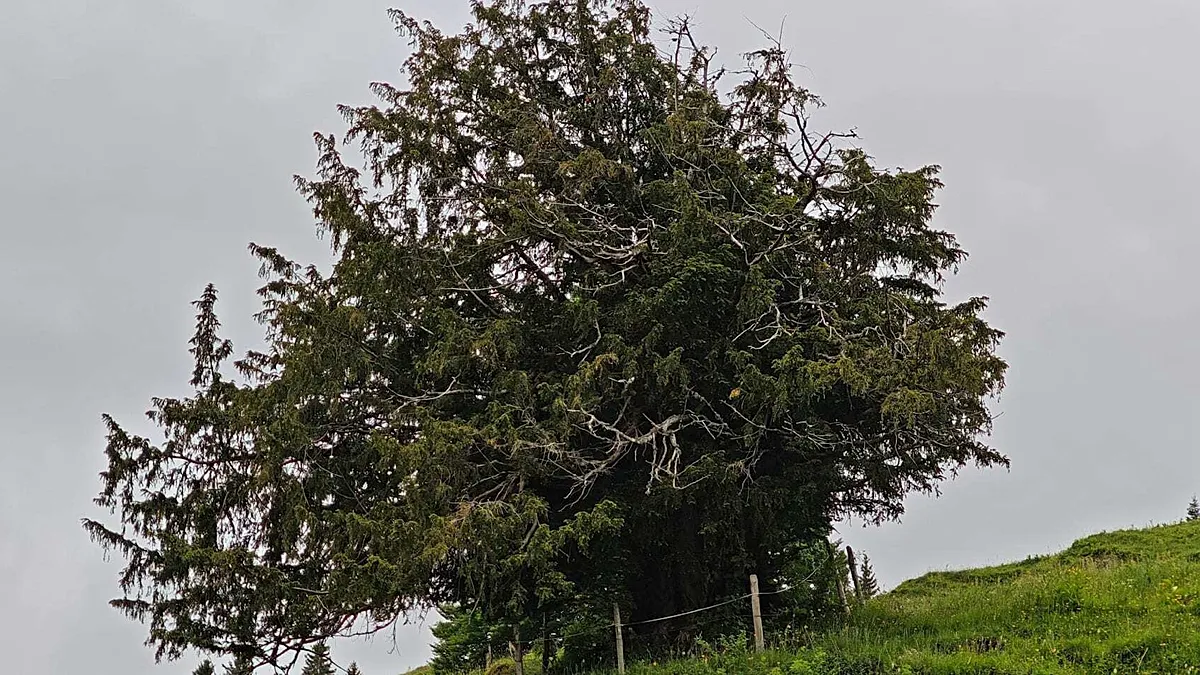
The ancient specimen occupies a secluded position on a grazed alpine meadow situated between the villages of Steibis and Balderschwang in the Upper Allgäu region. At an elevation of 1,100 metres above sea level, the tree rests on a north-west facing slope that places it near the upper boundary of where yews typically thrive in the Alpine landscape. This positioning is significant, as the species generally does not exceed approximately 1,300 metres in altitude within these mountain ranges.
The tree’s trunk measures an impressive 5.1 metres in circumference, a substantial girth that speaks to centuries of gradual growth. Its position on the slope creates unique microclimatic conditions that have both challenged and sustained the tree through its long existence.
During the winter half of the year it hardly gets any sun there, and it is noticeably colder than on south-facing slopes at this altitude. That is why it is a miracle that it has survived all these centuries and is obviously thriving – it may even be ‘pleased’ about the current warming.
These observations come from tree specialists who have studied the specimen’s environmental conditions. The limited winter sunlight and elevated cold temperatures would typically pose challenges for many species, yet this yew has not merely survived but appears to be flourishing. Experts suggest that contemporary climate warming may be providing additional benefits to this ancient organism.
Expert Assessment and Appearance
Andreas Roloff, a senior professor of tree biology at Dresden University of Technology, has expressed particular admiration for the tree’s physical character. His assessment emphasizes the visual complexity created by centuries of growth patterns and environmental responses.
Its trunk is a dreamlike monument with fissures, bulges, bumps, ribs, cracks and holes, made up of several very different sections.
The German Dendrological Society, an organization comprising specialists in tree science, has provided the primary age estimate for this remarkable specimen. Their assessment places the yew at approximately 1,100 years of age, making it the oldest known individual tree in Germany based on above-ground measurements.
Origins and Historical Significance
The manner in which this yew arrived at its remote alpine pasture remains uncertain. Scientists believe it was most likely not deliberately planted by human hands. Instead, a bird probably transported a seed to this elevated location, where favorable conditions allowed it to establish and grow over many centuries.
The yew holds deep historical significance in European culture. Evidence suggests that during the Neolithic period, approximately 5,000 years ago, these trees possessed special importance for communities in the South Tyrolean Alps. Perhaps the most famous connection involves Ötzi, the legendary “man from the ice” whose remarkably preserved remains were discovered in a glacier crevasse at more than 3,000 metres elevation. Ötzi carried a hunting bow crafted from yew wood, demonstrating the material’s valued properties even in prehistoric times.
Record-Breaking Status and Global Context
This newly identified yew displaces the village lime tree of Upstedt in Lower Saxony, which had held Germany’s oldest tree title until now. The Upstedt summer lime, estimated at around 1,000 years of age, remains an impressive specimen but now ranks second in national prominence.
Following closely behind is the Erle Feme oak in Raesfeld, located in the western Münsterland region. This oak, estimated at approximately 900 years old, boasts a trunk circumference exceeding twelve metres, making it potentially Germany’s thickest tree of its species. Beyond its physical dimensions, the Erle Feme oak carries historical distinction as Europe’s oldest known court tree. From 1363 through the end of the sixteenth century, secret tribunals known as ‘Femegerichte’ convened beneath its branches. The “Feme” courts inspired considerable fear during the Middle Ages, as their proceedings were frequently conducted in secrecy and their verdicts—ranging from fines to death sentences—were executed without appeal.
The European yew, the species to which this 1,100-year-old specimen belongs, represents one of the most ancient lineages in European forestry. These trees have existed for approximately 150 million years, making the yew Europe’s oldest native tree species. This extraordinary longevity places it alongside other remarkable ancient organisms worldwide.
At the global level, the oldest tree measured by above-ground age is a pine located in California’s White Mountains, exceeding 5,000 years in age. In Sweden’s Fulufjället National Park grows “Old Tjikko,” a Norway spruce whose root system is estimated at around 9,550 years old. The most ancient of all is the clonal colony known as “Pando” in Utah’s Fishlake National Forest, where an underground network of quaking aspen roots has been dated to approximately 80,000 years. A clonal colony consists of multiple plants that are genetically identical because they originated from a single ancestral organism.
The discovery of Germany’s oldest tree offers more than a record to claim. It provides insight into how species adapt to changing climates, how ecosystems persist through millennia, and how the natural world continues to surprise us with its enduring presence. As warming trends continue across Europe, this ancient yew stands as both witness and participant in one of the most significant environmental transformations in human history.
Related Reading
Frequently Asked Questions
What is More than 1 100 years old?
More than 1 100 years old is the main topic of this guide. The article explains the context, practical details, and next steps readers should understand.
Why does More than 1 100 years old matter?
More than 1 100 years old matters because readers are looking for a useful answer, not just a short summary. Good content should match search intent and help them decide what to do next.