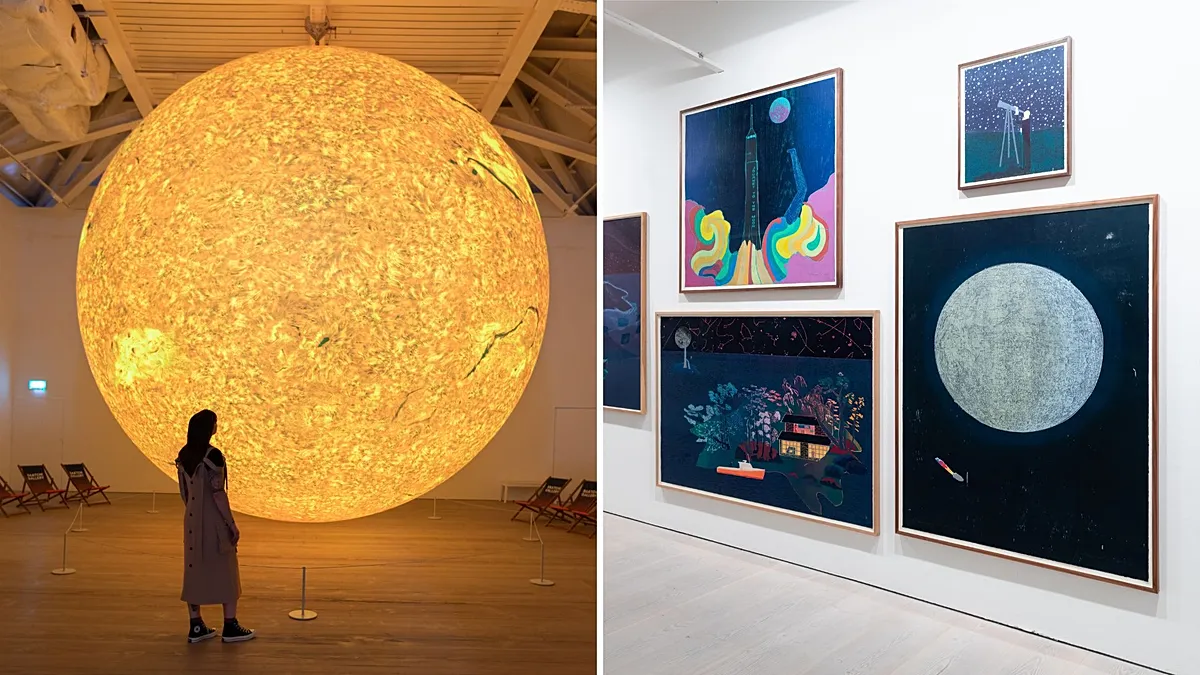
The Sun and the Moon: Saatchi Gallery’s New Summer Show Explores Celestial Inspiration
A Journey Through Time and Art
The Sun and the Moon – For millennia, the sun and moon have captivated human imagination, serving as symbols of time, identity, and cosmic wonder. From ancient rituals to modern artistic interpretations, these celestial bodies have woven themselves into the fabric of culture, science, and spirituality. This summer, the Saatchi Gallery is embarking on a groundbreaking exploration of this enduring fascination through its latest exhibition, The Sun and the Moon. Curated by Katherine Benson, the display spans nine gallery spaces across two levels, showcasing the work of over 170 artists who have drawn inspiration from the heavens. It marks the second installment in a series examining humanity’s relationship with the natural world, following the acclaimed FLOWERS – Flora in Contemporary Art and Culture from last year.
Benson, reflecting on the exhibition’s purpose, tells Euronews Culture:
“This is a 24-hour narrative, capturing how artists have interpreted the sun and moon through time. These celestial entities have shaped our lives for centuries, and we wanted to highlight the diverse ways they’ve influenced creativity.”
The exhibition is meticulously designed to mirror the arc of a day, guiding visitors through dawn, midday, dusk, and night. Each section not only represents a time of day but also delves into the stories, myths, and cultural practices tied to it, offering a multidimensional experience.
The Dawn of Cosmic Storytelling
The exhibition opens with a curated selection of works that trace humanity’s earliest encounters with the sun and moon. Patrick Caulfield’s vibrant compositions, Barbara Hepworth’s abstract sculptures, and Sinta Tantra’s intricate installations set the tone, blending historical and contemporary perspectives. A standout artifact in the dawn section is a 1st-century BC Sol Invictus Celtic Bust, alongside the Nebra Sky Disc—a 4,000-year-old Bronze Age relic that depicts the sun in a way that mirrors ancient astronomical knowledge. These pieces are juxtaposed with modern interpretations, such as costumes from the Royal Opera, to emphasize the timeless dialogue between past and present.
Benson explains that the dawn gallery explores how early civilizations perceived the sun and moon as divine forces. “It’s about the origins of celestial symbolism, from myths to practical applications like agriculture and navigation,” she says. The space invites contemplation of how these entities have been central to human survival and storytelling, from the role of the sun in determining seasonal cycles to the moon’s influence on tides and rituals.
Helios: A Sunlit Symphony
As the exhibition progresses, it reaches its climactic centerpiece: Helios, a six-meter illuminated sphere by British artist Luke Jerram. This installation is a collaborative marvel, combining 400,000 photographs of the sun by astrophotographer Dr. Stuart Green with NASA’s scientific observations. The piece is designed to immerse visitors, encouraging them to recline on deckchairs beneath its glow while the ambient soundtrack by Duncan Speakman and Sarah Anderson envelops the space. The music, crafted to evoke the sun’s presence in human life, ranges from serene tones to energetic crescendos, reflecting the dynamic interplay of light and warmth.
Jerram describes the work as an invitation to “step back and appreciate the sun’s role in sustaining life on Earth.” He emphasizes how the piece bridges art and science, transforming the gallery into a space where visitors can reflect on the sun’s contributions to energy, culture, and religion. “The idea is to make the cosmos feel tangible,” he says. “Through this installation, we aim to inspire awe and remind people of the sun’s everyday significance.” The Helios sphere, with its slow, radiant glow, becomes a metaphor for the passage of time and the cyclical nature of existence.
From Light to Lunar Legacy
After the sun’s grand display, the exhibition shifts focus to the moon, beginning with its phases and historical significance. Visitors are introduced to the moon’s role in timekeeping, mythmaking, and the development of lunar calendars. The transition into the moon section is marked by a room dedicated to the Apollo missions, titled Walking on the Moon. Here, the cultural impact of the 1969 moon landing is examined through art, with a particular emphasis on the often-overlooked contributions of women in the space program.
The centerpiece of this section is Moon Landing, a collaborative effort between textile artist Margot Selby and composer Helen Caddick. This piece celebrates the Navajo women who crafted the integrated circuits for Apollo 11 and the women at Raytheon who assembled the memory cores—a tribute to their unrecognized roles in the mission’s success. Caddick’s composition is deeply rooted in the logic of weaving, incorporating binary code into her musical structure. “Margot used binary patterns in her work, which fascinated me,” she says. “I translated that into a score for two harps, two cellos, and two violins, making them function like a coded language.”
The piece unfolds in six sections, mirroring the journey from the quiet solitude of a weaver at her loom to the chaos of a spacecraft’s descent. Selby’s textile, woven over four months by her and six studio collaborators, responds directly to the music, with its 30,000 individual threads shifting in rhythm and color to reflect the emotional and auditory landscape of the performance. “The colors are intuitive, but the patterns are a direct dialogue with the music,” Selby notes. This interplay between sound and fabric creates a visceral experience, blending the mechanical precision of technology with the organic beauty of art.
Intimate Reflections on the Lunar Realm
Elsewhere, the exhibition includes works that offer personal and emotional insights into the moon’s influence. Kay Gasei, a British Zambian mixed-media artist and 2021 Soho House Art Prize winner, contributes Moonlight Series Number Four: Boy by the Pool. This piece merges family memories with mythological storytelling, capturing the essence of childhood adventures under the moon’s light. “It’s about the freedom and mischief of nighttime exploration,” Gasei says. “The boy in the painting represents a universal longing to escape and discover.”
The painting, part of a series of four, invites viewers to reflect on the moon’s dual role as both a guardian and a muse. Gasei’s work challenges the viewer to see the lunar realm not just as a backdrop for myths but as a symbol of personal and collective memory. By weaving together the tangible and the imagined, the exhibition ensures that the sun and moon are not only cosmic phenomena but also deeply human experiences.
In addition to these highlights, the Saatchi Gallery’s The Sun and the Moon includes interactive installations, multimedia projections, and traditional artifacts, creating a rich tapestry of artistic and cultural expression. The exhibition’s structure, with its cyclical narrative, encourages visitors to move through time and space as they engage with the works. From the sun’s role in shaping civilizations to the moon’s legacy in space exploration, the show underscores the enduring connection between celestial forces and human creativity. As Benson concludes, the exhibition is a celebration of how art continues to illuminate the mysteries of the universe, one thread at a time.