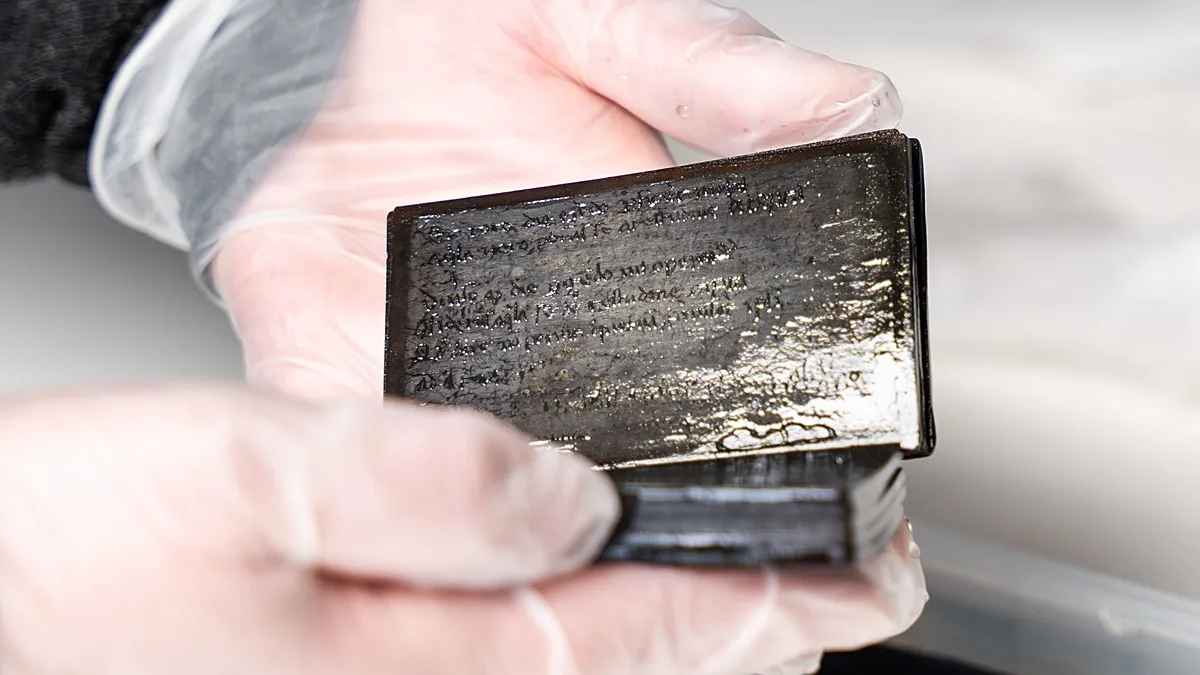
Rare Medieval Notebook Found in Paderborn Latrine
Rare medieval notebook found in Paderborn – In the heart of Paderborn, a city in the North Rhine-Westphalian region of Germany, a groundbreaking discovery has emerged from the depths of history. During the construction of a new administrative building, archaeologists from the regional association of Westphalia-Lippe (LWL) stumbled upon a remarkable artifact: a medieval notebook preserved in one of five ancient latrines that had been uncovered. This find, dating back approximately 700 to 800 years, offers an extraordinary glimpse into the past, revealing the ingenuity and daily practices of medieval society.
The Unlikely Source of a Valuable Discovery
While latrines are often viewed as utilitarian structures, they have proven to be treasure troves for archaeologists. Dr. Barbara Rüschoff-Parzinger, the LWL’s head of cultural affairs, highlighted this unexpected richness: “Unusual as it may sound, latrines are often extremely rich sources of finds for archaeologists.” The notebook, remarkably intact, was discovered in a latrine that had been exposed during the construction work. Its survival is attributed to the unique environmental conditions of its resting place.
The object measures a modest 10 by 7.5 centimetres, yet its contents could hold significant historical value. Crafted from wooden tablets coated in wax, it is encased in a leather cover embossed with a lily motif. This design suggests not only practicality but also a touch of sophistication, hinting at the owner’s social standing. The wax layer, a key component, was likely used as a writing surface, allowing for repeated use with a stylus. This tool, which could be used to scratch notes into the wax, was essential for creating and erasing records in a time before paper became widespread.
A Window into Medieval Life
Archaeologists estimate that the notebook contains ten pages, eight of which are inscribed on both sides. The text, written in Latin, appears to have been crafted by a single hand, indicating a personal or professional record-keeper. This could range from personal reflections to business transactions, shedding light on the intellectual pursuits of medieval citizens. The city of Paderborn, during the Middle Ages, was primarily inhabited by affluent citizens and merchants, who were among the few literate members of society. This makes the notebook’s existence even more intriguing, as it may reflect the daily activities of a community that valued written communication.
Another fascinating detail is the presence of silk fabric fragments, which could have served as toilet paper. These remnants, along with the notebook, suggest that the latrine users were not merely pragmatic but also had access to luxury materials. The combination of such elements underscores the social stratification of the period, where even the act of using a latrine might have been a marker of status.
Preservation Through Unlikely Means
What makes this discovery even more remarkable is the role the latrine itself played in its preservation. The airtight, damp, and low-oxygen environment within the structure created an ideal setting for the organic materials to remain largely undamaged. Susanne Bretzel, an LWL conservator, described the initial appearance of the notebook: “Enclosed in a clump of wet earth and barely recognisable at first, the object only became visible during cleaning in our restoration workshop in Münster,” she said. Despite centuries of subterranean exposure, the notebook retained a distinctively unpleasant odour, a testament to its origins.
Bretzel also noted that the pages were tightly pressed together, which shielded the wax layers from dirt and deformation. This compression, combined with the low-oxygen conditions, has ensured that the wooden tablets have not warped, preserving the clarity of the writing. The meticulous state of the notebook’s preservation raises questions about how it managed to survive such an environment, offering clues about the materials and techniques of the time.
Conservation and Future Research
Now that the notebook has been unearthed, the focus shifts to its conservation. The process is expected to take up to a year, during which time the organic components will be stored in distilled water to prevent further degradation. Scientists are currently analyzing the materials, including the wax, possible resin components, pigments, and the types of wood used. These investigations aim to uncover more about the craftsmanship and resources available during the Middle Ages.
As the analysis continues, researchers are eager to decipher the content of the notes. The Latin script, while challenging, may reveal insights into the writer’s life, their profession, or even the broader cultural context of Paderborn. The notebook’s existence challenges the notion that medieval life was devoid of intellectual pursuits, suggesting that even in a bustling city center, individuals took the time to document their thoughts and transactions.
Historians and archaeologists are particularly excited about this find, as it provides a tangible link to a time when written records were rare and precious. The notebook’s preservation in a latrine, a place often overlooked in historical studies, underscores the importance of examining all aspects of medieval life. It is a reminder that even the most mundane objects can hold extraordinary stories, waiting to be uncovered.
The discovery in Paderborn not only enriches our understanding of the past but also highlights the role of unexpected sources in historical research. By reevaluating the significance of everyday items, archaeologists can piece together a more comprehensive picture of medieval society. This notebook, with its elegant design and preserved content, stands as a symbol of human ingenuity and the enduring legacy of the past.