Venezuela Opens Its Oil Sector to American and European Investors in Sweeping Multi-Billion-Dollar Pact
Usagevpn.com – Caracas, Venezuela — A wave of investment agreements worth tens of billions of dollars was formally inked on Wednesday, marking the most aggressive foreign-entry push into Venezuela’s petroleum sector since Hugo Chávez nationalized the industry two decades ago. The signings came just days after the South American nation conceded to Washington effective majority control over approximately one-fifth of its enormous crude reserves — a concession that has drawn both praise from the White House and sharp constitutional criticism from analysts on both sides of the Atlantic.
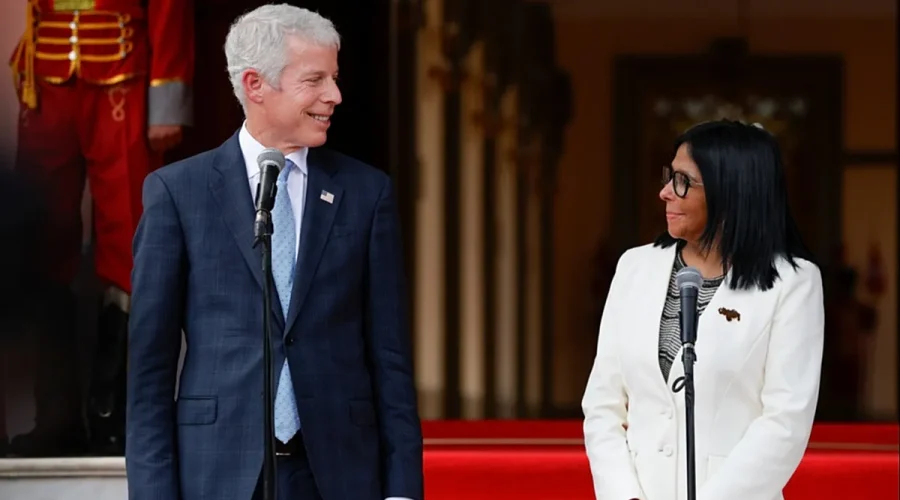
US Energy Secretary Chris Wright made the trip to Caracas personally to witness the ceremonies. He framed the transactions as a foundational step toward national recovery, telling reporters that the contracts with Chevron, GE Vernova (the power-and-energy spin-off of General Electric), and Italy’s ENI were
“critical in starting this ball rolling of peace, opportunity, and prosperity” in the country.
Washington’s Strategic Calculus
The deal sits at the intersection of energy policy, military posture, and domestic politics. President Donald Trump has publicly branded the arrangement the “biggest oil deal in world history,” a characterization that underscores how the administration views Venezuelan crude as a lever for broader geopolitical leverage. The timing is pointed: Republican lawmakers are bracing for potential losses in the November midterm elections amid soaring pump prices tied to the ongoing conflict with Iran, alongside a wider affordability squeeze in housing, groceries, and utility bills. Securing a reliable, low-cost supply of Venezuelan barrels is framed internally as a hedge against that domestic pressure.
Wright pushed back against the narrative that the United States is simply extracting resources. In his remarks he insisted the country was not “stealing Venezuelan oil,” adding that the administration was merely
“taking an idle, underground asset that isn’t doing anything for Venezuelan people and bringing the money, the technology to develop it.”
Chevron’s Five-Year Buildout
Of the three signatories, Chevron carries the largest operational footprint and the most concrete near-term commitments. The company, which already holds the only major American presence in Venezuelan fields, confirmed on Wednesday that it has been allocated additional acreage within the Orinoco Belt — the sedimentary basin that houses the bulk of the country’s heavy-crude output. Chevron plans to commit more than $7 billion (roughly €6 billion) over the next five years, with the stated objective of more than doubling current output to approximately 600,000 barrels per day.
“Chevron’s history in Venezuela spans more than a century, and our expanded position reflects our confidence in the country’s deep resource potential,” said CEO Mike Wirth in a prepared statement.
The expansion also includes a provision giving the Pentagon a stake in project profits — a structural element that distinguishes this arrangement from conventional upstream contracts and has intensified debate over the military-commercial entanglement embedded in the deal.
Scale of the Reserves at Stake
The numbers behind the concession are staggering by any global measure. Venezuela holds the largest proven crude-oil reserves on Earth, exceeding 303 billion barrels according to OPEC’s 2025 Annual Statistical Bulletin. Saudi Arabia trails at a distant second with 267 billion barrels. The specific package granted to North American Blue Energy Partners (NABEP) covers 17 oil fields containing an estimated 65 billion barrels, with 100-year exploitation rights attached.
Sovereignty Questions and Constitutional Friction
Interim President Delcy Rodríguez, who assumed office after the ouster of former president Nicolás Maduro in a military raid, has defended the concession as a pragmatic necessity. She denied that Venezuela is surrendering its wealth, arguing that opening the sector to American capital is the only realistic path to reviving investment in a sector that has languished under years of underfunding and mismanagement.
“More oil translates into more jobs, higher wages, better public services, hospitals, schools and food,” she said.
Rodríguez has projected that the combined deals will generate $209 billion (approximately €180 billion) in profit for the Venezuelan state over a 25-year horizon. Yet that figure rests on assumptions about production ramp-up, commodity prices, and political stability that many observers consider optimistic.
Critics in both countries have accused the administration of holding Venezuela economically hostage, warning that Rodríguez could face a fate similar to Maduro’s if she deviates from Washington’s demands. The question of whether an acting president possesses the constitutional authority to grant century-long rights over sovereign territory has not been settled. Venezuela’s constitution requires that arrangements of this magnitude receive approval from the National Assembly — a step that, as of the signing, had not occurred.
Ian Vásquez, vice president for international studies at the Cato Institute, wrote that the agreement “lacks legitimacy since it was agreed to with a dictatorship that has clung to power for decades through violence and by committing what was probably the largest electoral fraud in Latin American history in 2024.” He added that the pact was reached “under overwhelming pressure, military and otherwise, from the United States,” and cautioned that “any future Venezuelan democracy will question the deal, thus undermining confidence in the current arrangement.”
Industry Realities and the Long Road Ahead
Energy-sector analysts note that even with fresh capital and American technology, reviving Venezuela’s oil infrastructure will take years. The country’s upstream assets have suffered decades of deferred maintenance, aging pipelines, and a shortage of skilled engineers. Production has fallen well below its early-2000s peak, and the heavy, high-sulfur crude of the Orinoco Belt requires expensive upgrading and diluent infrastructure before it can reach export terminals at competitive cost.
Whether future Venezuelan or American administrations will honor, renegotiate, or overturn the NABEP framework remains an open question. What is clear is that the Wednesday signings represent the most significant restructuring of Venezuela’s oil governance since the 2007 hydrocarbons law, and that the next several years will determine whether the promised prosperity materializes or the arrangement collapses under the weight of its own political contradictions.
Related Reading
Frequently Asked Questions
What is US energy firms significantly expand operations?
US energy firms significantly expand operations is the main topic of this guide. The article explains the context, practical details, and next steps readers should understand.
Why does US energy firms significantly expand operations matter?
US energy firms significantly expand operations matters because readers are looking for a useful answer, not just a short summary. Good content should match search intent and help them decide what to do next.