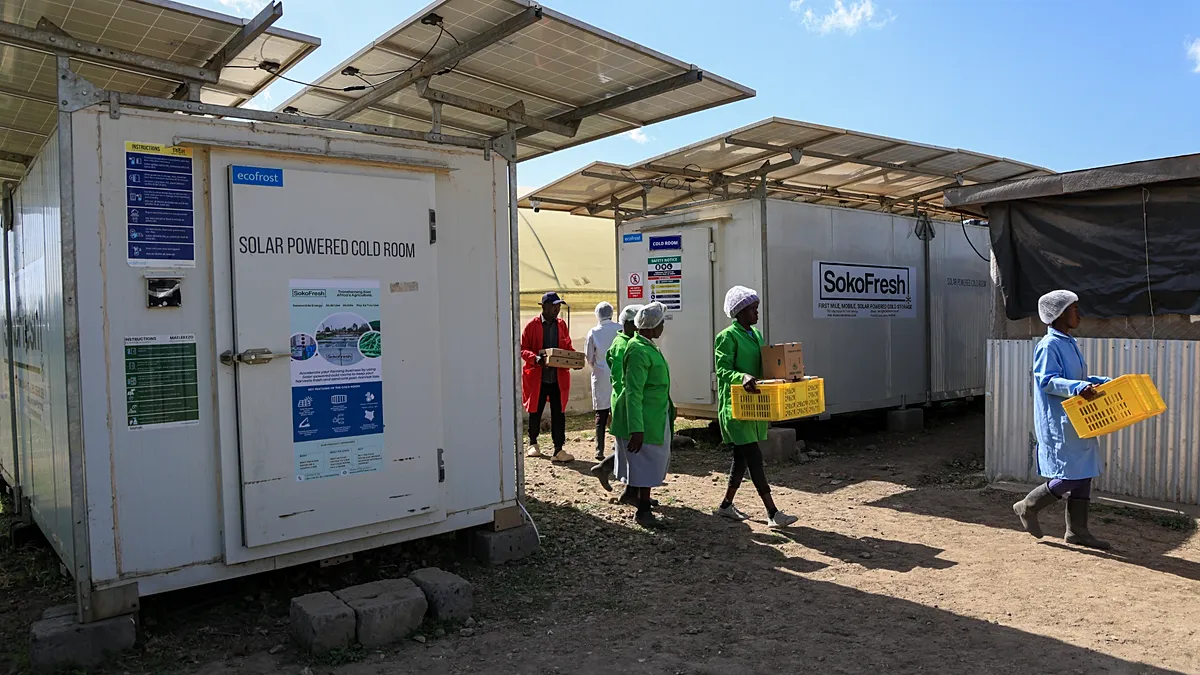
Solar-Powered Fridges Are Boosting Farmers’ Incomes by 50% While Cutting Food Waste
Solar powered fridges are boosting farmers – For years, the journey of food from farm to table has been fraught with obstacles. While most consumers take for granted the freshness of produce on their shelves, farmers face relentless challenges—droughts, scorching heat, monsoonal floods, and the ever-present burden of high fuel costs. Even when crops are harvested with care, they must be preserved to maintain quality and reach markets intact. This is where innovation is making a critical difference. In Kenya, a farmer named Yvonne Anyonyi Mumiah has found a lifeline through solar-powered cooling systems, which are now helping smallholders avoid spoilage and significantly improve their livelihoods.
The Hidden Cost of Fresh Produce
“You can do everything right on the farm,” Mumiah explains as she walks through rows of herbs and spices destined for European grocery stores. “But if the produce isn’t stored properly, you lose both the product and the income.” Her words highlight a widespread issue in agriculture: post-harvest losses. These losses, often due to inadequate storage, transport, and processing infrastructure, have long been a barrier to economic stability for farmers. Now, renewable energy is offering a breakthrough. By replacing traditional refrigeration with solar-powered cold storage, farmers can preserve their harvests more effectively, ensuring higher profits and reduced waste.
The pay-per-use model, which charges farmers based on the weight of goods stored, is reshaping how smallholders access cooling technology. This approach eliminates the need for upfront investments in expensive equipment, making it more accessible in regions where financial resources are limited. “This model allows farmers to rent storage space without owning a unit,” says Emmanuel Aziebor, regional director for Africa at CLASP, a nonprofit focused on energy-efficient appliances. “It’s a step toward making cold storage a practical solution for millions of smallholders.”
Africa’s Food Loss Crisis
According to the Food and Agriculture Organization, nearly 40% of food produced in Africa is lost between harvest and market. Poor infrastructure, unreliable electricity, and limited access to cooling facilities are the main culprits. Solar-powered fridges and warehouses are addressing this gap, enabling farmers to store perishable goods without depending on costly and inconsistent power grids. In Kenya, Nigeria, Ethiopia, Rwanda, and South Africa, these systems are gaining traction, offering a sustainable way to combat spoilage and stabilize supply chains.
“The biggest challenge was keeping the quality of our crops after harvest,” Mumiah recalls. Previously, she struggled with the $30,000 upfront cost of a solar-powered unit. Now, with access to shared cooling hubs, she can store her harvests safely, avoiding losses that once threatened her entire income. This shift is not just about preserving food—it’s about empowering farmers to negotiate better prices and reach distant markets without compromising freshness.
From Solar Power to Economic Transformation
The economic impact of solar-powered fridges is profound. Reports indicate that these systems can boost farmers’ earnings by up to 50%, as spoilage rates drop dramatically. For example, Soko Fresh, a company specializing in solar cooling, claims its customers have seen spoilage rates fall from as high as 50% to under two percent. This improvement translates to higher profits, as farmers can sell their produce at optimal times rather than being forced to rush to market.
Across Africa, the adoption of solar refrigeration is expanding rapidly. In Nigeria, ColdHubs has installed walk-in cold rooms in key agricultural markets, enabling farmers and traders to rent storage space daily. This model reduces the financial strain of purchasing and maintaining equipment, making it easier for smallholders to scale their operations. Similarly, in Rwanda, solar-powered systems are supporting dairy cooperatives, improving milk collection, and ensuring better quality for export. Ethiopia, meanwhile, is leveraging solar storage to strengthen its horticultural exports, a sector growing faster than many others in the region.
Experts emphasize that these innovations are critical as climate change intensifies. Rising temperatures are accelerating spoilage, with vegetables, fruits, dairy, and fish being particularly vulnerable. “Cooling technology is no longer a luxury—it’s a necessity,” Aziebor states. “Without it, farmers face significant losses, especially during extreme weather events.” In contrast, countries like India, China, Japan, the Netherlands, and the United States have established robust cold-chain networks that keep produce marketable for weeks. Africa’s progress, though slower, is accelerating, driven by the need to secure food supplies and reduce environmental harm.
Environmental and Economic Synergy
Solar-powered systems are also a win for the environment. Traditional cold storage often relies on diesel generators, which contribute to air pollution and greenhouse gas emissions. By switching to solar energy, farmers not only lower their operating costs but also reduce their carbon footprint. “We’ve been focused on expanding electricity access,” Aziebor notes, “but the real opportunity lies in how that access is used.” He argues that solar cooling bridges the gap between energy availability and economic productivity, creating a sustainable cycle of growth.
Despite these advancements, challenges remain. In many rural areas, electricity grids are still unreliable, and upfront costs for solar units can be prohibitive. However, the pay-per-use model and shared facilities are making it easier for farmers to participate. “The key is ensuring that solar energy is not just available, but accessible,” Aziebor adds. “This requires investment in infrastructure and training to maximize its potential.”
A New Era for African Agriculture
The integration of solar-powered cooling is part of a broader movement to modernize African agriculture. By preserving produce longer, farmers can diversify their income sources and participate in regional and global markets. This also has the potential to improve food security, as fewer losses mean more food available for consumption and trade. “When farmers can store their harvests, they gain access to better markets,” Aziebor explains. “That leads to higher prices, reduced waste, and increased resilience against market fluctuations.”
As the technology becomes more widespread, its impact is expected to grow. In South Africa, for instance, solar hubs are being used to support perishable goods, while Kenya continues to expand its network of off-grid cooling facilities. These efforts are not only transforming individual farms but also building more sustainable food systems across the continent. The shift from diesel to solar is a testament to the power of innovation in overcoming longstanding challenges, proving that renewable energy can be a catalyst for economic and environmental progress.
With temperatures rising and supply chains growing more fragile, the need for reliable cooling solutions has never been greater. Solar-powered fridges are more than a tool—they are a symbol of resilience, allowing farmers to thrive in the face of adversity. As investments in these systems increase, the hope is that they will become a standard part of agricultural practices, ensuring that food reaches consumers in the best possible condition while empowering farmers to build better futures. The future of farming in Africa is bright, thanks to the sun—and the technologies that harness its power.