A Sea Under Pressure: Four Decades of Mediterranean Data Finally Unified
Usagevpn.com – The Mediterranean basin has long been regarded as one of the most climate-vulnerable seas on Earth. Enclosed by land on three sides, with limited exchange through the narrow Strait of Gibraltar, it traps heat, accumulates pollutants, and responds to atmospheric forcing faster than most open oceans. For decades, scientists have suspected that its waters were warming, acidifying, and losing dissolved oxygen at rates that outpace global averages. What has been missing, however, is a single, coherent record long enough to separate genuine long-term shifts from the natural year-to-year swings that any sea exhibits. That gap is now closing.
Building Carimed from scattered archives
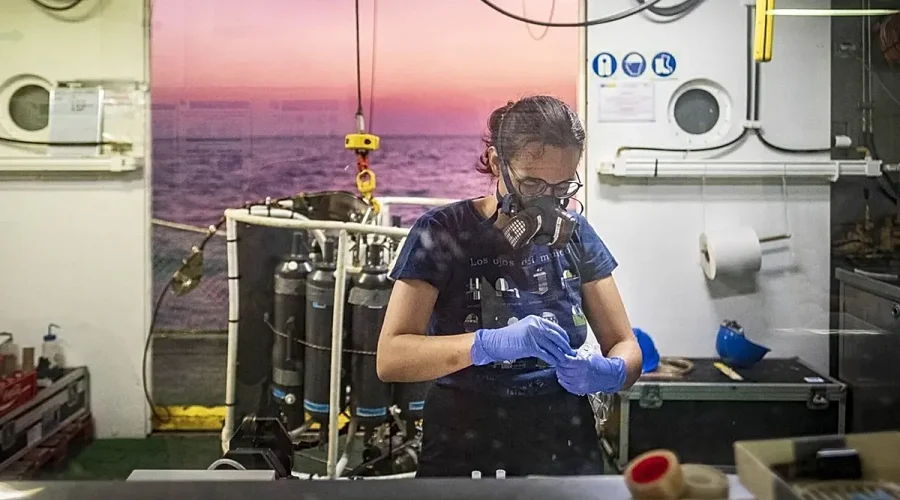
Researchers affiliated with the Spanish Institute of Oceanography (IEO-CSIC), specifically its oceanographic centres in A Coruña and the Balearic Islands, have assembled a consolidated database called Carimed. The effort draws on measurements gathered during 46 separate oceanographic campaigns conducted between 1976 and 2018, spanning virtually the entire Mediterranean basin. Collaborators from European institutions and the United States contributed additional datasets, broadening geographic and temporal coverage well beyond what any single national programme could achieve.
The variables tracked across those four decades include sea-surface and subsurface temperature, dissolved oxygen concentrations, pH (a proxy for acidity), dissolved inorganic carbon, and estimates of water-mass age — essentially how long a parcel of water has been isolated from the surface. Together these indicators paint a picture of the basin’s physical and biogeochemical state at any given point in time.
“A considerable part of the data was recovered from fragmented historical records or locally stored archives, thereby consolidating measurements that were previously inaccessible,” explains Marta Álvarez, chemical oceanographer at the A Coruña Oceanographic Centre and coordinator of the research group.
Álvarez notes that another significant share of the records originates from international campaigns carried out aboard both national and international research vessels, with participation from staff belonging to the IEO’s INOCEN group. Before this consolidation, much of the information existed in isolated institutional archives, collected at different times of year, using instruments of varying precision, and following protocols that had shifted over the intervening decades.
The comparability problem
Simply stacking a 1978 oxygen reading next to a 2018 one would be misleading. Analytical methods, sensor technology, sampling depth conventions, and even the seasonal timing of cruises have all evolved. Differences introduced by those methodological shifts could masquerade as environmental change, or conversely mask a real trend. To address this, the Carimed team subjected every measurement to a rigorous two-stage quality-control procedure (referred to internally as 2QC) calibrated specifically to the Mediterranean’s physical and chemical characteristics. The goal was straightforward: ensure that any residual difference between two time points reflects what actually happened in the water, not what changed in the laboratory or on deck.
“Thanks to the rigorous 2QC process, systematic biases in biogeochemical variables were minimised and a more coherent dataset was obtained,” states Maribel García-Ibáñez, researcher at the Balearic Islands Oceanographic Centre.
By filtering out instrument- and protocol-driven noise, the cleaned dataset allows scientists to identify changes that genuinely persist across years and decades with considerably more confidence than was previously possible.
What the Mediterranean is experiencing
The study associated with Carimed singles out three interlinked transformations as the dominant signals: sustained warming of surface and intermediate waters, progressive acidification (a drop in pH driven by the ocean’s absorption of anthropogenic CO₂), and a measurable decline in dissolved oxygen, particularly in the deep basin. Each of these shifts has cascading consequences. Warmer water holds less oxygen and stratifies more strongly, reducing the vertical mixing that replenishes deep-water oxygen. Acidification lowers the saturation state of calcium carbonate, stressing calcifying organisms from plankton to bivalves. Together, these pressures can restructure food webs, alter species distributions, and diminish the basin’s capacity to sequester carbon.
Because the Mediterranean’s enclosed geometry amplifies these effects relative to open oceans, even modest global forcing produces outsized local impacts. The basin’s fisheries, coastal tourism economies, and the biodiversity of its endemic species all depend on the sea remaining within a range of conditions that ecosystems have evolved to tolerate. Tracking whether those conditions are drifting outside that range is precisely what a multi-decadal record enables.
From observation to prediction
Carimed is not a closed archive. It is openly accessible to the broader scientific community and is designed to absorb new observations as future campaigns are completed, continually extending the temporal baseline. That expanding record serves two complementary purposes. First, it lets researchers monitor how processes tied to acidification, carbon storage in the water column, and the renewal cycle of deep Mediterranean waters have evolved over decades — changes that would be invisible in any single cruise or even a handful of cruises. Second, it provides the long-term observational anchor needed to validate and refine the numerical models that project how the basin will respond under various emissions scenarios.
For policymakers and coastal managers, the practical implication is that the Mediterranean’s trajectory over the coming decades is no longer a matter of extrapolation from short, noisy datasets. With four decades of harmonised measurements now available in one place, the signal of climate-driven change can be isolated from natural variability with a clarity that was simply unattainable before. The sea that has sustained Mediterranean civilisations for millennia is changing; Carimed gives the scientific community the tools to measure that change honestly, and to inform the decisions that will determine how quickly and how severely its ecosystems are disrupted.
Related Reading
Frequently Asked Questions
What is Mediterranean in flux?
Mediterranean in flux is the main topic of this guide. The article explains the context, practical details, and next steps readers should understand.
Why does Mediterranean in flux matter?
Mediterranean in flux matters because readers are looking for a useful answer, not just a short summary. Good content should match search intent and help them decide what to do next.