Italy Could Join Switzerland in Pioneering Solar Railways
Italy could be the next country – As renewable energy technologies reshape transportation networks across Europe, a new initiative has emerged that could redefine how railways contribute to sustainable power generation. Following Switzerland’s groundbreaking experiment, Italian stakeholders are now poised to take the next step in integrating solar energy into rail infrastructure, signaling a broader shift toward eco-friendly mobility solutions. This development highlights the growing potential of converting rail tracks into functional solar farms, a concept that has gained traction as countries seek innovative ways to harness clean energy.
The Swiss Experiment
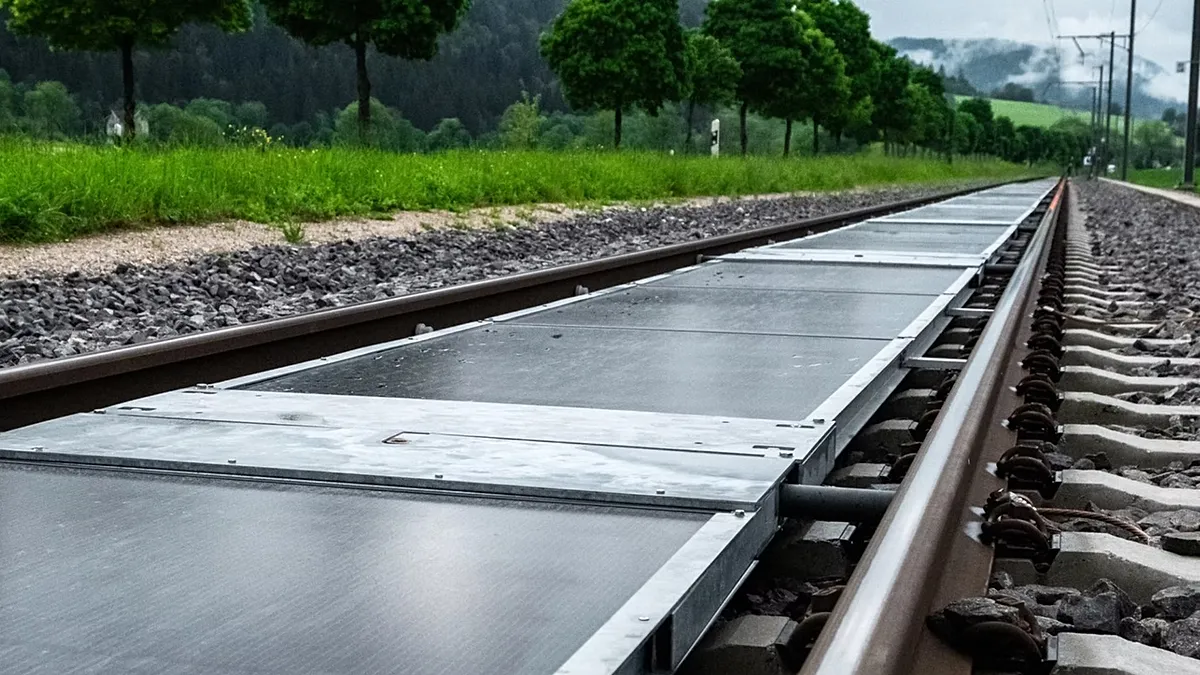
In a village nestled within the Val-de-Travers district, a Swiss innovation firm named Sun-Ways launched a trial that demonstrated the feasibility of solar-powered railways. The project involved the installation of 100 meters of photovoltaic panels along active train tracks, transforming a segment of the rail network into a dual-purpose system. Initially conceived as a three-year test, the initiative saw the deployment of 48 custom-designed solar panels, collectively generating 18 kilowatts of power. Remarkably, the trial’s positive outcomes were evident within the first year, prompting Sun-Ways to consider expanding the system to a permanent installation.
The success of the project hinges on the unique design of the solar panels, which are angled to optimize sunlight absorption throughout the year. While the ideal tilt for solar efficiency in regions like Spain ranges between 30° and 35°, the railway panels faced a 10% reduction in energy production due to their fixed orientation. However, this loss is negligible compared to the overall output, with the system generating approximately 16,000 kilowatt-hours annually. This amount is equivalent to the energy consumption of a typical UK household, underscoring the practicality of such projects.
“The plant worked perfectly, and we didn’t have to carry out any special maintenance,” Sun-Ways told Euronews Earth. “For this first pilot project, the electricity is sent directly to the grid, but we are already working to reinject the electricity produced with Sun-Ways power plants directly into the railway substations or into the train traction line.”
Technical Innovations and Challenges
Despite the promising results, implementing solar railways requires overcoming several engineering hurdles. One of the primary concerns raised by the International Union of Railways is the risk of micro-cracks in panels, which could lead to fires or interfere with train operations through glare. Sun-Ways addressed these issues by developing more durable panels than those used in rooftop installations, incorporating an anti-reflection filter to reduce visual distractions. Additionally, built-in sensors monitor the panels’ performance, while brushes on train ends clean their surfaces, ensuring consistent energy production.
The design of the solar panels also considers the environmental context of railway lines. Unlike sloped rooftops, which are naturally suited for optimal tilt, the fixed angle of railway-mounted panels results in a 10% efficiency loss. However, this trade-off is deemed acceptable given the scale of potential energy generation. If fully realized, a similar system across Switzerland’s 5,317-kilometer railway network could yield around one terawatt-hour of electricity annually. This would account for roughly two percent of the nation’s total energy needs, offering a scalable model for other countries.
Expanding the Vision
While Switzerland’s trial has set a precedent, the focus is now shifting to Italy as the next potential hub for solar railway development. A recent collaboration agreement between Sun-Ways and an Italian business partner, connected to Rete Ferroviaria Italiana—the national railway infrastructure operator—has paved the way for a pilot project. Details of this initiative are expected to be announced in the coming months, with plans to replicate the Swiss model on a new scale.
Parallel efforts are also underway in other regions. Sun-Ways has secured government approval to implement a solar railway system in South Korea, while discussions with companies in the Netherlands, China, India, and Singapore are exploring additional opportunities. These partnerships reflect a global interest in leveraging railway corridors for renewable energy, particularly as urbanization and transportation demands continue to rise.
The broader implications of this technology extend beyond energy production. By converting railways into power sources, nations can reduce their reliance on fossil fuels, lower carbon emissions, and optimize land use. Railway tracks, often occupying vast stretches of land, could serve as strategic sites for energy generation without disrupting existing transportation services. This approach aligns with Europe’s push for green infrastructure, where every component of the energy system is scrutinized for sustainability.
Potential for Widespread Adoption
The scalability of solar railways is a key factor in their appeal. In Spain, for instance, a 34° tilt for solar panels was found to minimize annual production losses, with studies showing less than one percent efficiency reduction. This principle could inform future designs, as engineers work to balance practicality with optimal energy capture. For railway applications, the fixed angle might be a compromise, but the overall output remains significant.
With the initial trial in Switzerland yielding 16,000 kWh per year, the potential for expanding this model is evident. If replicated across the entire 5,317-kilometer Swiss rail network, the system could produce energy equivalent to 760 football fields, a striking visual representation of its scale. Such a transition would not only support the country’s energy goals but also set a benchmark for other nations to follow. Italy’s participation in this initiative could further accelerate the adoption of solar railways, particularly as the European Union intensifies its focus on reducing emissions and diversifying energy sources.
As Sun-Ways continues to refine its technology, the company aims to integrate solar energy more seamlessly into railway systems. Future projects may involve direct power injection into train traction lines, cutting down on transmission losses and enhancing efficiency. This innovation could transform railways from mere transit systems into vital components of the energy grid, creating a symbiotic relationship between transportation and renewable power. With ongoing collaborations and expanding ambitions, the solar railway concept is no longer a distant dream but a tangible pathway toward a greener future.
The successful trial in Switzerland has already proven that solar railways are viable, even in challenging environments. As Italy prepares to join the movement, the project’s potential to generate substantial energy while maintaining operational reliability becomes clearer. This dual-purpose infrastructure not only supports environmental goals but also offers cost-effective solutions for energy production. As the world races to meet climate targets, the integration of solar power into railways exemplifies how innovation can drive sustainability across multiple sectors.