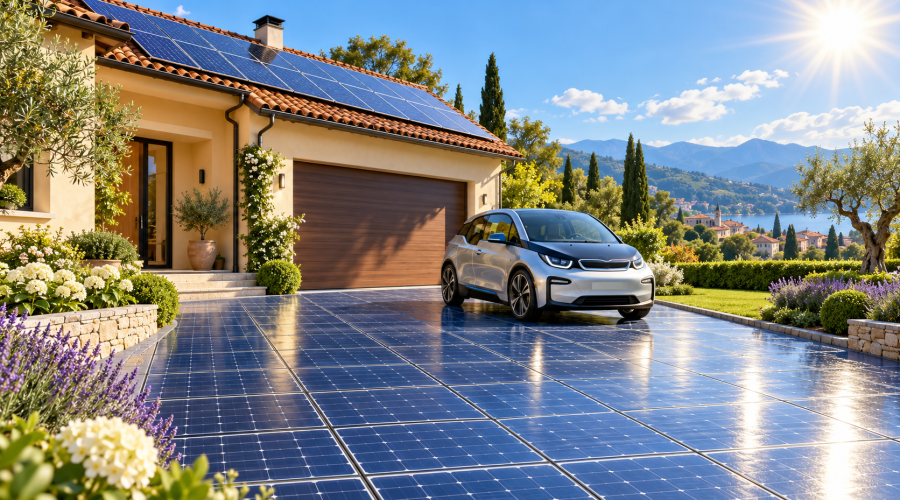
Solar moves beyond the roof as households look for energy independence
Usagevpn.com – Driveways, patios and balconies are becoming part of Europe’s solar expansion, with homeowners seeking more ways to produce electricity as energy costs remain elevated. The shift comes as the war on Iran and disruption around the Strait of Hormuz have pushed oil and gas prices higher, increasing pressure on household budgets across the continent.
The Strait of Hormuz is a crucial maritime passage that normally handles roughly one-fifth of global oil supplies. Its disruption has sharpened concern about dependence on imported fossil fuels, while also highlighting the value of locally generated renewable power. Solar Power Europe estimates that solar generation has avoided €40 billion in EU gas-import costs since the conflict started.
Even with those savings at a wider economic level, many households are still facing expensive electricity and gas bills. That has encouraged more people to explore systems that allow them to generate a share of their own power.
Demand rises as energy uncertainty persists
Interest in home solar has increased sharply in several markets. German renewable-energy company Enpal BV recorded a 30 per cent jump in solar-panel inquiries after the opening weeks of the US-Israel war against Iran.
In the UK, EON saw solar interest rise 23 per cent between 23 February and 1 March. Interest then climbed another 63 per cent from 2 to 8 March. The figures point to a growing desire among households to reduce their exposure to sudden changes in energy prices.
“People are choosing solar because it puts them back in control.”
Sonia Dunlop, chief executive of the Global Solar Council, says volatile bills have made self-generation increasingly appealing for households in Europe and elsewhere.
“After years of volatile energy bills, households in Europe and across the world want to take energy into their own hands and solar is one of the most affordable ways to do that.”
Patios and driveways become potential power sources
Rooftops remain the main location for residential solar, but they are not an option for every property. Heavy shade can limit output enough to extend the financial payback period, while thatched roofs are not suitable for conventional panel installation. As equipment costs have declined and products have become more adaptable, companies have begun turning attention to other sun-exposed surfaces.
PLATIO is among the businesses developing photovoltaic paving for decks, patios and other outdoor areas. The company unveiled its first prototypes in 2016 and now operates across 13 European countries. Its goal is to replace conventional paving materials, including asphalt and paving stones, with surfaces that can generate electricity in homes, parks and urban settings.
One early example was installed in 2018 at a family home in Kecskemét, Hungary. The nine-square-metre driveway system has a capacity of 1.7 kWp. Under favourable conditions, it could generate enough electricity for regular background demand such as a refrigerator, freezer, LED lighting and smaller kitchen devices, including a blender or slow cooker.
PLATIO completed a larger project in 2021 at the courtyard of a six-apartment building near Frankfurt, Germany. That installation has a capacity of 6.64 kWp. At maximum generation, it could exceed the annual electricity needs of a typical three-bedroom home, although actual production depends on factors including sunshine, location and maintenance.
UK-based SolarPave is pursuing similar uses for solar technology in outdoor living spaces. Its completed Yorkshire projects include a solar driveway at a residence and a solar floor on a residential balcony.
Built for daily use, but output has limits
Solar paving is designed to withstand the demands of an outdoor surface. PLATIO uses hardened, slip-resistant glass over its photovoltaic components, allowing people to walk over the panels and vehicles to be parked on them.
As with roof-mounted panels, keeping the surface reasonably clean helps maintain production. Dirt can reduce output, although PLATIO says losses from dust can be as low as three per cent, depending on the individual installation.
These systems do face an unavoidable disadvantage compared with panels positioned at an angle on a roof. Flat-mounted units capture less direct sunlight for much of the day, and dirt can accumulate more readily on horizontal surfaces. For that reason, a solar driveway or patio will generally produce less electricity than an equivalent rooftop array installed at an optimum angle.
That does not make the technology irrelevant. In the right setting, power from a patio, driveway, fence or balcony can still reduce the amount of electricity a household needs to buy from the grid. The precise payback period is difficult to predict because it varies with local sunlight, system size, electricity consumption, installation costs and how much of the generated power can be used on site.
A broader role for household solar
For homeowners, the appeal of solar paving is not necessarily replacing a conventional rooftop system. It can offer an additional option where roof space is limited, unsuitable or unavailable. It may also help properties with large outdoor paved areas make practical use of surfaces that would otherwise only serve access, parking or recreation.
“As prices have fallen and designs have become more versatile – driveways, patios, fences and car parks are becoming part of the picture.”
Dunlop says the expansion of solar into these spaces supports a broader change in how Europe can build its energy system.
“Every sunny surface we put to work brings Europe closer to an energy system that is cheaper, more secure and owned by the people it serves.”
As households weigh the costs and practical limits of different solar options, rooftop panels are likely to remain central. But the growing use of photovoltaic surfaces underfoot shows how energy generation is increasingly being integrated into the everyday fabric of homes and neighbourhoods.
Related Reading
Frequently Asked Questions
What is Every sunny surface is being put?
Every sunny surface is being put is the main topic of this guide. The article explains the context, practical details, and next steps readers should understand.
Why does Every sunny surface is being put matter?
Every sunny surface is being put matters because readers are looking for a useful answer, not just a short summary. Good content should match search intent and help them decide what to do next.