Poland Warns of Possible Russian Drone Pressure on NATO’s Eastern Flank
Usagevpn.com – Tusk – Polish Prime Minister Donald Tusk has urged the country to prepare for a difficult period ahead, warning that intelligence assessments point to a heightened risk of Russian hybrid attacks involving drones and missiles against nations backing Ukraine, including Poland.
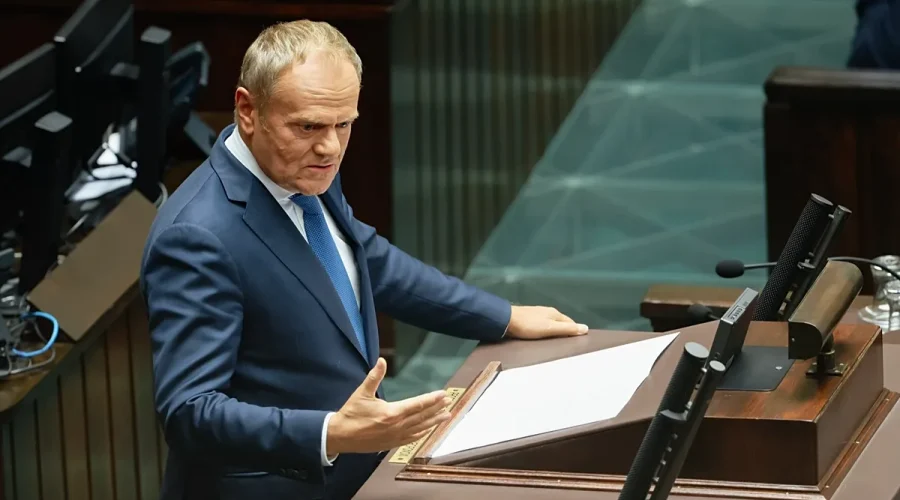
Speaking during a special address to the Sejm, Tusk said the government was sharing what it regarded as the likeliest outlook for the coming months. He said the period through early spring could bring serious security tests for Poland, particularly as late autumn and winter are expected to be a decisive stage of Russia’s war against Ukraine.
“It is a scenario involving serious events and requiring us to be focused, serious and, above all, mentally ready to pass difficult tests,” Tusk said.
He stressed that the challenge would affect the entire country, not only the government or armed forces. The prime minister framed preparedness as a matter of national resilience: protecting borders, airspace, homes and the political unity needed during a period of intensified regional tension.
Faster drones and a changing battlefield
A central concern is Russia’s large-scale deployment of a new category of jet-powered drone. Tusk said these aircraft can move at far greater speed than more familiar drone models, fly at higher altitudes and descend on their intended targets after approaching from above.
He warned that effective countermeasures are still limited in many countries. That creates an urgent need for Poland and its partners to develop practical answers to a threat that is evolving faster than many existing air-defence systems were designed to handle.
“This is work we, too, have to do,” Tusk said of the need to counter the new drones.
Tusk said he planned to visit Ukraine for discussions with President Volodymyr Zelensky. Their talks are expected to focus on cooperation within what he described as an anti-ballistic coalition, including ways to draw on Ukrainian experience, capabilities and capacity alongside those of other partners.
Ukraine’s experience is especially relevant because it has faced sustained drone and missile attacks throughout the war. For Poland, closer cooperation could help turn battlefield lessons into stronger defensive planning along NATO’s eastern border.
Strikes near Poland’s border raise concern
The prime minister also pointed to continuing attacks on Ukraine’s energy network, despite earlier expectations of an energy truce mentioned by US President Donald Trump. Tusk said attacks on Ukrainian infrastructure have continued and increasingly affect facilities near Poland’s border crossings with Ukraine.
Those strikes have implications beyond Ukraine because transport and logistical links near the border are important to the movement of goods, humanitarian assistance and wider regional connectivity. Tusk said Moscow’s objective is to inflict the broadest possible damage on Ukraine’s economy and logistics system.
“For now, Ukraine’s,” he added.
Russian forces are expected to maintain frequent, high-intensity attacks on six important Ukrainian cities, Tusk said. He also warned of efforts to destroy stockpiles needed for Ukraine’s defence as well as railway infrastructure that supports the country’s economy and military logistics.
He noted that more than 300 Ukrainian railway locomotives have been destroyed by Russian forces in recent weeks. The scale of those losses illustrates why rail links have become a major target: they remain vital for moving people, supplies and equipment across a country under sustained attack.
Concern over “accidental” incursions
Tusk said intelligence services see a possibility that Russia’s plans could include drone and missile strikes on countries supporting Ukraine. In his assessment, some incidents could be presented publicly as accidents, even if they enter NATO territory or cause damage.
Such a tactic, he argued, could be intended to test the alliance’s political resolve rather than trigger an immediate, open confrontation. A drone or missile crossing into the territory of one or more eastern-flank NATO members could be accompanied by claims that no deliberate aggression occurred and that a collective response is unnecessary.
“There is a real risk that the territory of one or several NATO countries on the eastern flank may be entered by drones or other types of missiles,” Tusk said.
The broader strategic aim, Tusk said, would be to undermine NATO solidarity and persuade member states that Article 5—the alliance’s collective-defence commitment—is less dependable in practice than in principle. He cautioned that incidents framed as accidental could occur more than once.
For Poland, the warning highlights the importance of coordinated air surveillance, rapid communication among allies and political clarity when an incident occurs. The issue is not simply whether an object crosses a border, but how NATO members interpret the event and respond together.
Appeal for political unity
Tusk also linked the security threat to political developments across Europe, where elections and public debates can create openings for openly pro-Russian forces. He appealed to politicians across party lines, singling out lawmakers from the Confederation party, not to amplify narratives that serve Moscow’s interests.
“Whipping up hostility towards the European Union, towards our allies, towards Ukrainians, is directly implementing Russia’s strategy,” he said.
He concluded by calling for a common national position on border security, Polish airspace and the safety of households. Tusk warned that some European politicians may seek reasons to avoid standing with eastern NATO members during a crisis. His message to the Sejm was that political differences must not weaken Poland’s ability to act as a united country when its security is being tested.
Related Reading
Frequently Asked Questions
What is Tusk?
Tusk is the main topic of this guide. The article explains the context, practical details, and next steps readers should understand.
Why does Tusk matter?
Tusk matters because readers are looking for a useful answer, not just a short summary. Good content should match search intent and help them decide what to do next.