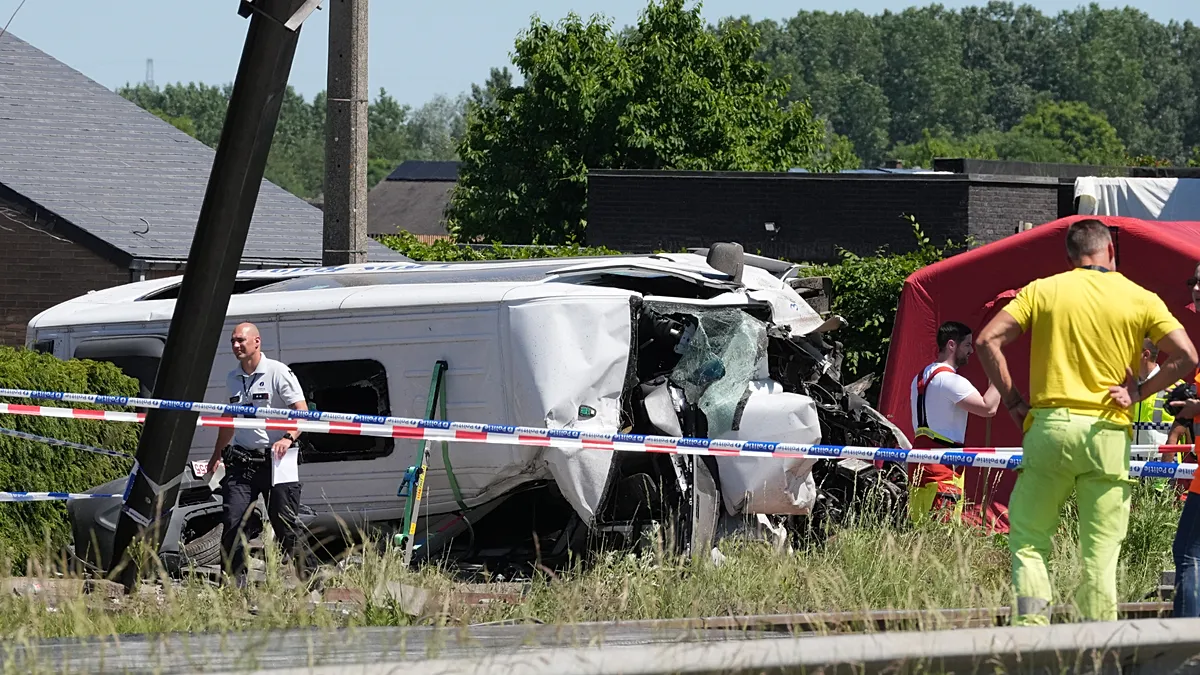
Tragedy at Belgian Level Crossing: Officials Label Incident as One of the Worst in History
One of the worst accidents at Belgian – On Tuesday morning, a devastating collision at a level crossing in the Belgian municipality of Buggenhout claimed the lives of four individuals while leaving five children injured. The incident, which occurred around 8:15 AM, involved a school bus and a passenger train, marking a severe disruption in the local community and raising urgent questions about railway safety measures.
Details of the Collision and Casualties
The school bus, carrying nine passengers, including seven children with specific educational needs, was en route to a local school when it collided with the train. According to Federal police spokesperson An Berger, the tragic event resulted in the deaths of two minors—one aged 12 and another 15—as well as the fatalities of the driver and a bus assistant. Five other children sustained injuries and were transported to a hospital, where their conditions are reported to be stable.
“This is one of the worst accidents in the history of Belgium at a level crossing,” stated Thomas Baeken, a representative of Infrabel, the Belgium Railway Infrastructure Manager. He emphasized that the crossing was closed at the time of impact, with red lights flashing and barriers lowered. “Why does the chauffeur still proceed? We don’t know.”
Meanwhile, Dimitri Temmerman, a spokesperson for the National Railway Company of Belgium (SNCB), confirmed that all 100 passengers aboard the train were safely evacuated without any injuries. The train, traveling from Bruges to Mechelen, was reported to be moving at 90 kilometers per hour when the collision occurred. Despite the driver’s attempt to apply emergency brakes, the accident could not be avoided as the train was already very close to the crossing point.
Investigation and Safety Equipment Details
Authorities have launched an investigation to determine the exact causes of the incident. Infrabel officials highlighted that the level crossing had been closed for some time before the bus entered the tracks, yet the collision happened almost instantly. “The crossing was already closed quite some time before the car was driving onto the level crossing,” Baeken noted. “But the impact was almost immediate because the train was already really close to the crossing, leaving no time for a full stop.”
Following the crash, the school bus was thrown into a pole before coming to rest in front of a nearby residence. The sequence of events underscores the critical importance of adherence to level crossing protocols. Infrabel confirmed that the crossing in question was equipped with two barriers, four lights, and both a sound and a bell signal, a setup designed to alert drivers and pedestrians of approaching trains.
EU-Level Variations in Safety Standards
Despite the robust safety systems in place, the incident has sparked a debate about the consistency of level crossing regulations across the European Union. Vincent Godeau, Infrabel’s security advisor, explained that equipment standards vary by country. “Each level crossing has a safety setup decided by Infrabel and also by the government,” he said. In Belgium, the current design includes two red lights and one white light, while in France, only a single red light is used without a white signal.
Godeau also referenced the 1968 Vienna Convention on Road Traffic, which establishes universal rules for road users. Among its key provisions is the requirement for drivers to halt at red lights, with the St Andrew’s cross serving as the international symbol for railway crossings without gates or barriers. While these guidelines apply broadly, the specifics of implementation remain country-dependent, leading to potential gaps in safety measures.
Context on Belgium’s Level Crossing Safety Record
Infrabel reported that accidents at level crossings in Belgium have been declining in recent years, with approximately 20 incidents recorded last year. However, this particular crossing had not seen a major accident since 2007, making the recent collision particularly alarming. The event has prompted renewed calls for enhanced monitoring and maintenance of such critical infrastructure.
Local officials and residents have expressed deep concern over the incident, highlighting the need for stricter compliance with crossing protocols. “This tragedy reminds us that even with safety systems in place, human error can still lead to catastrophic outcomes,” said a statement from the Buggenhout municipal council. The community is now awaiting the findings of the ongoing investigation to understand whether mechanical failures, procedural oversights, or other factors contributed to the collision.
Broader Implications for Railway Safety
The accident has reignited discussions about the balance between efficiency and safety in railway operations. While Belgium’s level crossings are equipped with advanced features like automated barriers and multiple warning signals, the incident raises questions about the effectiveness of these systems in preventing collisions. “We must ensure that all drivers are fully aware of the dangers associated with railway crossings,” Baeken added, emphasizing the importance of public education alongside technological safeguards.
Experts suggest that the design of level crossings, combined with driver behavior, plays a pivotal role in accident prevention. For instance, the presence of two red lights at this crossing might have provided additional visibility, yet the bus driver’s decision to proceed despite the signals remains a mystery. “It’s unclear whether the driver overlooked the signals or was inattentive at the moment of impact,” Godeau explained. This ambiguity highlights the need for further analysis and the potential for improvements in safety protocols.
Impact on Families and Community
The loss of four lives, including two children, has left families and the broader community in mourning. The school bus was transporting students who rely on specialized transportation for their education, adding a layer of emotional weight to the tragedy. Local schools have since paused their morning routines, with educators and parents expressing solidarity with the affected families.
Residents of Buggenhout have also called for increased scrutiny of the level crossing’s safety features. “Every day, hundreds of people pass through this crossing, and it’s a reminder of how vulnerable we all are to such accidents,” said a local parent. The municipality is working closely with Infrabel to assess whether the crossing’s equipment was functioning correctly at the time of the incident.
As the investigation continues, the focus remains on preventing similar disasters in the future. Infrabel has committed to reviewing all safety measures at the crossing and implementing additional precautions if necessary. The incident serves as a stark reminder of the importance of vigilance, even in areas where safety systems are in place. For now, the community grapples with the aftermath, seeking answers and hope for a safer future for all who rely on these crossings daily.