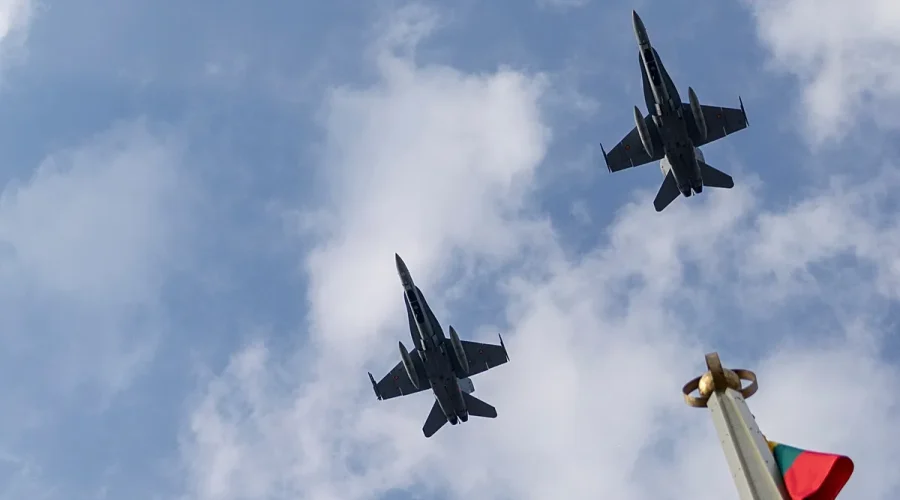
NATO air defences respond after drone enters Lithuanian territory
Usagevpn.com – NATO aircraft destroyed a drone after it crossed into Lithuania from Belarus on Tuesday, marking the first time an unmanned aircraft has been shot down over Lithuanian soil. The incident has intensified attention on the security of the alliance’s eastern flank as Russia’s war against Ukraine continues.
Lithuanian Foreign Minister Kestutis Budrys said the interception demonstrated that the alliance remains prepared to defend its members. He praised the allied air presence over the Baltic states, saying it helps protect the region’s skies and strengthens collective security.
A drone that just entered Lithuanian airspace was destroyed by NATO fighter jets.
President Gitanas Nauseda confirmed the action in a post on X, stressing that military preparedness is essential as Russia escalates its aggression in Ukraine.
With Russia intensifying its aggression against Ukraine, such readiness is vital for our region.
Route through Lithuania
Lithuania’s National Crisis Management Centre said the drone crossed the border from Belarus before travelling westward through the Lentvaris and Trakai areas. It eventually came down in a rural location near Pratkūnai village in Kaunas county.
The trajectory placed the aircraft well inside Lithuanian territory and underlined the difficulty of managing airspace close to an active war zone. Although drones have entered the airspace of Lithuania, Latvia and Estonia repeatedly since Russia launched its full-scale invasion of Ukraine in 2022, NATO interceptions remain uncommon.
Moscow had not commented on the episode.
For Lithuania, the event carries particular importance beyond the immediate security response. The country has long relied on NATO’s Baltic air-policing mission, under which allied aircraft rotate through the region to monitor and protect the airspace of the Baltic states. Lithuania, Latvia and Estonia do not operate the kind of fighter fleets normally used for continuous national air defence, making the allied mission a visible expression of NATO’s collective-defence commitment.
A pattern of pressure along NATO’s eastern edge
The shoot-down came amid a wider series of aerial incidents involving countries near Russia and Ukraine. Poland announced aviation operations only hours later, citing Russian jet-powered drones striking Ukrainian territory close to its borders. Warsaw described those measures as preventive steps to protect airspace in areas neighbouring the conflict.
The Polish decision reflected growing concern that attacks, navigational errors or diverted aircraft can create direct risks for NATO states even when they are not the intended target. Governments on the eastern flank increasingly view such incidents as tests of the alliance’s readiness, whether they result from deliberate actions or from the expanding use of drones in the war.
In May, NATO’s air-policing mission destroyed a Ukrainian drone that had entered Estonian airspace. That was the first interception of its kind since the beginning of the full-scale war. European officials have also highlighted cases in which Russia diverted Ukrainian drones intended for industrial and oil targets near St Petersburg on the Gulf of Finland.
These developments show how the air war over Ukraine is affecting a far broader area. Drones can travel long distances, fly at low altitude and change course quickly, creating challenges for civilian authorities and air-defence forces alike. A rapid response is intended both to prevent harm on the ground and to make clear that NATO territory is monitored and defended.
Diplomacy and fighting continue in parallel
The Lithuanian incident unfolded during a sensitive phase in efforts to reduce the fighting. Ukrainian President Volodymyr Zelenskyy has said Kyiv is prepared to take “de-escalatory steps” if Moscow does the same. His remarks followed US President Donald Trump’s announcement that Russia and Ukraine had agreed to stop attacking each other’s energy infrastructure.
Despite that stated agreement, combat activity continued overnight. Ukrainian forces struck Russian military targets in Krasnodar Krai, while Russia launched 102 drones against Ukraine. The contrast between diplomatic language and continued drone warfare illustrates the uncertainty surrounding any prospective reduction in hostilities.
For countries bordering Belarus, Russia or Ukraine, the practical consequence is a sustained need for surveillance and coordination. Lithuania’s response was presented by its leaders as evidence that NATO’s defence arrangements can react when an aerial threat crosses into allied territory.
Lithuania’s evolving deterrence debate
The event also comes as Lithuania reassesses its longer-term role in European security. In July, Nauseda said he wanted the country to participate in Western nuclear deterrence directed at Moscow. Lithuania has since begun the process of removing its constitutional prohibition on hosting nuclear weapons.
That proposal is likely to remain closely watched across Europe, where debate over deterrence has become more urgent during the war in Ukraine. Any change would involve major political and security considerations, but it signals how sharply the regional threat assessment has changed.
Tuesday’s drone interception therefore had significance beyond a single aircraft. It highlighted the immediate operational demands facing NATO’s eastern members and reinforced Lithuania’s argument that allied unity, air policing and credible deterrence are central to regional security.
Related Reading
Frequently Asked Questions
What is NATO committed and ready after shooting?
NATO committed and ready after shooting is the main topic of this guide. The article explains the context, practical details, and next steps readers should understand.
Why does NATO committed and ready after shooting matter?
NATO committed and ready after shooting matters because readers are looking for a useful answer, not just a short summary. Good content should match search intent and help them decide what to do next.