Snake Under the Hood: Toulouse Suburb Motorist Finds 1.5-Metre Boa Constrictor in Engine Bay
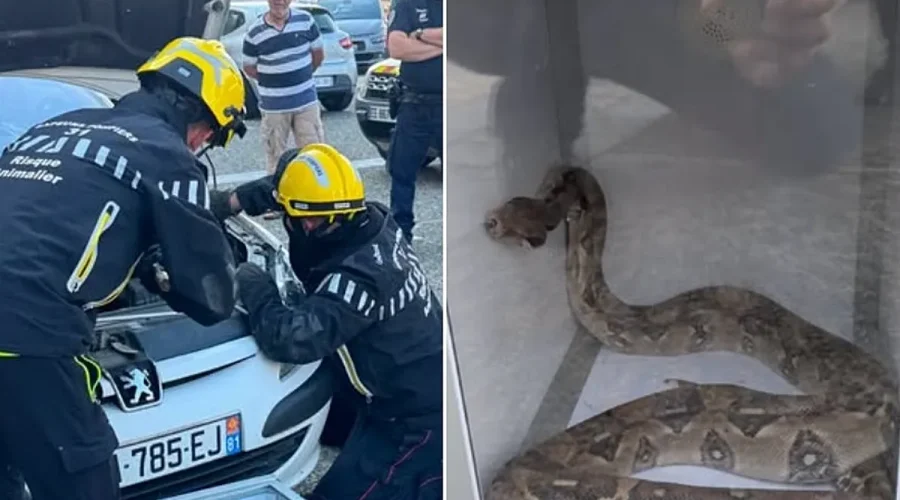
Usagevpn.com – A routine maintenance task turned into a wildlife rescue operation when a driver in Colomiers, a residential suburb on the western edge of Toulouse, opened his car bonnet to replace a dead battery and found a living boa constrictor coiled inside the engine compartment. The reptile, measuring roughly 1.5 metres from snout to tail, had apparently settled into the warm machinery space after the vehicle sat undriven for an entire month. The species in question, Boa constrictor, is native to South America and can exceed three metres in length in the wild, making the sight of one tucked beneath a French sedan’s front panel an extraordinary surprise for anyone expecting only corroded terminals and a flat battery.
The Rescue Operation
The Haute-Garonne departmental fire brigade dispatched a five-person team to the scene, including two specialists from its RAN unit — the dedicated animal-rescue detachment trained to handle incidents involving live creatures. Working methodically, the crew extracted the constrictor from the cramped engine bay and transferred it into a glass container for safe transport. The brigade subsequently posted details of the operation on its social media channels, inviting the public to help identify the snake’s origin and determine whether it had escaped from a private collection or a commercial facility.
The animal was ultimately delivered to a local veterinary school, where it could receive a full health assessment before being placed in appropriate long-term care.
Why an Exotic Boa Survives in a French Suburb
Boa constrictors are thermophilic reptiles that thrive in consistently warm environments. France’s string of record-breaking heatwaves over recent years has altered the survival calculus for escaped exotic snakes. Temperatures that once would have killed a free-ranging constrictor within days now allow it to persist for weeks or months, foraging on insects, small lizards, and other prey available in suburban gardens and hedgerows. Climate-driven range expansion of non-native reptiles is a growing concern for French wildlife authorities, who monitor sightings and coordinate rescues through departmental fire services.
Strict Rules Governing Exotic Pets in France
Keeping a boa constrictor — or any non-native reptile — in France is not a casual hobby. Owners must comply with a layered regulatory framework: national legislation on exotic pet ownership, European Union directives on captive breeding and trade documentation, and international obligations under CITES (the Convention on International Trade in Endangered Species of Wild Fauna and Flora), which lists constrictor snakes among protected vertebrates. Purchasing, housing, breeding, and transporting these animals each carry specific paperwork and enclosure requirements. Rescue services routinely remind the public that an escaped boa is not merely a nuisance but a potential regulatory violation, and that owners bear legal responsibility for their animals’ whereabouts.
A Second Escape Within Days
The Colomiers incident was not an isolated event. A few days later, animal specialists attached to the Toulouse fire brigade were summoned to Montesquieu-Volvestre, a commune in the same Haute-Garonne department, where another boa — this one approximately one metre long — had slipped out of a vivarium and entered the surrounding landscape. The proximity of the two escapes within a short window underscored how fragile the containment of large constrictors can be, particularly during periods of sustained heat when reptiles become more active and more inclined to seek cooler microclimates.
Are Boas Dangerous to People?
For most adults, a boa constrictor presents a manageable risk. The species lacks venomous fangs; its bite, while potentially painful, does not deliver toxins. The primary threat mechanism is exactly what the common name implies: the snake coils its muscular body around prey and applies constriction until the victim can no longer breathe. In the wild this strategy targets small mammals, birds, and reptiles. An adult human is generally too large for a constrictor to fully encircle, though smaller individuals — children, elderly persons, or anyone caught off guard — could face genuine danger if a large snake became entangled around the torso or neck.
Boa constrictors feed mainly on insects, spiders, and smaller animals such as lizards. They do not pose a danger to adult humans under normal circumstances.
Nonetheless, the sight of a metre-and-a-half reptile draped across a car’s alternator and radiator fan is enough to send most motorists straight to the emergency line. The Colomiers driver’s decision to call for professional help rather than attempt a DIY removal was, in this case, the correct and safest course of action.
Broader Implications
As global temperatures climb and urban heat islands intensify, French authorities anticipate more encounters between residents and escaped exotic reptiles. The combination of laxer informal pet-keeping practices, climate-driven survivability, and the sheer size of species like the boa constrictor means that what was once a contained household curiosity can become a public-safety event requiring multi-agency response. The Colomiers episode, while ultimately resolved without injury, serves as a reminder that the boundary between a private terrarium and a municipal emergency call can be thinner than a single cracked vivarium lid.
Related Reading
Frequently Asked Questions
What is French driver discovers 1 5 metre?
French driver discovers 1 5 metre is the main topic of this guide. The article explains the context, practical details, and next steps readers should understand.
Why does French driver discovers 1 5 metre matter?
French driver discovers 1 5 metre matters because readers are looking for a useful answer, not just a short summary. Good content should match search intent and help them decide what to do next.