France Launches 10-Month Voluntary Military Service for 3,000 Young Volunteers
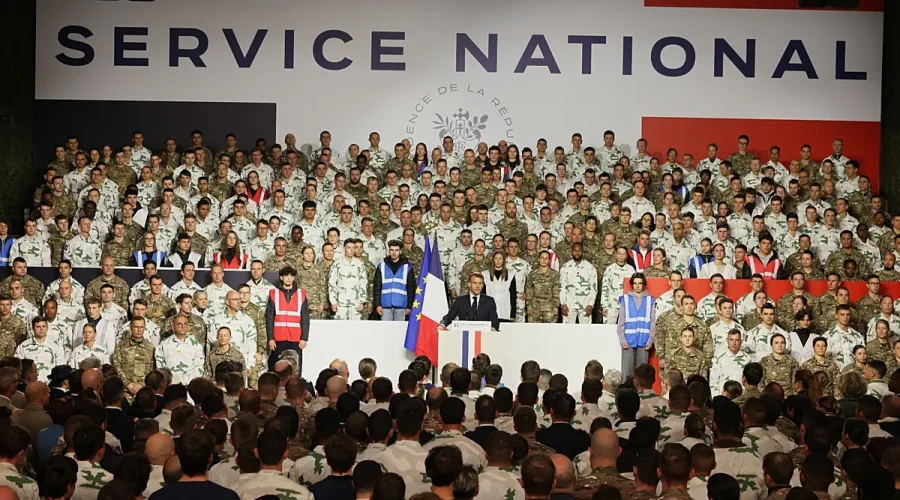
Usagevpn.com – On Monday, roughly 3,000 French citizens aged in their late teens and early twenties stepped into what amounts to a modern reinvention of national service. The programme, entirely voluntary, marks the first operational cohort of a scheme designed to replace the Universal National Service framework that the state had previously dismantled. For the volunteers, the experience will span ten months of structured military life — discipline, physical drill, regimental songs, and weapons familiarisation — before they are embedded into an active unit of the army, air force, or navy.
What the Ten Months Actually Involve
Each participant begins with a five-week block of basic military training, the kind of foundational conditioning that instils chain-of-command habits, fieldcraft basics, and collective identity. After that initial phase, volunteers are assigned to a parent unit where they carry out duties alongside regular service members. In exchange, the state provides housing, meals, and uniform, and pays a monthly stipend of €800. The figure sits above the minimum wage threshold but well below full-time military pay, positioning the scheme as a civic-experience programme rather than a career entry point.
For the inaugural cohort, every assignment is geographically confined to French soil. There are no overseas deployments, no secondments to allied forces, and no operational rotations abroad. The government has made clear that the programme’s early iterations will remain domestic in scope, allowing administrators to work out logistical and welfare issues before any expansion of theatre.
Selection: Motivation Over Credentials
A notable feature of the first intake is the selection criterion. Candidates were chosen on the strength of their written applications and stated motivation. Academic qualifications played no role; a degree neither helped nor hindered an applicant’s chances. This deliberate decoupling of service eligibility from formal education signals the government’s intent to draw from a broad socioeconomic cross-section of the population rather than from a narrow professional class.
Growth Trajectory: From 3,000 to 50,000
The current cohort of 3,000 is explicitly a pilot. The stated near-term objective is to scale annual intake to 10,000 volunteers. Beyond that, the government has outlined a long-range ambition of up to 50,000 participants per year by 2035. Reaching that figure would make the programme one of the largest structured youth-engagement initiatives in Western Europe, comparable in scale to the largest national-service schemes that operated in continental Europe during the Cold War era.
The military rationale behind the growth targets is straightforward: build a deep, trained pool of young adults who have already experienced military culture, basic skills, and unit cohesion. Many of these individuals could subsequently enlist in the regular forces or join the reserve components, giving the armed forces a pipeline of pre-socialised recruits at a fraction of the cost of recruiting from civilian life.
Why Compulsory Service Remains Off the Table
Despite the programme’s name echoing older conscription-era language, officials have signalled that a return to mandatory national service is not on the agenda. Two structural constraints make that outcome improbable in the foreseeable future.
First, capacity. France’s combined armed forces number approximately 200,000 personnel. A full conscription cohort would encompass an entire annual birth cohort — roughly 700,000 young people — a number more than three times the size of the entire active force. Absorbing that volume would require a wholesale restructuring of barracks, training establishments, command chains, and logistics that no current planning document contemplates.
Second, fiscal pressure. France’s public finances remain under sustained strain from pension obligations, energy-transition spending, and defence modernisation budgets. The cost of running the voluntary programme at the 10,000-per-year level is projected to approach €1 billion by 2030. Scaling that to a compulsory cohort of several hundred thousand would multiply the outlay by an order of magnitude, a figure that would be politically and economically difficult to sustain.
Historical and Strategic Context
France ended its peacetime conscription system in 1997, transitioning to a fully professional army over the following decade. The Universal National Service concept that the new programme supplants had been floated in various policy papers as a way to maintain a civic-military link without reinstating mandatory enlistment. Its scrapping, followed by the introduction of this voluntary alternative, reflects a compromise: the state retains the institutional architecture of national service while leaving the decision to serve squarely with the individual.
Strategically, the timing is not incidental. France maintains significant commitments in the Sahel, the Indo-Pacific, and NATO’s eastern flank. A steady flow of young adults who have completed ten months of structured military training — even if they never re-enlist — strengthens the reserve base and widens the talent pool from which the armed forces can draw when operational tempo demands additional manpower. In that sense, the programme functions less as a standalone civic initiative and more as a force-multiplier for a military that is already stretched across multiple theatres.
For the 3,000 volunteers who began their five-week basic-training block this week, the immediate reality is simpler: a shared dormitory, a daily schedule of physical exertion and instruction, and a monthly bank transfer of €800. Whether they emerge from the experience as future reservists, career soldiers, or simply citizens with a year of military vocabulary in their repertoire remains to be seen. What is certain is that France has opened a door that, for two decades, had been firmly shut.
Related Reading
Frequently Asked Questions
What is France begins new voluntary national service?
France begins new voluntary national service is the main topic of this guide. The article explains the context, practical details, and next steps readers should understand.
Why does France begins new voluntary national service matter?
France begins new voluntary national service matters because readers are looking for a useful answer, not just a short summary. Good content should match search intent and help them decide what to do next.