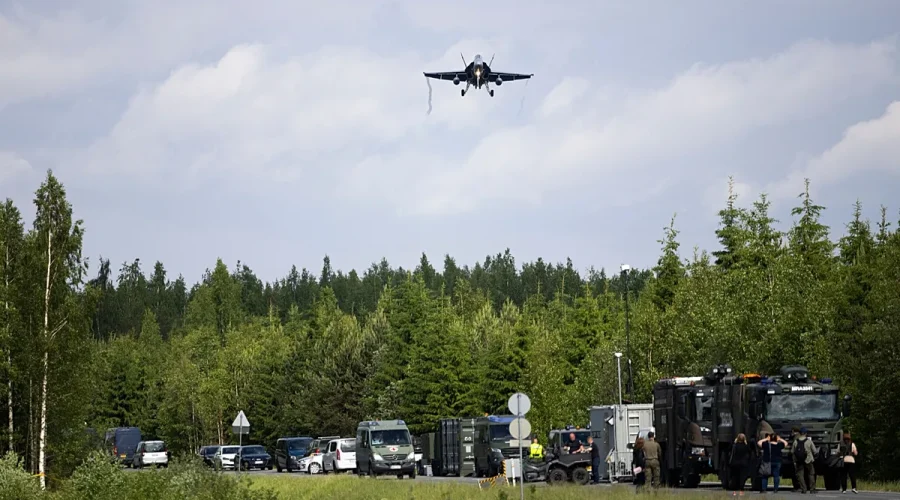
Finland Suspects Russian Aircraft Airspace Breach
Usagevpn.com – Finland suspects Russian aircraft of violating its sovereign airspace, according to a statement released by the country’s defence ministry on Thursday evening. Helsinki confirmed that a Russian military plane had crossed the national boundary earlier in the day and opened an immediate inquiry into the event. The announcement lands amid a string of similar episodes that have kept Finnish border watchers on high alert throughout the year.
“Every suspected violation of air space is taken seriously,” Defence Minister Antti Hakkanen told reporters in an official ministry communication. “An investigation is underway.”
The stakes are amplified by geography. Finland shares a 1,340-kilometre land frontier with Russia — one of the longest in Europe — running from the Baltic coast southward to the Arctic Ocean in the north. Since Moscow launched its full-scale invasion of Ukraine in February 2022, that once-quiet boundary has become a zone of continuous military vigilance, with Finnish radar operators tracking every contact within range.
A Recurring Pattern Along the Northern Frontier
Thursday’s episode is the latest in a short but troubling series. Finnish authorities previously logged two Russian military aircraft entering national airspace — one in May, another in June — and in both instances summoned the Russian charge d’affairs to register a formal diplomatic protest. The repetition has sharpened public debate in Helsinki over how frequently Russian aviation assets test the outer limits of Finnish sovereignty.
The security context has shifted dramatically since 2022. After decades of carefully maintained military non-alignment, Finland applied to join NATO following the Ukrainian invasion and completed accession in April 2023. Membership now places the country squarely inside the alliance’s collective-defence framework, so any airspace incursion also triggers Article 5 deliberations and reshapes NATO eastern-flank planning.
Drone Threats and the Gulf of Finland
Beyond fixed-wing aircraft, Finnish military intelligence has flagged a quieter but arguably more persistent hazard: long-range drones drifting northward from the Ukrainian theatre. Major General Pekka Turunen, head of the Finnish Defence Intelligence (FDI) service, warned as early as January that the probability of unmanned aerial vehicles crossing into Finnish territory was climbing steadily.
Speaking ahead of the Thursday release of a periodic Finnish military-intelligence report on the national security environment, Turunen elaborated on the mechanism behind that growing risk.
“The risk of a drone drifting into Finnish airspace or onto Finnish territory is growing all the time, the more Ukraine strikes in this area near the Gulf of Finland,” Turunen said.
The logic is straightforward. As Ukrainian forces extend strike range toward Russian logistics hubs and naval assets operating in the Gulf of Finland, drones travel longer distances and spend more time over international waters before reaching their targets. A miscalculation in navigation, wind drift, or fuel management can carry such a platform across the Finnish border. The intelligence report noted that while the overall security picture had deteriorated since 2022, the situation remained broadly stable compared with the same period a year earlier — a relative calm that does not eliminate the acute risk of a single drone event triggering a wider crisis.
Europe’s Drone Wall and NATO’s Eastern Sentry
Finland’s concerns mirror a continent-wide anxiety. Last September, drone flyovers into NATO airspace reached an unprecedented scale, prompting European leaders to agree on developing what they termed a “drone wall” along the alliance’s borders — a layered network of sensors, radar, and interceptor assets designed to detect, track, and neutralise unmanned intrusions before they reach populated areas or critical infrastructure.
In November, NATO military officials confirmed that a new American anti-drone system had been deployed to the alliance’s eastern flank, adding a dedicated capability to the existing air-defence architecture. The programme was accelerated further after a drone violated Polish airspace, an event that led NATO Secretary General Mark Rutte to announce the creation of the Eastern Sentry programme, explicitly aimed at deterring further Russian incursions into member-state airspace.
Earlier on the same Thursday, a Romanian F-16 fighter jet shot down an explosive-laden maritime drone operating close to Europe’s largest offshore gas project, underscoring how quickly a single unmanned platform can escalate into a multilateral incident.
Frequently Asked Questions
What exactly did Finland’s defence ministry confirm on Thursday? The ministry stated that it believed a Russian aircraft had entered Finnish national airspace earlier that day and that an investigation was underway. No further technical details — such as aircraft type, altitude, or duration of the incursion — were released at the time of the statement.
How many airspace incidents has Finland recorded this year? Including Thursday’s event, Finnish authorities have identified at least three suspected Russian aircraft incursions in 2026: one in May, one in June, and the Thursday incident. Each prior case prompted a formal diplomatic protest lodged through the Russian charge d’affairs.
Why does Finland’s NATO membership matter for airspace violations? As a NATO member since April 2023, Finland is covered by Article 5 collective defence. A confirmed armed incursion into Finnish airspace would therefore engage the alliance’s decision-making process, not merely a bilateral dispute between Helsinki and Moscow.
What is the “drone wall” and where is it being deployed? The drone wall is a layered sensor-and-interceptor network agreed by European leaders last September to detect and neutralise unmanned aerial intrusions along NATO’s eastern borders. A dedicated American anti-drone system was deployed to the eastern flank in November, and the Eastern Sentry programme — announced after a drone violated Polish airspace — adds further deterrence capability.