Northern Italy’s Late-Summer Storm Surge: When a Marine Heatwave Meets Continental Air
Usagevpn.com – For weeks, scorching temperatures had pinned northern Italy in a grip that strained power grids, parched farmland, and pushed hospitals to capacity. Then, within a single afternoon-to-evening window on 20 August 2026, that heat collapsed. What replaced it was a violent atmospheric disturbance carrying torrential rain, destructive wind, and tens of thousands of lightning discharges across Liguria, Lombardy, and the northern reaches of Tuscany. The transition was not gradual; it was abrupt, and its intensity was amplified by an unusual oceanic precondition that scientists say underscores how climate change is reshaping the Mediterranean’s seasonal rhythm.
The Oceanic Trigger
The immediate fuel for the storm system was a marine heatwave that had driven sea-surface temperatures above 33 °C in the western Mediterranean, as measured by a buoy operated by Spain’s Aemet meteorological service off the coast of Majorca. When a pulse of cooler, thermally unstable air from the west collided with the stagnant hot air mass still sitting over the Italian peninsula, the resulting instability—loaded with moisture drawn from the overheated sea—ignited a cascade of convective events that meteorologists classify among the most intense late-summer outbreaks in recent memory.
Liguria: Lightning, Rail Disruption, and Coastal Devastation
The westernmost region bore the first and arguably the most concentrated blow. Italy’s Civil Protection agency tallied roughly 40,000 lightning strikes across the Ligurian territory during the event. One bolt struck a Frecciabianca intercity train shortly after it departed Genoa’s terminal bound for Rome on the morning of Thursday 20 August, halting the convoy and requiring all passengers to evacuate onto the trackside.
Along the Ligurian Riviera, the storms’ wind component proved equally destructive. Seaside bathing installations between Cogoleto and Arenzano were battered; cabins, sunbeds, and parasols were torn from their moorings and scattered across the promenade. Further west, a second lightning strike disabled the railway traffic-control centre at Ventimiglia, suspending rail services along the western corridor.
Out on the water, a textbook supercell organized itself off the Tigullio coast, dumping extraordinary volumes of rain in minutes rather than hours. Within a 24-hour window, Chiavari and Lavagna each received approximately 200 millimetres of precipitation. A waterspout spun up off Rapallo, and streets in all three municipalities flooded, inundating shops and damaging municipal infrastructure. On the slopes above Sestri Levante, mature trees were uprooted and fell onto residential areas.
The agricultural toll was immediate and, in some sectors, existential. Coldiretti, the principal farmers’ association, described conditions in the Tigullio hinterland as “alarming,” with particular emphasis on olive orchards:
“The picture that emerges is that of a year compromised for the olive harvest, and we are receiving reports of losses in the wine-growing sector as well.”
Northern Tuscany: Wind, Rain, and a Tornado
More than 23,000 lightning strikes were logged across the northern Tuscan provinces during the same period. The Lamma Consortium, which operates the Environmental Monitoring and Modelling Laboratory for Sustainable Development, quantified the rainfall: in a twelve-hour span, provinces of Massa Carrara, Lucca, and Grosseto recorded totals of 60 to 70 millimetres, while Siena, Pisa, and Livorno received 40 to 50 millimetres.
Wind speeds reached damaging thresholds across the region. Gusts peaked at 106 km/h along the Pisa coast, 103 km/h within the province of Florence, 93 km/h on the island of Gorgona, 92 km/h in Viareggio, and 86 km/h in the Arezzo area. In Grosseto itself, a tornado tore the roof from a building, sending debris across the street.
Lombardy: Debris Flows, Evacuations, and Isolated Communities
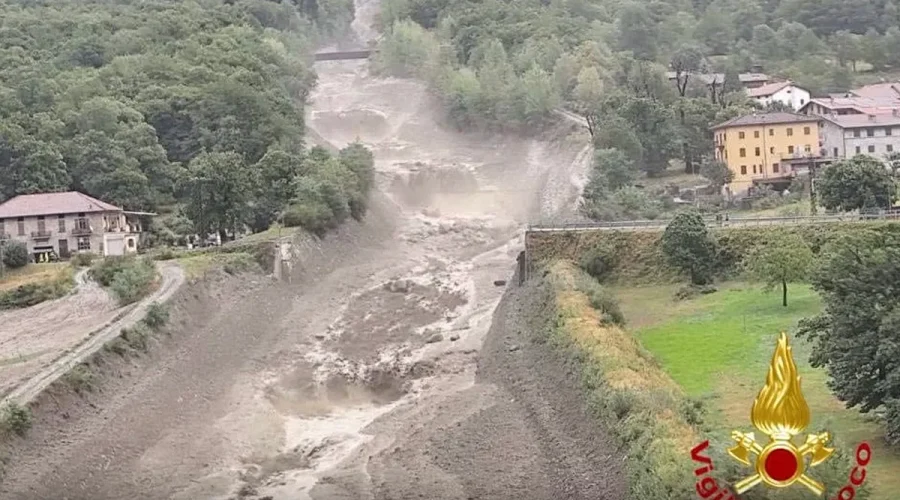
In the mountainous provinces of Brescia, Sondrio, and Bergamo, the storm’s rainfall translated into geomorphological hazards. At Sonico, a debris flow channeled through Val Rabbia hurled water, boulders, and rubble onto state road 42—the route climbing to the Tonale Pass—collapsing a bridge and severing the corridor. Around 350 residents in the Bergamo area were evacuated as waters rose and slopes became unstable.
The Lombardy regional hydrometeorological and climate centre (Arpa) recorded rainfall totals reaching 250 millimetres on the Orobic Alps near Lake Como, among the highest single-event accumulations for that latitude in recent decades. In Alta Val Brembana, also within the province of Bergamo, a slope failure closed a provincial road, and falling trees crushed several parked vehicles.
By the morning of Friday 21 August, six municipalities—Valleve, Carona, Foppolo, Branzi, Valbondione, and Gandellino—remained cut off from road access. A campsite at Isola di Fondra was cleared of its occupants amid fears of a further landslide.
The Wider Climate Context
While attribution science still requires event-specific analyses to link any single storm directly to anthropogenic warming, the broader trajectory is unambiguous. Decades of peer-reviewed research have established that rising global mean temperatures—driven primarily by combustion of coal, oil, and gas—lengthen the atmospheric moisture budget, intensify convective available potential energy, and extend the seasons during which extreme precipitation can occur. The same warming that has fueled the heatwaves, droughts, and wildfires ravaging France and Spain over recent weeks also primes the atmosphere for the kind of explosive rainfall now flooding northern Italy.
Europe, in particular, is warming at a rate exceeding the global average, a fact tracked continuously by the Copernicus climate-monitoring programme. Each additional fraction of a degree raises the probability that late-summer disturbances of this magnitude will recur with increasing frequency, placing coastal infrastructure, mountain communities, and agricultural systems under compounding stress. The events of 20–21 August 2026 are, in that framing, not an anomaly but a preview.
Related Reading
Frequently Asked Questions
What is Extreme weather?
Extreme weather is the main topic of this guide. The article explains the context, practical details, and next steps readers should understand.
Why does Extreme weather matter?
Extreme weather matters because readers are looking for a useful answer, not just a short summary. Good content should match search intent and help them decide what to do next.