Europe’s Fire Season Forces a Reckoning on How the Continent Plans for Catastrophe
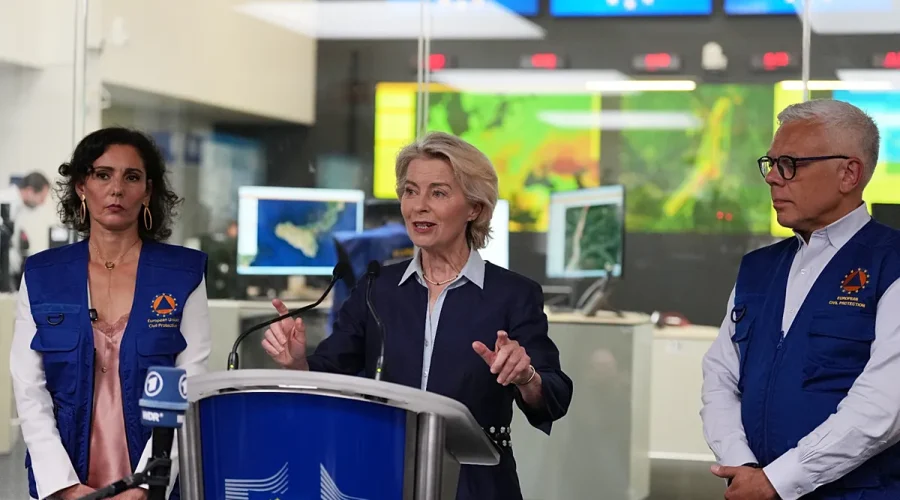
Usagevpn.com – An unusually early and ferocious wildfire season has pushed national firefighting services across the continent to their limits, prompting the European Commission to issue a stark warning: the old playbook of reacting to one disaster at a time is no longer adequate. Speaking from the European Emergency Response Centre — the operational nerve centre of the Commission’s civil protection department — President Ursula von der Leyen told reporters on Monday that the bloc must fundamentally recalibrate how it prepares for emergencies in an era defined by overlapping, simultaneous, and increasingly severe crises.
“We must be prepared for a world where extreme events happen more often, in more places, and at the same time.”
The remark came as climate-driven volatility makes extreme weather less predictable and more likely to strike multiple regions at once, overwhelming the capacity of any single member state to respond alone. Von der Leyen acknowledged that the character of disasters is shifting: what once arrived as isolated, manageable incidents now arrives as cascading, concurrent shocks that can saturate national resources within hours.
The Scale of This Summer’s Response
The numbers behind the warning are concrete. Since April, the EU’s mutual-assistance civil protection mechanism has been triggered ten times specifically for wildfire operations. Nearly 800 firefighters were pre-positioned in zones identified as high-risk before the worst of the season peaked, and teams drawn from 25 member states were deployed across affected areas over the summer months. Four distinct heatwaves had already been recorded across Europe by the end of May, setting the stage for the fire conditions that followed.
Humanitarian Aid and Crisis Management Commissioner Hadja Lahbib, standing beside von der Leyen during the briefing, placed a human scale on the disruption: roughly 300,000 people were evacuated from their homes this summer because of wildfire activity.
“We have a good strategy, but we need to step up because climate change is not knocking at the door, it’s inside the room. It’s inside Europe, unfortunately, we are the fastest warming continent.”
A Record-Breaking Burn Area
Commission data puts the total area scorched across the EU this year at more than 600,000 hectares — a figure exceeding twice the long-term average recorded over the preceding two decades. That gap between historical norms and current reality is precisely what von der Leyen cited as evidence that the continent’s preparedness architecture, built around episodic, single-event assumptions, is now structurally mismatched to the threat environment.
Budget Tensions Complicate the Response
The push for greater upfront investment collides with a fiscal climate in which several member states are pressing to shrink the EU’s proposed long-term budget for 2027–2034. Germany, Austria, Denmark, Finland, the Netherlands, and Sweden have all signalled intent to trim the envelope, and negotiations over the multiannual framework are resuming under that pressure. For Brussels, the argument is straightforward: the cost of prevention is a fraction of the cost of repeated reconstruction.
Climate Action Commissioner Wopke Hoekstra, in a recent interview, conceded the tightness of public finances but insisted the arithmetic favours early spending.
“All evidence shows that making the upfront investments is way cheaper than just being hit by fire, being hit by floods and then paying for the damage. That’s just way more costly.”
From Single-Event Planning to Simultaneous-Crisis Architecture
Beyond the fiscal debate, the Commission is quietly reshaping its civil-protection doctrine. The old model assumed one disaster at a time — a flood here, a quake there — with resources mobilised after the fact. The new model plans for multiple crises unfolding concurrently: a wildfire in the south while a flood crests in the north, while a cyberattack degrades grid management systems, while sabotage targets an energy interconnector or a hospital’s supply chain. These “hybrid” threats can fracture everyday life without resembling a conventional military strike, yet they compound each other and multiply the load on emergency services.
The Commission’s stated aim is to ensure that lessons extracted from each crisis feed directly into earlier intervention and stronger preparedness, rather than remaining post-hoc reports filed away.
The Eastern Flank Dimension
The simultaneous-crisis framing also intersects with security concerns along the EU’s eastern border. Commissioners from Eastern Flank member states have recently urged von der Leyen to take urgent steps against growing Russian pressure on the Baltic states, including the creation of a dedicated high-level coordinator for the region. In that context, civil-protection resilience is no longer purely a climate question; it is also a question of whether hospitals, energy networks, and communication systems can withstand deliberate disruption while natural disasters are already straining them.
Household Resilience: The 72-Hour Standard
In March 2025, Lahbib had already flagged the need for stronger inter-state coordination, larger emergency reserves, and a more resilient population. Among the measures she outlined was practical guidance for households to sustain themselves independently for at least 72 hours — a benchmark drawn from international disaster-management practice — so that when simultaneous crises saturate professional responders, ordinary families are not left entirely without means of survival.
The message from Brussels, delivered against the backdrop of a summer that burned more land than two decades of averages combined, is unambiguous: the continent’s next generation of civil-protection planning must assume concurrency, not sequence, as the default scenario.
Related Reading
Frequently Asked Questions
What is Europe must prepare for a new era?
Europe must prepare for a new era is the main topic of this guide. The article explains the context, practical details, and next steps readers should understand.
Why does Europe must prepare for a new era matter?
Europe must prepare for a new era matters because readers are looking for a useful answer, not just a short summary. Good content should match search intent and help them decide what to do next.