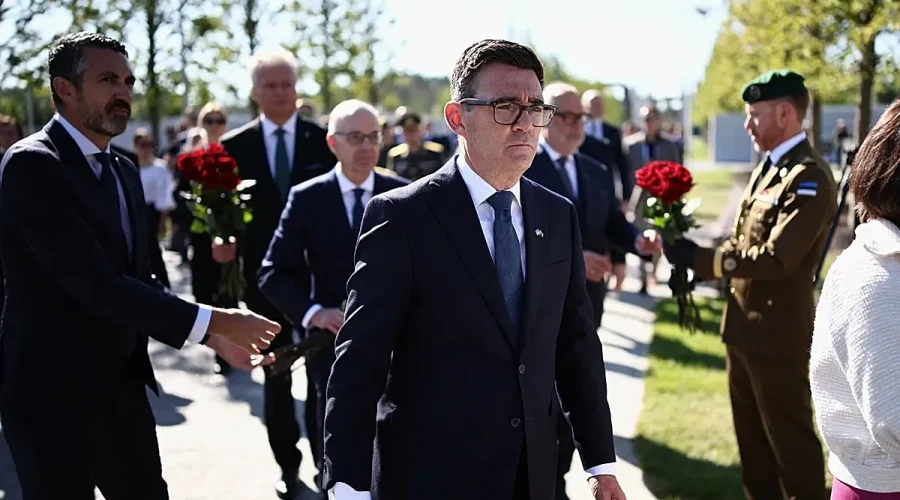
UK Leader Urges Greater Ambition in Rebuilding European Ties Ahead of Kyiv Summit
Usagevpn.com – Britain’s prime minister has called for a more assertive posture in re-engaging with the European Union, signalling that London wants to accelerate cooperation across defence, trade, and broader policy domains. The remarks came during a high-profile bilateral encounter with European Council President António Costa, held aboard a train en route to Kyiv on Sunday evening, just hours before the pair arrived in the Ukrainian capital to observe the country’s Independence Day celebrations on Monday.
A Train-Board Conversation with European Leadership
The setting was unusual for a summit-level dialogue: two heads of state and government discussing the architecture of trans-Atlantic and intra-European security while wheels rolled westward toward Ukraine’s capital. A Downing Street spokeswoman confirmed the substance of the exchange, noting that Burnham told Costa the United Kingdom needed to push harder toward deeper institutional alignment with the bloc.
“The UK had to be bolder in terms of getting closer to the bloc,” Burnham told Costa during the journey, a Downing Street spokeswoman said.
He elaborated that this ambition encompassed expanding the already-substantial defence and security partnerships between London and its European allies, extending cooperation into every facet of the bilateral relationship. The two leaders also concurred that a UK-EU summit already scheduled for later this year would serve as a natural forum to advance that agenda.
Two Years of Post-Brexit Repair Work
The push to mend London’s ties with Brussels has been a defining foreign-policy project for the past two years. After the fractious aftermath of the 2016 referendum, successive governments have worked to move beyond the acrimony that defined the early post-Brexit period. Former prime minister Keir Starmer, who framed his foreign policy around placing Britain “at the heart of Europe,” negotiated what he termed a Brexit “reset” with Brussels in 2025, promising to cut through layers of regulatory friction and administrative overhead that had accumulated since the transition period ended.
Yet the reset has progressed unevenly. Officials on both sides acknowledge that substantive disagreements persist, and the pace of implementation has disappointed those who expected faster results. A proposed youth mobility scheme — designed to restore the free movement of young workers and students that ended with Brexit — has proved especially contentious, with EU member states raising concerns about labour-market effects and reciprocity. Negotiations that were slated to resume in July were shelved when a planned summit was postponed following Starmer’s departure from office.
Burnham’s Evolving Stance on Rejoining
The current prime minister’s relationship with the question of full EU membership has shifted over time. Earlier in his political career, Burnham — a former mayor of Greater Manchester — publicly advocated that Britain should seek to rejoin the Union. Yet during his campaign for the Makerfield by-election earlier this year, he walked back that position, arguing the political moment was not ripe for reopening the question.
“My view is that Brexit has been damaging,” Burnham said in May. “But I also believe the last thing we should do right now is re-run those arguments.”
That calibrated position — acknowledging the referendum’s costs while declining to relitigate it — appears to underpin his current strategy of deepening practical cooperation without formally reopening accession talks. The “bolder” language used on the train to Kyiv thus signals an intensification of existing engagement rather than a wholesale policy reversal.
Kyiv: Solidarity and the £25 Billion Commitment
This week marks Burnham’s first international trip as prime minister. In Kyiv, he is scheduled to meet President Volodymyr Zelenskyy and deliver a public address reaffirming Britain’s commitment to Ukraine’s defence against Russia’s full-scale invasion, which began in February 2022. Speaking from the capital on Monday, he directed his remarks personally to the Ukrainian people.
“We are with you in this struggle all the way heart and soul,” he said. “And as prime minister, let me say that I am with you personally.”
Since Moscow launched its full-scale invasion in February 2022, the United Kingdom has delivered a broad package of military hardware, economic sanctions, and financial aid to Kyiv. London has committed £25 billion in funding across defence, humanitarian, and reconstruction programmes, making it one of Ukraine’s largest bilateral donors. The defence and security ties Burnham referenced on the train — joint exercises, intelligence sharing, and arms supply chains — form a substantial part of that package and represent the most advanced dimension of UK-EU cooperation today.
For European policymakers watching from Brussels and beyond, the message from the train corridor is clear: London intends to convert the post-reset momentum into concrete institutional depth before the year’s UK-EU summit, while simultaneously demonstrating that British leadership in European security remains undiminished by its non-member status. Whether that ambition translates into measurable progress on the youth mobility file and other sticking points will be the test in the months ahead.
Related Reading
Frequently Asked Questions
What is Britain must be bolder in seeking?
Britain must be bolder in seeking is the main topic of this guide. The article explains the context, practical details, and next steps readers should understand.
Why does Britain must be bolder in seeking matter?
Britain must be bolder in seeking matters because readers are looking for a useful answer, not just a short summary. Good content should match search intent and help them decide what to do next.