Spain train crash investigation focuses on 17-minute chain of events
Usagevpn.com – A devastating collision on Spain’s Madrid–Seville high-speed railway has left at least 69 people dead and more than 100 injured, placing renewed scrutiny on signalling safeguards and decisions made at the national rail control centre.
The crash happened at 8:53 am on Wednesday 28 October near Urda, in the central province of Toledo. Renfe’s AVE 2080 struck the rear of Iryo service 6076, which was stopped on the same track at kilometre 118 of the line.
The disaster is Spain’s second major high-speed rail tragedy in less than a year. A crash at Adamuz, in Córdoba province, killed 46 people in January 2026. The latest accident has intensified questions about how a line designed for fast, closely managed rail traffic could permit two trains to remain on a collision course.
Signal failure disrupted the line
The first problem emerged at roughly 8:30 am, when an IT malfunction interrupted communications over around 63 kilometres of the Madrid–Seville route. The failure disabled the LZB safety system, which exchanges information between trains and railway infrastructure to supervise movements and preserve safe separation.
Six trains were affected and either stopped or changed speed. Iryo 6076 had 147 passengers on board, including a baby. AVE 2080 was carrying 397 passengers.
LZB has operated on the route since the line opened in the 1990s. It is expected to be replaced by the newer European Rail Traffic Management System, known as ERTMS. Yet the outage itself is not considered a complete explanation for the crash, because rail operating procedures provide alternative methods for controlling traffic when the principal signalling equipment is unavailable.
The central issue is whether those backup protections were used correctly and whether the information available to controllers was acted on quickly enough.
Permission to continue
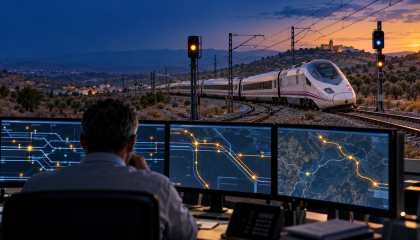
At 8:36 am, an Adif controller at Madrid’s Atocha station authorised the AVE driver to continue under the lineside signalling block, or BSL, system. The order permitted normal running despite the LZB outage. The driver sought confirmation, and the controller confirmed the instruction.
That wording now appears critical to the investigation. A train operating under “driving on sight” rules must travel at a speed that lets its driver stop before an obstruction. In this situation, the maximum permitted speed would have been 40 kilometres per hour.
Normal running, by contrast, allowed the AVE to proceed far faster. The train travelled about 25 kilometres after receiving clearance before it struck the stationary Iryo service.
“Inexplicable”
Transport Minister Óscar Puente used that word to describe the control centre’s decision, arguing that the AVE should not have been allowed to resume its journey in those circumstances.
The timeline before impact
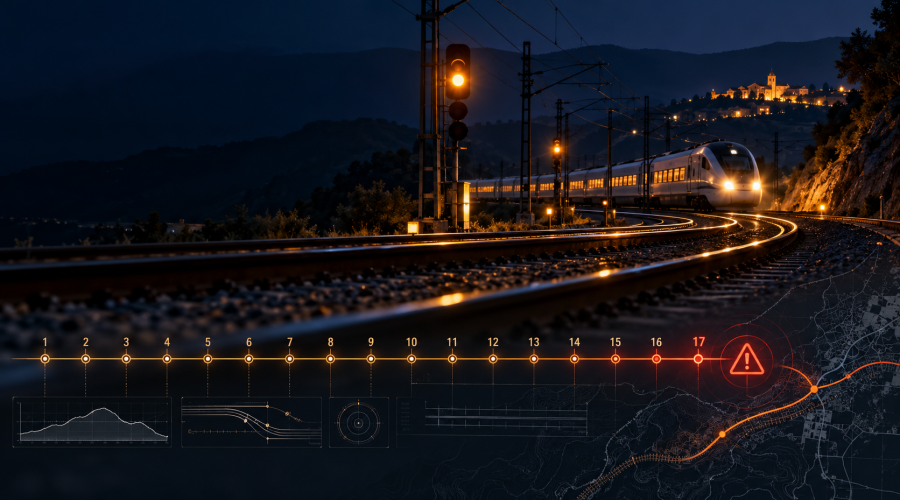
Events unfolded rapidly after the communications fault began. At 8:30 am, the computer problem brought down LZB supervision and forced several trains on the high-speed line to halt.
Six minutes later, AVE 2080 was cleared through the BSL arrangement and permitted to continue normally.
At 8:41 am, the Iryo driver informed the Atocha control centre that her train was still stopped near Urda because transmission had been lost. She too was granted permission to proceed.
Seven minutes later, at 8:48 am, the Iryo driver contacted the control centre again. She said she could not restart the LZB system and that the train remained at a standstill. No instruction for the AVE to stop has emerged from the communications released so far.
Five minutes after that warning, at 8:53 am, the AVE hit the rear of the Iryo train.
Questions for the technical and judicial inquiries
Investigators are expected to examine the recorded communications, traffic-management logs and black-box information from both trains. These records should help establish what controllers knew at each stage, what instructions were issued, and whether operating procedures were followed after the LZB system failed.
The key question is why the AVE was not told to reduce speed or stop once the control centre had been notified that the Iryo train could not restart and was still occupying the route ahead.
The government has initially raised the possibility of human error at Adif’s control centre, though responsibility has not been determined. The inquiry must also clarify whether staff had complete and timely information, whether the BSL procedure was applied appropriately, and whether other safeguards should have prevented both trains from entering the same section of track.
High-speed lines depend on continuous coordination between drivers, signalling equipment and control centres. When automated supervision fails, the remaining layers of protection become especially important. The outcome of this investigation will therefore extend beyond the immediate decisions made near Urda, testing the resilience of emergency procedures on one of Spain’s most important rail corridors.
Related Reading
Frequently Asked Questions
What is Spain train crash?
Spain train crash is the main topic of this guide. The article explains the context, practical details, and next steps readers should understand.
Why does Spain train crash matter?
Spain train crash matters because readers are looking for a useful answer, not just a short summary. Good content should match search intent and help them decide what to do next.