Oil tanker fire raises fresh alarm in Strait of Hormuz
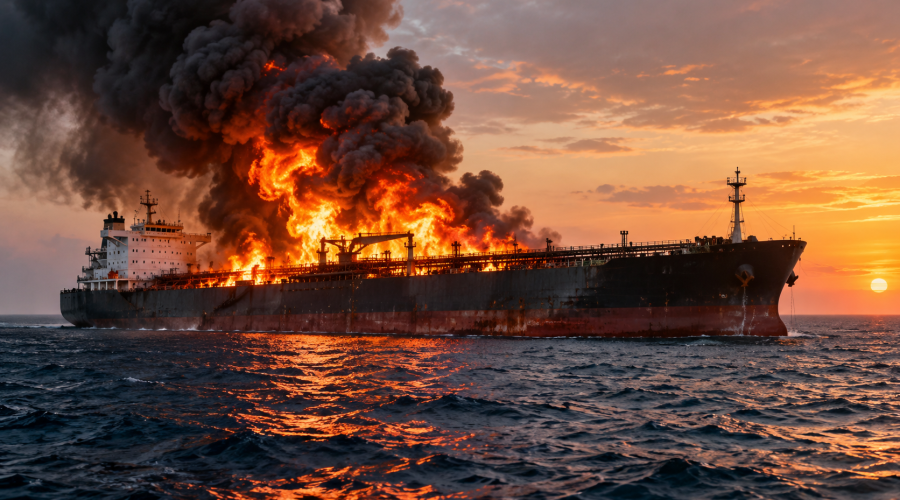
Usagevpn.com – A tanker carrying more than two million barrels of oil caught fire after hitting a sea mine in the Strait of Hormuz on Saturday, as tensions over passage through one of the world’s most important energy waterways continue to intensify.
Iran’s Revolutionary Guard Corps said its naval arm was involved in monitoring the incident and described the blast as severe. The vessel had been trying to use what the IRGC called an unauthorised route through the Strait when the mine detonated, triggering a large explosion and a major fire.
The precise location of the strike has not been clarified. Images circulated by Iran’s Fars news agency appeared to show a ship burning at sea, though further details about the tanker, its crew, its flag or the extent of the damage were not immediately available.
Iran alleges vessel attempted to avoid detection
In its statement, the IRGC navy accused the tanker of disabling its positioning equipment and radar in an apparent attempt to pass without being detected. The allegation could not be independently verified.
The Guard used the episode to reinforce its position that shipping in the Strait must comply with Iranian rules. Its statement also repeated Iran’s assertion that the waterway is closed.
The Strait of Hormuz is closed, and the consequence of defying Iranian regulations in the Strait of Hormuz is burning in the fire of trust in the terrorist US army,
The wording reflects the sharply conflicting messages coming from Tehran and Washington over control and access in the narrow maritime passage. For commercial operators, the dispute adds uncertainty to a route that is central to the movement of crude oil and liquefied gas between Gulf producers and global markets.
A strategic route at the centre of the conflict
The Strait of Hormuz links the Persian Gulf with the Gulf of Oman and the wider Arabian Sea. It is a vital transit corridor for energy exports, with roughly one quarter of global seaborne oil trade normally moving through the passage.
That importance means disruption in the Strait can have consequences well beyond the immediate area. Tanker traffic supports supply chains reaching Asia, Europe and other markets, while any sustained impediment to shipping can heighten concerns over oil availability, insurance costs and the safety of crews at sea.
The waterway has become a focal point of confrontation between Iran and the United States since the Iran war began in late February. Iran effectively restricted passage after US and Israeli strikes on the country. The United States subsequently imposed a naval blockade on Iranian ports.
Saturday’s tanker fire illustrates the danger facing vessels attempting to navigate a militarised environment where competing authorities are issuing opposing directions. A sea mine presents a particular threat because it can damage a ship without a direct encounter between naval forces, creating serious risks for crews, cargoes and nearby traffic.
Washington rejects Tehran’s claim of control
The US military has consistently rejected Iranian statements that the IRGC controls the Strait. American officials have said commercial shipping has continued to move through the region despite what they describe as unjustified aggression by the Guard.
Admiral Brad Cooper, who leads US Central Command, said on Friday that American forces were coordinating with regional allies and shipping-industry partners to support vessels using the route. His remarks were intended to reassure commercial operators that the United States and its partners remain engaged in protecting maritime traffic.
Let me be clear, the Strait of Hormuz is controlled by the United States and our regional partners, not Iran,
It remains open for business.
Those statements stand in direct contrast to the IRGC’s declaration that the waterway is shut. The disagreement is more than rhetorical: it leaves shipowners, charterers and crews confronting potentially incompatible demands while attempting to move through a confined and strategically sensitive area.
Safety concerns for commercial shipping
The immediate priority following the fire will be determining the condition of the tanker and the people aboard it. The information released so far does not establish whether there were casualties, whether assistance reached the vessel, or whether oil was released into the sea.
It also remains unclear how the tanker came into contact with the mine and whether other vessels may face similar hazards. Navigation in the Strait normally depends on predictable routes, functioning communication systems and close coordination among vessels. Allegations that a ship’s tracking and radar systems were switched off underscore the operational dangers surrounding passage through the area.
For crews, the incident is a reminder that the Strait’s commercial role does not remove the risks created by regional conflict. Tankers passing through the corridor carry large volumes of fuel, making even a single accident or attack potentially hazardous for personnel, shipping operations and the marine environment.
With Iran insisting on restrictions and the United States maintaining that the route remains open, commercial traffic now faces an unstable picture. Saturday’s blaze adds another urgent warning that the contest over the Strait of Hormuz is playing out not only through political statements and military deployments, but also in the safety of ships attempting to cross one of the world’s most consequential maritime chokepoints.
Related Reading
Frequently Asked Questions
What is Super tanker ablaze after striking mine?
Super tanker ablaze after striking mine is the main topic of this guide. The article explains the context, practical details, and next steps readers should understand.
Why does Super tanker ablaze after striking mine matter?
Super tanker ablaze after striking mine matters because readers are looking for a useful answer, not just a short summary. Good content should match search intent and help them decide what to do next.