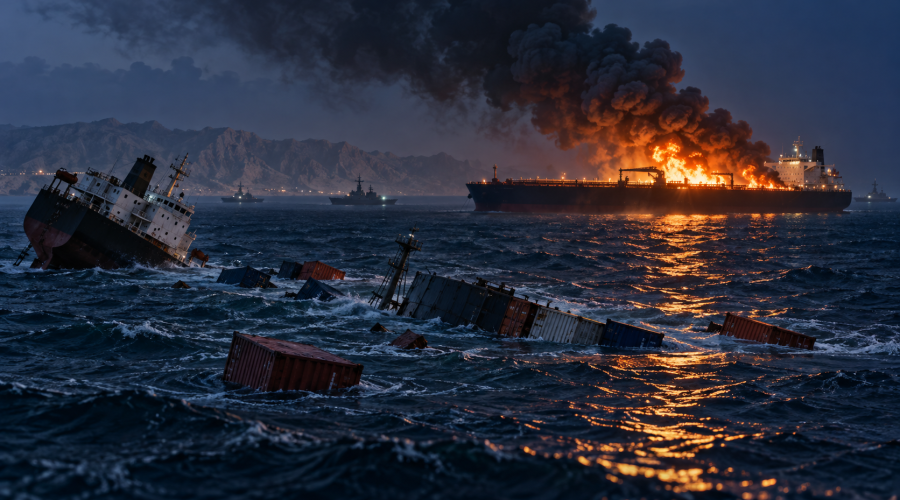
Another tanker catches fire near Hormuz amid shipping attacks
Usagevpn.com – Another tanker catches fire near Hormuz as disruption deepens around one of the world’s most important shipping routes. An oil tanker was seen burning in the Gulf of Oman on Thursday after entering an area designated by Iran’s navy as restricted while its tracking equipment was switched off.
The incident was the second tanker fire near the Strait of Hormuz within 24 hours. It followed the sinking of two commercial vessels in nearby waters, raising fresh concerns about the danger to crews and cargo passing through the region.
Details of the latest tanker fire remain unclear
Iranian naval monitoring teams patrolling the eastern side of the Strait of Hormuz detected the vessel inside the prohibited zone. Its identity, flag, cargo and the condition of people on board were not immediately known, and authorities had not confirmed what caused the fire.
The earlier blaze on Wednesday also involved a tanker near the strait whose tracking systems had been disabled. Another tanker catches fire near Hormuz under similar circumstances, intensifying scrutiny of vessels that stop transmitting their position in a highly volatile area.
Two cargo ships sank after separate incidents
On Wednesday, the container ship GFS Pride sank after a fire broke out on board. All 21 crew members were rescued. Iran’s Islamic Revolutionary Guard Corps said the vessel had struck a sea mine, while maritime sources said it had been damaged by an unidentified projectile.
A second cargo ship, the Cape Dao, later sank after previously being hit by a projectile. One crew member died during the initial attack.
Videos circulating online appeared to show floating containers, debris, mobile phones and luxury goods near the Strait of Hormuz, with people in small boats collecting items from the water. The footage could not be independently verified.
US Central Command, which oversees American military operations in the region, had not publicly commented on Thursday’s tanker fire by the time of publication.
Why the Strait of Hormuz matters
The Strait of Hormuz connects the Gulf with the Gulf of Oman and the Arabian Sea. Its narrow shipping lanes make it a vital passage for global energy supplies and international trade, meaning even short disruptions can have far-reaching consequences.
Iran’s Revolutionary Guard declared waters approaching the strait a prohibited zone in September, after comments by Mohsen Rezaei, secretary of the Supreme National Security Council. IRGC spokesman Hossein Mohbi said the zone covered parts of the Gulf of Oman and Arabian Sea leading towards the passage.
“Smart control”
Ali Azmayi, commander of the IRGC naval force, said Tehran exercises what he described as “smart control” over the strait and requires ships to obtain permission to transit. His comments followed US statements that the route remains open and under Washington’s control.
Iran has warned that vessels violating rules in the designated waters could face penalties. Tracking transponders are especially significant because they help identify vessels and establish their movements; when they are switched off, uncertainty rises for nearby ships and emergency responders.
FAQ: Shipping risks near Hormuz
What is known about the tanker fire?
Another tanker catches fire near Hormuz, but authorities had not immediately identified the vessel or confirmed its flag, cargo, crew status or the cause of the blaze.
Is the Strait of Hormuz closed?
Tehran declared the strait closed in late February, at the start of the war with the United States. Washington later imposed its own naval blockade around the waterway.
Why are vessels at greater risk in the area?
Recent fires, projectile strikes and ship sinkings have created severe uncertainty for commercial navigation. Operators and crews face urgent questions over safe passage, applicable restrictions and access to assistance during an emergency.