Ukraine’s Lyman Counter-Offensive Disrupts Russian Donbas Strategy
Usagevpn.com – Ukraine has blunted a major Russian effort to tighten control over the Donetsk region, disrupting a planned manoeuvre that sought to surround the remaining Ukrainian-held areas of the Donbas. An assessment by the Washington-based Institute for the Study of War, drawing largely on open-source intelligence, describes the outcome as a serious operational setback for Moscow.
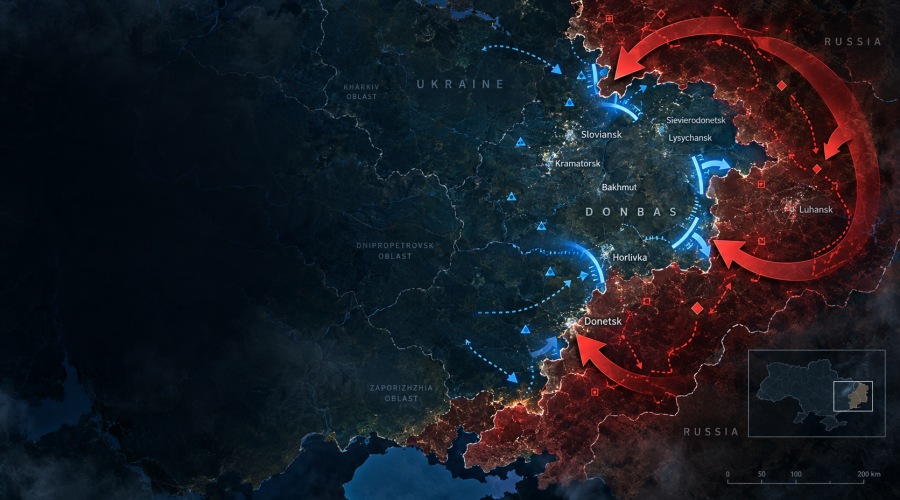
The Russian objective centred on a large pincer movement aimed at Ukraine’s defensive “fortress belt,” the network of fortified positions, towns and supply links that supports Ukrainian control of parts of Donetsk region. One axis pushed southward from the Lyman area, while another moved from the Pokrovsk-Dobropillia direction in the south-west. The intended meeting point was near Barvinkove in neighbouring Kharkiv region.
Had the two thrusts joined, Russia would have been much closer to enclosing Ukrainian forces defending the Donbas. Such an outcome would also have supported the Kremlin’s long-running goal of seizing the whole of Donetsk region and offered a visible territorial result to present to the Russian public after the costs of the war.
Operation Vivaldi Breaks the Northern Arm
Ukraine’s response on the Lyman axis, known as Operation Vivaldi, struck at the northern side of the Russian plan. Ukrainian troops advanced along the Ridkodub-Nove-Novomykhailivka line in the north and the Yarova-Drobysheve-Stavky line farther south.
Those operations removed a Russian salient that had posed a threat to Sloviansk from the north-east. Russian units were compelled to shift into defensive positions, while the planned advance towards Sloviansk from that direction was effectively abandoned.
Andrii Biletskyi, commander of Ukraine’s 3rd Army Corps, said the operation’s first three stages, conducted from the middle to the end of September, recovered 176 square kilometres. President Volodymyr Zelenskyy later gave a lower range of 125 to 140 square kilometres as of 3 October. He also said Russian losses had risen markedly during the previous two to three months.
The Institute for the Study of War indicated that the operation’s effect may extend beyond the publicly stated Ukrainian territorial figures. Beyond reclaiming ground, Kyiv’s forces preserved their hold on the Lyman area and the supply routes that run through it. Maintaining those routes is important because the wider defensive system in the Donbas depends on the ability to reinforce positions, move equipment and sustain troops under pressure.
A Harder Task for Russia’s Remaining Advance
The failure of the northern thrust leaves Russia’s south-western drive from the Pokrovsk-Dobropillia sector as the remaining part of the original encirclement concept. That force now faces a considerably more demanding task: pursuing wider objectives without the northern axis that was meant to share pressure on Ukrainian defences.
Russian troops still hold limited gains near Kostyantynivka and east of Sloviansk. However, they have had difficulty keeping up momentum in both areas. The assessment argues that Russia’s current approach can impose attritional pressure, but is poorly suited to producing the rapid, large-scale manoeuvre needed to break Ukrainian defences across the entire fortress belt.
Russian tactics have heavily relied on infantry infiltration, drone strikes and bombardment. These methods can gradually erode positions and force difficult local decisions, yet they do not easily create the fast mechanised breakthroughs necessary for a sweeping encirclement. The difference matters: taking isolated positions over time is not the same as severing the supply and movement routes of a broad defensive system.
Russian formations elsewhere along the front may also have been pulled towards the northern sector in response to the Ukrainian counter-offensive. If so, the need to reinforce Lyman would have added further strain to Moscow’s ability to sustain simultaneous offensive efforts.
Conflicting Claims Over September’s Territorial Changes
The assessment also disputed widely circulated Russian claims that Moscow’s forces captured another 1,301 square kilometres of Ukrainian territory during September, a figure roughly two and a half times greater than totals cited in earlier months.
Using geolocated photographs and videos, satellite imagery and visually confirmed information, the institute concluded that Russian assault units were forced out of at least 80 square kilometres in September. It calculated Russia’s net territorial retreat for the month at 175.18 square kilometres, a total that includes locations Russian troops briefly entered but failed to retain.
The gap between public assertions and battlefield evidence is especially stark in Donetsk region. Vladimir Putin told the Valdai Club last week that Russia controlled 89% of the region. The institute estimated Russian-held territory there at no more than 81%.
“So far removed from reality that they resemble hallucinations.”
That was the institute’s description of Putin’s statements about Russian breakthroughs in September. It said it could not determine whether Putin is aware that the figures are inaccurate or whether he has accepted distorted frontline information supplied by military structures. The assessment linked the problem to a deeply rooted culture of dishonesty within the Russian command system.
A Fluid Frontline, but a Pause in Russia’s Advance
The situation around Lyman and the wider Donbas remains changeable. Russian forces are likely to alter their methods, shift resources and search for new ways to regain momentum. A further mobilisation drive or technological changes could affect the balance of fighting, although neither development would automatically produce the breakthrough Moscow has sought.
For now, Operation Vivaldi appears to have halted a plan that could have placed Ukraine’s remaining Donetsk defences under much greater pressure. The immediate significance lies not only in the territory recovered, but in the disruption of a larger campaign design: Russia has lost ground around Lyman and, with it, a key element of its attempted encirclement of the fortress belt.
Related Reading
Frequently Asked Questions
What is Ukraine s Operation Vivaldi foils Russia?
Ukraine s Operation Vivaldi foils Russia is the main topic of this guide. The article explains the context, practical details, and next steps readers should understand.
Why does Ukraine s Operation Vivaldi foils Russia matter?
Ukraine s Operation Vivaldi foils Russia matters because readers are looking for a useful answer, not just a short summary. Good content should match search intent and help them decide what to do next.