Madrid housing protest draws vast crowds after parliamentary setback
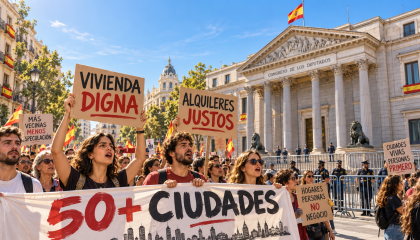
Usagevpn.com – Spain’s housing crisis moved back to the centre of political debate on Saturday as large demonstrations unfolded across the country, led by tenants and housing campaigners demanding lower rents, stronger protections and a broader change in housing policy.
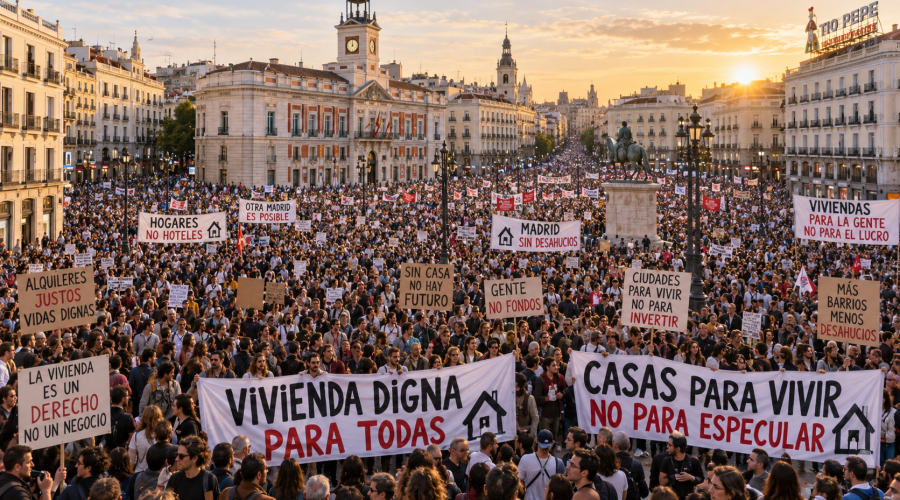
In Madrid, organisers said close to 500,000 people joined the march, while authorities estimated attendance at roughly 70,000. The capital’s demonstration followed a week-long protest camp in Puerta del Sol, one of Madrid’s best-known central squares and a major tourist destination.
Marchers carried signs calling for a “General strike” and shouted “Down with rentierism” as they moved through the city. The gathering remained peaceful despite a substantial police deployment.
Tenants’ groups push for deeper reforms
The protests came one day after Congress rejected two government housing decrees intended to improve tenant protections. The first proposal was defeated by 178 votes to 172, while the second failed by 184 votes to 166.
The People’s Party, Vox and UPN voted against the measures, while Junts declined to support them. The votes intensified pressure on Prime Minister Pedro Sánchez, who has begun considering whether to call an early election, a decision that lies solely with him.
“There is an irreparable disconnect between what the people want and what the parties vote for.”
The statement from the Tenants’ Union, which is coordinating much of the mobilisation, captured the anger expressed by protesters after the legislative defeat. The group is calling for rents to be reduced by 50%, permanent rental contracts and the expropriation of homes owned by vulture funds.
Its spokesperson, Valeria Racu, said no date has yet been fixed for a general strike. Discussions are continuing with other organisations, with the aim of making any strike “historic”.
Antonio Garamendi, president of the CEOE employers’ confederation, said he respected the demonstrations but warned that his organisation would respond if a general strike were called. He considers such action “illegal”.
Protests spread from Madrid to the islands
Housing rallies were held in numerous Spanish cities. In Valencia, protesters marched toward the Palau de les Arts Reina Sofía, the venue for the Valencia Real Estate Summit 2026, a property investment event featuring former Ciudadanos leader Albert Rivera among its speakers.
The Valencia protest became more confrontational than the march in Madrid. Some demonstrators removed barriers and pushed through a police cordon before throwing objects at officers. Police used rubber bullets and tear gas, and several people reached an upper section of the building.
Four groups called the Valencia march, including the Tenants’ Union and the Housing Union. Demonstrations were also held elsewhere, showing that concerns over access to affordable housing extend far beyond the capital.
In Donostia, protesters entered a second consecutive day of action. The LAB union called the mobilisation with support from the Tenants’ Union. Cádiz also saw a march ending at City Hall, where participants read a manifesto. Organisers there highlighted the strain on residents, saying average rents stand at about €900 while the price of buying a home reaches €200,000.
Further marches took place in Las Palmas de Gran Canaria, while rallies were held on Lanzarote, Fuerteventura and Tenerife. Teruel is due to join the nationwide campaign on Sunday with a demonstration beginning at Plaza del Torico at 18:30.
Sol encampment remains a symbol of the movement
In Barcelona, camp participant Luana Rocha said the intention was to remain in place indefinitely as organisers work toward a wider industrial action.
“We are heading towards a general strike”.
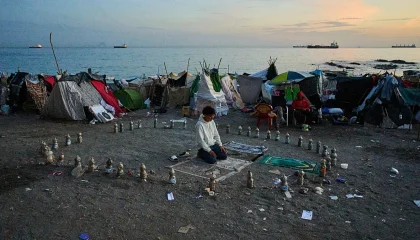
Madrid’s Sol encampment reached its seventh night with around 2,000 people present. The camp began after the eviction of Maricarmen Abascal, an 87-year-old woman who was removed from her home on a stretcher and is recovering in hospital.
Housing activists say an investment company purchased the property where Abascal had lived for about seven decades and attempted to raise her rent by 275%. Following public backlash, the new owners agreed that she could return under a low-rent arrangement.
Her case has become a potent illustration for campaigners who argue that older residents, low-income households and long-term tenants are increasingly vulnerable when homes change hands. The demands voiced in the streets focus not only on individual evictions, but also on the broader effect of rising rents and investment-driven property ownership on neighbourhood stability.
Political pressure grows after failed decrees
The rejection of the housing measures has sharpened divisions among Spain’s political parties. Sánchez ended his speech in Congress with a warning to those who opposed the decrees.
“History will judge you sooner than you think and more harshly than you imagine”.
Opposition parties have renewed calls for an election, and the prospect is also gaining support among some PSOE leaders and ministers. Junts, however, has urged the PSOE to negotiate instead of moving directly toward a new vote.
Junts spokesperson Míriam Nogueras described the rejected measures as “a poorly drafted law”. The party’s secretary general, Jordi Turull, said the proposals could have “discouraged” property sales. PSOE representatives responded that the text already contained Junts’ ideas, asking: “What more do they want?”
Deputy Prime Minister Yolanda Díaz placed responsibility for evictions on opposition figures, saying they “have three names”: Feijóo, Abascal and Nogueras. PP leader Alberto Núñez Feijóo, meanwhile, said he would seek a legal mechanism to prevent another term from passing without a budget.
For demonstrators, the parliamentary arguments have reinforced a sense that housing has become an urgent national issue. Whether the street protests develop into a general strike may depend on the ability of tenants’ organisations, unions and other groups to convert that frustration into sustained action in the weeks ahead.
Related Reading
Frequently Asked Questions
What is Nearly 500 000 people protest in Madrid?
Nearly 500 000 people protest in Madrid is the main topic of this guide. The article explains the context, practical details, and next steps readers should understand.
Why does Nearly 500 000 people protest in Madrid matter?
Nearly 500 000 people protest in Madrid matters because readers are looking for a useful answer, not just a short summary. Good content should match search intent and help them decide what to do next.