China launches EU chemical dumping inquiry ahead of Beijing trade meetings
Usagevpn.com – China has begun an anti-dumping investigation into a chemical imported from the European Union just days before senior EU and Chinese officials are due to meet in Beijing, adding pressure to already tense trade relations between the two sides.
The Chinese commerce ministry announced on Saturday that it will investigate imports of p-nitrotoluene from the EU. The compound is used in the production of dyes, medicines and pesticides. Chinese producers requested the inquiry, arguing that low-priced European shipments are affecting their ability to operate and manufacture competitively.
“Damage to production and operations”.
The investigation is scheduled to be completed within 12 months, although Chinese authorities may prolong it for a further six months if necessary. Its launch comes amid wider disagreement over market access, industrial policy and the sharp imbalance in trade between Brussels and Beijing.
Trade defence measures become a central issue
Anti-dumping procedures are a common trade-defence mechanism. They examine whether an exporter is selling goods abroad at a lower price than in its domestic market, or below the cost of producing them. If authorities determine that such pricing has harmed local industry, World Trade Organization rules permit the importing country to impose additional tariffs, known as anti-dumping duties.
The EU has increasingly relied on such investigations as imports from China have expanded. In September, Brussels opened an inquiry into polyvinyl chloride imports from several countries, including China. That move followed a period in which the bloc has used trade-defence tools at a much higher rate than usual.
European Commission President Ursula von der Leyen said in August that the EU had launched 30 trade-defence investigations over the preceding year, almost three times the normal pace. She linked the heightened activity to Chinese imports increasing by 45% over five years.
Beijing rejects the suggestion that Chinese companies are competitive because of state backing. It has also signalled that additional EU action aimed at limiting Chinese businesses or goods could bring retaliatory steps from China.
“China has repeatedly reiterated that the EU needs to face its own economic and trade problems directly and resolve mutual concerns through dialogue and consultation,” the spokesperson said.
Sefčovič visit faces a demanding deadline
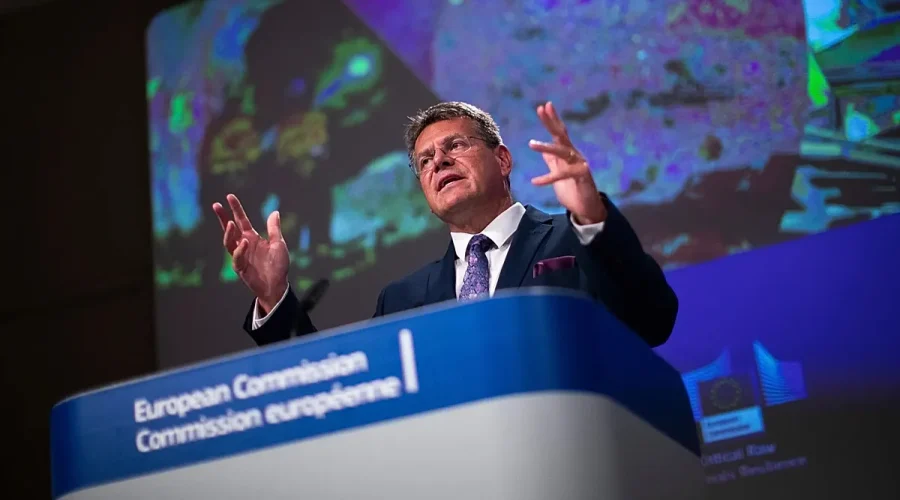
The new inquiry arrives shortly before EU Trade Commissioner Maroš Sefčovič travels to Beijing on 8 and 9 October. He is expected to co-chair a meeting of the EU-China Trade and Investment Council and hold talks with China’s Commerce Minister Wang Wentao.
For Brussels, the visit is more than a routine diplomatic engagement. It coincides with the deadline set in June for the dialogue with Beijing to produce its first concrete outcomes. EU officials are seeking commitments from China to reduce exports to the European market and to extend a truce involving rare earth exports.
The scale of the challenge is reflected in the EU’s trade deficit with China, which stands at about €1 billion per day. That gap has made trade policy a politically sensitive subject across the bloc, particularly as European industries seek stronger protections against what they view as unfair competitive pressure.
Rare earths are especially important because they are used in a broad range of modern technologies and industrial applications. A continued pause in export-related tensions would therefore offer some reassurance to European companies dependent on reliable supply chains. At the same time, Brussels wants evidence that discussions can lead to measurable changes rather than simply preserve dialogue.
Political consequences could follow
Sefčovič has made clear that the outcome of the Beijing meetings will shape the EU’s next steps. In an interview last month, he described the negotiations as highly political and stressed that they needed to generate real results.
“A strong political movement to push for, I would say, harsher measures”.
He also said that if he returned without a result to present to EU leaders, there would be pressure to pursue alternatives.
“The political interest would be to look for the solution through other instruments”.
EU leaders are scheduled to gather in Brussels on 15 and 16 October, one week after Sefčovič’s Beijing trip. Their meeting could become an important moment for assessing whether the talks have eased tensions or instead strengthened the case for further measures against Chinese imports and companies.
China’s probe into p-nitrotoluene does not by itself decide the larger trade dispute, but its timing is significant. The case places a specific European industrial product under scrutiny while broader negotiations are approaching a critical point. It also illustrates how trade investigations can carry political weight beyond the goods being examined.
Both sides continue to say that dialogue is the preferred route. Yet the growing use of anti-dumping inquiries, the EU’s concerns about its trade deficit and China’s warnings of countermeasures show how limited the room for compromise may be. The Beijing meetings will test whether practical agreements can be reached before the dispute develops into a more damaging cycle of restrictions and responses.
Related Reading
Frequently Asked Questions
What is China opens anti dumping probe into?
China opens anti dumping probe into is the main topic of this guide. The article explains the context, practical details, and next steps readers should understand.
Why does China opens anti dumping probe into matter?
China opens anti dumping probe into matters because readers are looking for a useful answer, not just a short summary. Good content should match search intent and help them decide what to do next.