Ceuta Faces Renewed Pressure After Stabbing and Beach Health Warning
Usagevpn.com – Ceuta is confronting a fresh combination of security, health and accommodation concerns after two migrant minors were injured in a knife incident and authorities issued a warning over contaminated seawater at a beach where an encampment remains.
The stabbing took place on Thursday in the La Marina area during a confrontation involving underage migrants. National Police officers responded to the incident, while emergency medical teams treated the two young people for cuts near their ankles. The episode has added to concern in a city already under intense strain from the arrival of tens of thousands of migrants.
For Ceuta, the immediate challenge extends beyond responding to isolated incidents. The autonomous city must manage the needs of people arriving at its borders while dealing with limited places for those who remain. The shortage of suitable accommodation is increasingly shaping daily life for migrants, local services and nearby communities.
Health concern at Trampolín beach
Authorities have separately identified a potential public-health issue at Trampolín beach. Ceuta’s Department of Health has advised against contact with the water after laboratory analyses found levels of intestinal enterococci and Escherichia coli that exceeded the limits established for coastal bathing waters.
The samples were collected on 23, 25 and 28 September. In its report released on Friday, the department described the concentrations as “very high” and concluded that exposure to the water presents a health risk.
“Very high” concentrations of intestinal enterococci and Escherichia coli were found above the thresholds for coastal waters.
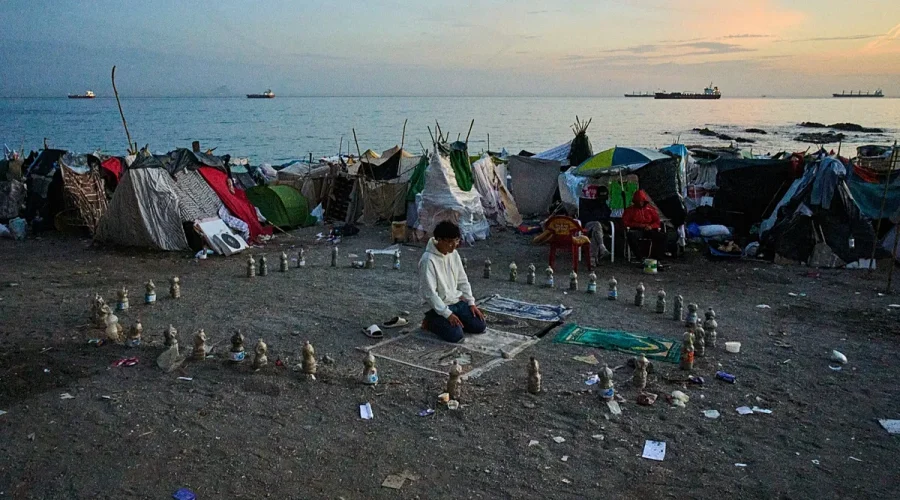
The warning comes while a migrant encampment continues to occupy the area. The presence of the camp and the contamination alert highlight how an emergency that is often discussed in terms of border management also affects public spaces, sanitation and the safety of people living in or passing through the city.
Officials have taken another preventive step at Benítez beach, where fencing is to be installed to stop further encampments from being set up in a bathing zone. The measure reflects the difficulty of balancing access to public areas with the need to prevent conditions that could worsen health or safety problems.
Accommodation shortages drive unsafe arrangements
With formal lodging difficult to secure, some migrants have turned to improvised places to sleep. Garages, cars and vacant vans have been used as temporary overnight shelters. In several neighbourhoods, rooftop spaces are being rented for about 12 euros per night.
Security forces have also found properties being used to accommodate unusually large groups. At one residence described as a “patera flat”, National Police and Civil Guard officers discovered as many as 30 people inside, most of them minors.
These arrangements raise wider concerns about overcrowding, exploitation and the wellbeing of young people who lack stable accommodation. They also underline the gap between the scale of the arrivals and the capacity available to house people safely. A place intended for ordinary residential use can quickly become unsuitable when large numbers of vulnerable people are forced to share it.
Some residents have voiced anger at what they see as people making money from migrants’ urgent need for shelter. Their criticism has focused on the prospect that precarious living conditions are being turned into a source of private profit at a time when many arrivals have few alternatives.
Calls for a coordinated response
The UGT-Ceuta local union has called for greater support for public services and workers facing the effects of the continuing arrivals. It wants the government to provide a coordinated plan capable of protecting service quality while helping the city return to normal functioning.
The union has demanded “sufficient resources” to preserve public-service standards and protect workers.
The request places emphasis on the practical consequences of the emergency: health teams, police, social services and other public employees must respond to immediate needs while maintaining services for the wider population. The pressure is particularly acute when the people requiring assistance include minors, whose care demands safe accommodation and rapid access to medical and welfare support.
Spain’s Ombudsman, Ángel Gabilondo, is visiting Ceuta this week to examine the humanitarian situation directly. His programme includes a meeting with Juan Jesús Vivas, president of the autonomous city, and a visit to Ceuta University Hospital.
The visit is expected to offer a closer view of how the crisis is affecting the city’s institutions and residents. It also brings attention to the overlapping issues now facing Ceuta: violence involving vulnerable young people, a health alert at a public beach, crowded informal housing and growing demands on public services.
As authorities address the immediate risks, the underlying question remains how Ceuta can provide safe, lawful and sustainable arrangements for people who arrive without a place to stay. The incidents of recent days show that delays in meeting basic needs can have consequences far beyond accommodation alone.
Related Reading
Frequently Asked Questions
What is Tension rises in Ceuta?
Tension rises in Ceuta is the main topic of this guide. The article explains the context, practical details, and next steps readers should understand.
Why does Tension rises in Ceuta matter?
Tension rises in Ceuta matters because readers are looking for a useful answer, not just a short summary. Good content should match search intent and help them decide what to do next.