Inside Europe’s Largest Battery Test Centre, Safety Is Put Under Extreme Pressure
Usagevpn.com – In the Lusatian town of Klettwitz in eastern Germany, battery technology is exposed to conditions designed to reveal its limits long before it reaches a vehicle, a home or a renewable-energy site. At DEKRA’s major battery testing centre, engineers subject prototypes to severe cold, intense heat, dust, vibration, crushing forces, water and fire.
The purpose is straightforward: failures are far safer to investigate in a controlled laboratory than after a battery has been installed in a consumer’s garage, an electric vehicle or a large storage facility. Some batteries withstand the punishment, while others may fail dramatically. Every outcome helps manufacturers understand whether a model can meet the requirements for certification.
From Siberian cold to Saharan heat
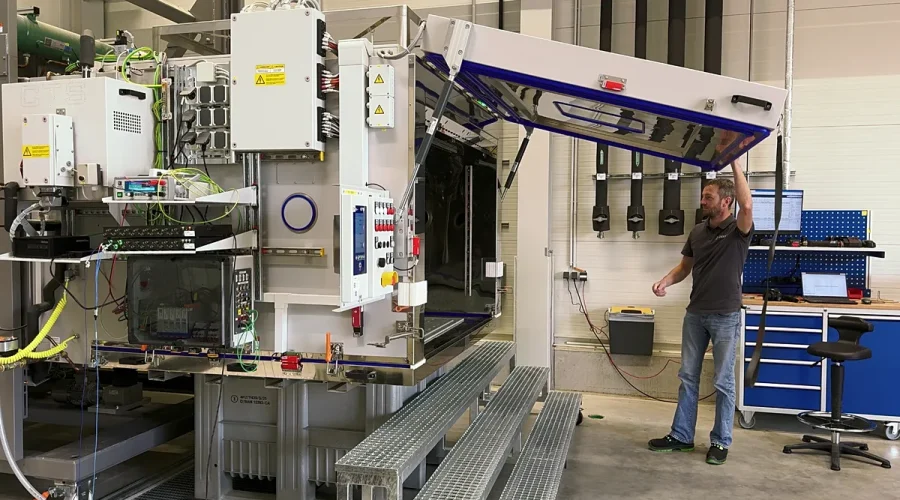
The facility contains a long series of garage-sized test chambers, each assigned to a different kind of examination. Thermometers, warning lights and industrial controls fill the spaces where battery prototypes are pushed through simulated lifetime conditions.
Thomas Hucke, head of DEKRA, describes how the centre recreates demanding climates that batteries may encounter during normal use.
“We’re testing how battery prototypes behave at very low temperatures, or at very high temperatures. From Siberia to the Sahara,” Hucke explains. “In other words, the classic environmental conditions that a battery like this experiences over its lifetime.”
One control setting can bring temperatures down to minus 40 degrees Celsius. Such tests are intended to show how a battery responds at the outer edge of expected operating conditions, where performance, charging behaviour and safety may be challenged.
Dust is another major concern. Batteries intended for specialised uses, including deployment in desert environments, must demonstrate that they can tolerate such exposure before they are approved for sale. DEKRA uses dedicated dust chambers to test whether equipment can keep functioning when fine particles are driven into its surroundings.
Testing batteries beyond electric cars
While electric-vehicle batteries remain an important part of the workload, the centre is increasingly examining large stationary systems. These installations can store electricity produced by wind turbines and solar farms for later use, making them an important element of a wider energy transition.
Some incoming prototypes are commercially sensitive. In one testing hall, staff shielded a newly delivered unit from view, underlining the competitive value of battery designs before they reach the market.
The scale of the buildings reflects the size of the equipment being assessed. Hucke points to tests involving substantial stationary storage systems as well as chambers that recreate the constant movement experienced by batteries in transport.
“We also test very large batteries,” says Hucke, explaining the enormous size of the test hall, “such as stationary energy storage systems, for example.”
Vibration testing examines what could happen when a vehicle travels over a kerb or experiences a mechanical shock. Repeated movement and impacts can affect internal components over time, so the resulting data is documented and sent to manufacturers. A battery is certified only after it satisfies the required stress criteria.
Fire risk and the need for resilient storage
Battery safety matters particularly as electrification expands beyond road transport. Hucke says the transition must be both sustainable and secure, with independent testing helping ensure that technical standards are followed.
“The EU has drawn up a Battery Regulation which sets out the tests that must be carried out on batteries. It’s about sustainability, the value chain, and ultimately, always about safety.”
At the centre’s fire hall, teams recently attempted to ignite an entire battery container. The scenario is relevant for large energy-storage facilities placed near renewable generation sites. As hotter conditions and destructive wildfires become more pressing risks in parts of Europe, planners need to understand whether a storage unit can endure a nearby blaze up to specified temperatures.
Testing also addresses accidents, incorrect charging and improper discharge. These are situations in which battery systems must continue to prevent danger, even when their normal operating conditions have been disrupted.
“What happens in the event of a fire? In an accident? Or if batteries are overcharged or discharged improperly? Batteries must remain safe even in these situations,” he says.
For stationary storage, this scrutiny is especially significant. Solar and wind power are variable by nature, and intermediate storage can help retain generated electricity for use at another time. But wider adoption depends not only on capacity and efficiency; it also requires confidence that installations are designed to cope with foreseeable hazards.
The crushing bed’s final challenge
One of the centre’s most imposing spaces is a bunker-like hall with a ceiling several storeys high. Heavy metal blocks are anchored to the floor, forming the “crush bed,” where batteries are mechanically compressed in an oversized vice.
“We’ve got an oversized vice here,” says Hucke, where batteries are clamped to be stress tested. “The battery is squeezed – and the regulations stipulate that absolutely nothing must happen.”
The phrase captures the uncompromising nature of the work. After exposure to cold, heat, water, dust and physical shocks, a prototype may be forced between steel clamps to determine whether damage triggers an unsafe reaction. A violent failure is precisely what the test centre is designed to identify before the product enters daily use.
Behind the dramatic images of fire, freezing chambers and crushing machinery is a practical objective: batteries are becoming central to transport and renewable-power systems, and their safety must be proven under conditions far tougher than ordinary operation. In Klettwitz, those limits are tested deliberately, documented carefully and used to decide whether a new battery is ready for the real world.
Related Reading
Frequently Asked Questions
What is What happens if a solar farm?
What happens if a solar farm is the main topic of this guide. The article explains the context, practical details, and next steps readers should understand.
Why does What happens if a solar farm matter?
What happens if a solar farm matters because readers are looking for a useful answer, not just a short summary. Good content should match search intent and help them decide what to do next.