Syria’s President Calls for Regional Calm as Iran War Raises Fears of Further Escalation
Usagevpn.com – Syrian President Ahmed al-Sharaa has warned that the conflict surrounding Iran could intensify, while urging governments across the Middle East to avoid panic and coordinate efforts to limit the damage from war.
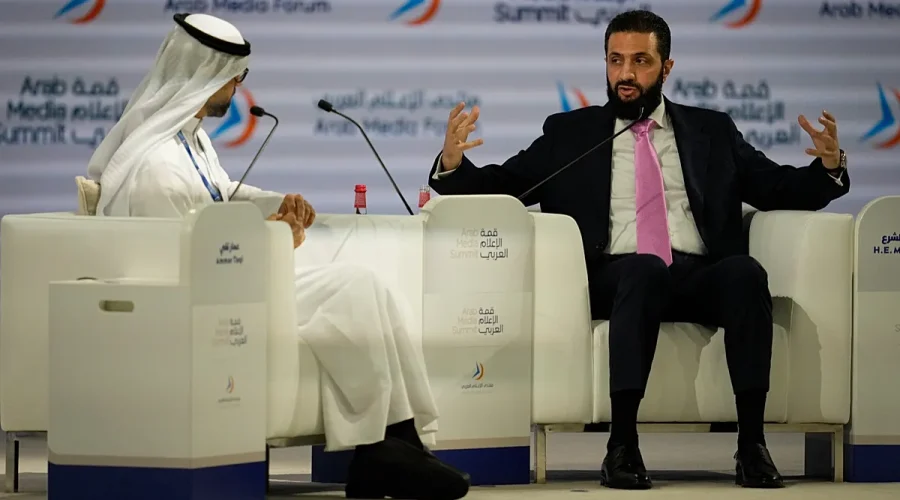
Speaking on Tuesday at the opening of the Arab Media Summit in Dubai, al-Sharaa said the region faced an unpredictable period. He expressed hope that countries would remain focused on stability as tensions continue to affect security, trade and economic planning.
“It looks like escalation is on the way” in the region gripped by the Iran war, and “with all the tensions, nobody can predict” what will happen, but the hope is that the situation “remains stable.”
In response to a question during the summit, al-Sharaa called on regional states to “keep calm” and work collectively to address the consequences of conflict. He said that approach was especially important for Syria as it attempts to move beyond decades marked by destruction and warfare.
A new phase for Syria
Al-Sharaa described the country as being at the beginning of a major transition. Syria, he said, has an opportunity to reshape its position after what he characterised as 60 years of destruction and 17 years of war.
“Syria is being transformed into a story being told across the world.”
He said the country’s difficult recent history should not prevent it from seeking a new start. The Syrian president presented the current moment as a potential opening for political and economic renewal, while acknowledging that reform would require patience.
Damascus, he said, is moving through a transformational stage toward democracy. He also referred to sanctions that former US President Donald Trump has been helping to lift, describing the process as a break from constraints that had tied Syria to its past.
“We are expecting some shocks and we need to move into a quieter stage.”
Al-Sharaa said Syria needed time for institutional changes and wider reforms to take hold. His remarks reflected the challenge of pursuing domestic transformation while the wider region faces the risks of a growing confrontation.
Trade routes, supplies and economic opportunity
Much of al-Sharaa’s address focused on Syria’s possible role in regional connectivity. He said that crises linked to the Iran war could also highlight the importance of alternative transport, security and supply-chain routes between East and West.
“People are talking about Syria as a pathway, as security and supply chains can link the West and the East.”
He pointed to the United Arab Emirates as an example of a country seeking opportunities amid disruption, including efforts to adapt to the closure of the Strait of Hormuz. The waterway is a significant route for regional trade, so any interruption can create pressure on shipping, supplies and commercial planning well beyond the Gulf.
Syria, al-Sharaa said, has historically served as a commercial crossroads. He argued that trading and negotiation are deeply rooted in the country’s identity, and that a transparent approach could strengthen confidence in Syria’s future partnerships.
“Syria has always been a trade pathway as being traders and negotiators has been in our DNA.”
He added that Syria’s credibility was growing because it was not aligned with a single direction. Al-Sharaa also said his government looked to other Arab countries for experience and practical lessons rather than attempting to develop every solution independently.
“We rely on our dear brothers and sisters in the Arab world and learn from them, so we don’t try to reinvent the wheel.”
Food security and reliable supplies were among the priorities he identified for the region. Al-Sharaa said Syria offers opportunities in these areas that have attracted interest from European investors, neighbouring countries and Gulf-backed investment activity.
For ordinary people, the stakes of these issues are immediate. Regional conflict can affect the movement of goods, the cost and availability of essential products, investment decisions and the ability of governments to plan for long-term recovery. Al-Sharaa said Syria was trying to find ways to reduce the impact of war while working with Arab partners to support peace and economic growth.
Media responsibility during a volatile period
The Arab Media Summit opened Tuesday with regional leaders, officials, media executives, analysts, writers and influencers in attendance. The programme includes eight specialist forums, including a forum scheduled for Wednesday, and is expected to bring together around 10,000 participants.
Al-Sharaa used his keynote appearance to stress the role of journalism in a period of rapid developments and competing narratives. He said media workers carry a serious responsibility to verify information and avoid turning reporting into political advocacy.
“It is a heavy burden to work in the media, to fact-check and to stay away from politicising.”
He said audiences need reliable information about events shaping their societies, particularly when uncertainty and conflict can accelerate the spread of unverified claims. His message placed accuracy, authentication and direct communication at the centre of responsible coverage.
“People’s lives are in the hands of the media, as they need to keep up with the Arab societies to be aware of the actual facts of what is happening: authenticate information with channels and people and the messages of media.”
Al-Sharaa’s broader appeal was for restraint alongside cooperation: a region facing an unstable security environment, but one that can still pursue recovery, trade links, food security and economic development if it prevents tensions from driving further disruption.
Related Reading
Frequently Asked Questions
What is Escalation is on the way but region?
Escalation is on the way but region is the main topic of this guide. The article explains the context, practical details, and next steps readers should understand.
Why does Escalation is on the way but region matter?
Escalation is on the way but region matters because readers are looking for a useful answer, not just a short summary. Good content should match search intent and help them decide what to do next.