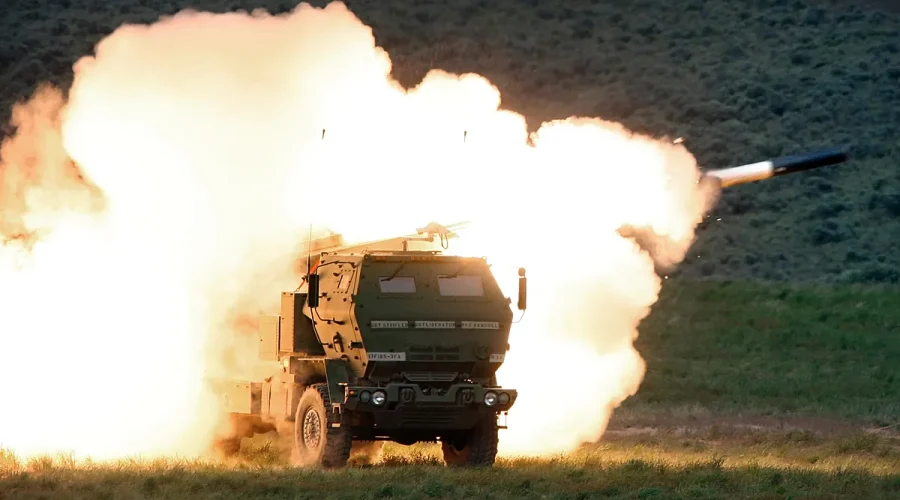
Sweden Buys Lockheed Martin HIMARS in €630M Deal
Usagevpn.com – Sweden to buy Lockheed Martin’s High Mobility Artillery Rocket System is the central fact behind a €630 million contract confirmed Monday by the Swedish Ministry of Defence. Ten HIMARS launchers, paired with a dedicated ammunition package, will enter Swedish service with initial deliveries scheduled for 2027. The spending falls inside the military’s standard annual investment envelope—no special parliamentary appropriation is required.
Closing a Post-Cold War Capability Gap
Stockholm framed the acquisition as an “opportune purchase,” language that signals how long the shortfall has lingered. Since the Cold War ended, Sweden’s long-range strike portfolio has rested on Bofors Archer self-propelled guns and assorted grenade-launcher platforms. HIMARS changes that calculus: the system fires precision-guided rockets and, in certain configurations, short-range tactical ballistic missiles at ranges well beyond what towed or self-propelled artillery can reach. Swedish units will cover substantially larger operational footprints, and the platform interoperates with systems already fielded by NATO partners, simplifying coalition logistics and joint-fire coordination.
The purchase slots directly into Sweden’s total defence bill for 2025–2030, the multi-year spending framework adopted as the country deepens its integration into the alliance it formally joined in 2024. Across Europe, governments are simultaneously accelerating defence investment in response to the war in Ukraine, and Stockholm’s decision lands squarely within that continental rearmament wave.
Nordic Coordination and Industrial Stakes
Alongside the procurement announcement, Swedish Defence Minister Pål Jonson and Finnish Defence Minister Antti Häkkänen signed a joint declaration committing both governments to cooperation on rocket artillery. The pact spans training curricula, education programmes, capability development, maintenance logistics, supply-chain security, and the prospect of joint production runs. The technical logic is straightforward: Finland already operates the Multiple Launch Rocket System (MLRS), which shares the same munitions families and core components as HIMARS. Pooling stockpiles, spare parts, and maintenance expertise lets the two neighbours avoid costly duplication and sustain readiness more efficiently than either could alone.
“The introduction of rocket artillery clearly demonstrates that Sweden is taking responsibility for security in Europe,” Jonson said, adding that “together, we [Sweden and Finland] are developing important capabilities for NATO’s collective defence.”
A separate industrial dimension keeps value inside Sweden’s own defence sector. Lockheed Martin and Swedish defence group Saab will sign a declaration exploring the integration of Saab’s Ground-Launched Small Diameter Bomb with the HIMARS launcher, alongside munitions production for HIMARS and other platforms including the Patriot air-defence system. The arrangement matters because European governments have been purchasing American weapons while facing sustained domestic pressure to rebuild their own industrial base. Munitions output in particular has become a continent-wide bottleneck since Russia’s full-scale invasion of Ukraine in February 2022, with demand for artillery shells, guided rockets, and interceptor warheads far outstripping pre-war capacity. For Saab, the partnership opens a high-volume munitions market without requiring an entirely new launcher architecture. For Lockheed Martin, it secures a long-term European customer and a local production partner that can shorten supply lines for NATO operations in northern Europe. For Stockholm, it converts a foreign procurement into a partially domesticated capability, reducing future dependence on transatlantic logistics for resupply.
Strategic Context
Sweden’s geographic position—sharing a land border with Russia’s Kaliningrad corridor via the Baltic states and projecting naval power into the Gulf of Bothnia—makes long-range land-based strike capability a force multiplier for both deterrence and defence. The HIMARS acquisition, paired with the Finnish coordination framework and the Saab industrial tie-in, positions Sweden to contribute meaningfully to NATO’s northern flank while retaining sovereign control over its own munitions supply chain.
Frequently Asked Questions
How many HIMARS systems will Sweden receive? Ten launchers, accompanied by a corresponding ammunition package, under a contract valued at approximately €630 million.
When will deliveries begin? Initial deliveries are slated for 2027, funded within the ordinary annual investment budget rather than through a special appropriation.
What does the Finnish coordination agreement cover? Training, education, capability development, maintenance logistics, supply-chain security, and potential joint production runs between Sweden and Finland, leveraging Finland’s existing MLRS fleet which shares munitions families with HIMARS.
How does Saab fit into the deal? Lockheed Martin and Saab will explore integrating Saab’s Ground-Launched Small Diameter Bomb with the HIMARS launcher and producing munitions for HIMARS and the Patriot air-defence system, keeping industrial value within Sweden.