AfD’s Historic Sweep of Saxony-Anhalt Redraws Eastern Germany’s Political Map
Usagevpn.com – The far-right Alternative für Deutschland (AfD) has claimed a dominant share of the vote in Saxony-Anhalt’s state parliament election, delivering what exit-poll projections suggest is the most lopsided result in the state’s post-reunification history. With roughly 44.5 percent of ballots cast, the party has pulled well ahead of every other contender, raising the immediate question of whether it can assemble a workable governing majority in Magdeburg. The outcome lands at a particularly sensitive moment for Chancellor Friedrich Merz, whose federal coalition already faces mounting strain in Berlin.
What the Numbers Show
Projections compiled by ARD place the AfD at 44.5 percent of the vote, a figure that would translate into a commanding plurality of seats in the newly constituted Landtag. The Christian Democratic Union (CDU), long the anchor of centre-right politics in eastern Germany, trails at just 18.5 percent. Die Linke follows at 9.5 percent, while the Social Democratic Party (SPD) registers approximately 8 percent. The newly formed BSW (Bündnis Sahra Wagenknecht) is projected at around 5 percent, putting its parliamentary entry in genuine doubt given the threshold dynamics at play.
The gap between first and second place — more than twenty-five percentage points — dwarfs anything seen in a Saxony-Anhalt contest since reunification. For a state of roughly 2.1 million residents, the result signals a wholesale realignment of voter allegiance that had been building across eastern Länder for several election cycles.
A Candidate’s Claim to Legacy
Ulrich Siegmund, the AfD’s lead candidate for the state, addressed supporters shortly after polls closed and framed the night as a watershed moment for the party’s eastern base.
“We have made history in Saxony-Anhalt,” Siegmund declared.
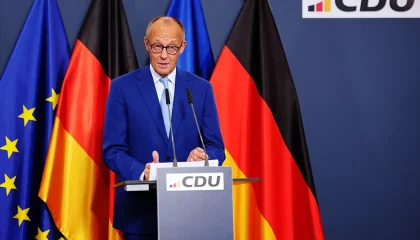
The CDU’s campaign manager Sven Schulze, by contrast, faced a campaign that ended in what internal party assessments are expected to describe as a catastrophic performance. The CDU’s share of the vote represents a steep decline from its position in the 2021 Landtag election and underscores the erosion of traditional centre-right support in the region.
Record Turnout and Voter Sentiment
More than 1.7 million eligible voters turned out for the poll, producing a participation rate of approximately 80 percent — a record for the state. The previous election in 2021 drew just 60.3 percent of the electorate, meaning the surge of nearly twenty points in a single cycle reflects not merely a shift in preference but a deepening sense that the stakes of the contest have changed.
Post-vote analysis by Infratest dimap identified four factors that proved decisive for voters in Saxony-Anhalt: a sustained decline in trust toward established parties, anxieties over social-security provision, dissatisfaction with the economic trajectory, and attitudes toward migration. The convergence of these grievances in a single electoral event explains much of the magnitude of the AfD’s gain.
Why This Matters Beyond Magdeburg
Saxony-Anhalt has long served as a bellwether for eastern German politics. If the AfD succeeds in forming a government — whether as a single-party majority or through a coalition arrangement — it would become the first far-right party to head a German state administration since the end of the Second World War. That distinction carries symbolic weight far beyond the state’s borders, potentially altering the calculus for the party’s ambitions in other eastern Länder and, ultimately, in federal politics.
For Chancellor Merz’s coalition, the result compounds existing pressures. A federal government that depends on CDU partners in eastern states now faces a party that has just demonstrated it can outflank the CDU by a factor of two-and-a-half in precisely those regions. The political arithmetic in Berlin will need recalibrating in the coming weeks.
The Road Ahead
Formal seat allocations will follow once the state electoral authority completes its count. Whether the AfD can command a majority outright, or must seek a junior partner, will determine the shape of the next government. Die Linke and the SPD, together holding roughly 17.5 percent, face the task of building a credible alternative bloc if they wish to keep the AfD out of power. The BSW’s uncertain parliamentary status adds another variable to the coalition mathematics.
For now, the political centre of gravity in eastern Germany has shifted decisively eastward — toward a party that, until Sunday, had never governed a German state. The question is no longer whether the AfD can win elections in the region. It is whether the rest of the political spectrum can respond before the next ballot arrives.
Related Reading
Frequently Asked Questions
What is news German far right AfD wins?
news German far right AfD wins is the main topic of this guide. The article explains the context, practical details, and next steps readers should understand.
Why does news German far right AfD wins matter?
news German far right AfD wins matters because readers are looking for a useful answer, not just a short summary. Good content should match search intent and help them decide what to do next.