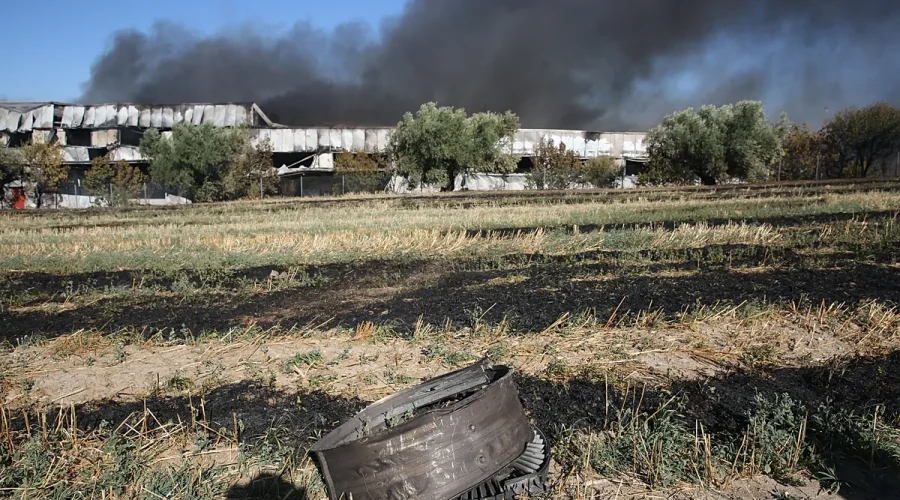
Phantom F-4 Plunges Into Ground at Tanagra, Killing Both Crew Members During Athens Flying Week Display
Usagevpn.com – The annual Athens Flying Week air show was thrown into mourning on Saturday after a twin-seat McDonnell Douglas F-4 Phantom II fighter jet lost altitude mid-display and slammed into the ground at Tanagra air base, killing both pilots aboard. The aircraft was performing in front of thousands of spectators when it suddenly dropped from its flight path and struck the terrain, triggering an immediate explosion on impact. Officials confirmed the deaths of the two crew members shortly after the crash.
The incident unfolded during one of the most heavily attended aviation events in south-eastern Europe. Athens Flying Week, scheduled for 5 and 6 September this year, draws large crowds to Tanagra each year with its programme of tight-formation flying, high-G manoeuvres, and parachute descents. The Phantom F-4, a Cold War-era interceptor originally developed by McDonnell Douglas, has served in Greek Air Force squadrons for decades and remains a familiar sight at Greek air shows, though its age makes every flight a calculated risk that crews and organisers manage carefully.
Immediate Aftermath and Emergency Response
The impact ignited a substantial fire that quickly spread beyond the airfield perimeter into the surrounding forested terrain. Within hours, a large-scale firefighting operation was underway: 115 firefighters and 36 vehicles were committed to the scene, supported by three dedicated ground teams. Aerial assets were also brought into play, with nine aircraft and four helicopters rotating over the blaze on a periodic basis; one of the helicopters was tasked specifically with coordinating the overall operation.
By late Saturday afternoon, authorities reported that the fire’s behaviour had improved, though the threat was not yet fully contained. Earlier that afternoon, an alert was broadcast through Greece’s 112 emergency number to warn residents in the wider Tanagra area about the spreading flames and possible smoke drift.
Police moved swiftly to manage traffic and protect nearby communities. The service road running alongside the Athens–Lamia national motorway was closed, as was the Oinoi provincial road at the village of Oinoi, limiting access to the affected corridor while crews worked.
Official Reaction and Event Cancellation
Defence Minister N. Dendias, who had been attending the Thessaloniki International Fair, cut short his schedule there and began the return journey to Athens to oversee the response and liaise with the Air Force command. Organisers of Athens Flying Week announced that all remaining events planned over the weekend were cancelled, effectively ending the show a day before its scheduled close.
The circumstances surrounding the loss of altitude remain under investigation. Witnesses and broadcast footage captured the moment the jet began its uncommanded descent, but no definitive mechanical cause had been identified in the immediate aftermath. Greek military investigators are expected to examine the wreckage, flight data, and maintenance records in the days ahead.
Context: Tanagra, the Phantom, and Greek Air Show Tradition
Tanagra air base, located in Boeotia roughly 40 kilometres north of Athens, has hosted military aviation displays for decades and serves as a primary operating site for several Greek Air Force units. The base’s proximity to the capital makes it a natural venue for national-level air shows, though the surrounding woodland and agricultural land mean that any accident carries a heightened risk of collateral damage.
The F-4 Phantom II entered Greek service in the late 1960s and saw combat during the 1974 Cyprus crisis. Over the decades, the type has been progressively retired from frontline interceptor duties, yet it retains a prominent role in ceremonial and display flying because of its visual presence and the heritage it represents for Greek pilots. Its twin-seat configuration allows a pilot and a systems officer or instructor to share the cockpit, which is why two crew members were aboard at the time of the crash.
Athens Flying Week occupies a place in the Greek public calendar comparable to other major European air shows: it showcases current and legacy military aircraft, invites foreign air displays in some years, and provides families with a rare close-up look at operational jets. The cancellation of this year’s remaining programme underscores how quickly a single accident can reshape an event built over months of planning, and how the safety of spectators and surrounding communities remains the overriding concern whenever a military aircraft leaves its intended flight path.
As of the latest updates, the two pilots have not been publicly identified, and the Air Force has asked for privacy while families are informed. The investigation into the cause of the altitude loss is expected to take weeks, with findings typically released through official defence channels once preliminary and final reports are complete.
Related Reading
Frequently Asked Questions
What is Two pilots killed in Phantom F 4?
Two pilots killed in Phantom F 4 is the main topic of this guide. The article explains the context, practical details, and next steps readers should understand.
Why does Two pilots killed in Phantom F 4 matter?
Two pilots killed in Phantom F 4 matters because readers are looking for a useful answer, not just a short summary. Good content should match search intent and help them decide what to do next.