EU Leadership Declares a New Era of Security After Drone Strike on German Soil
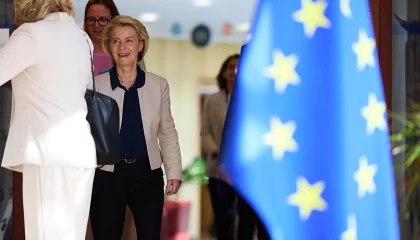
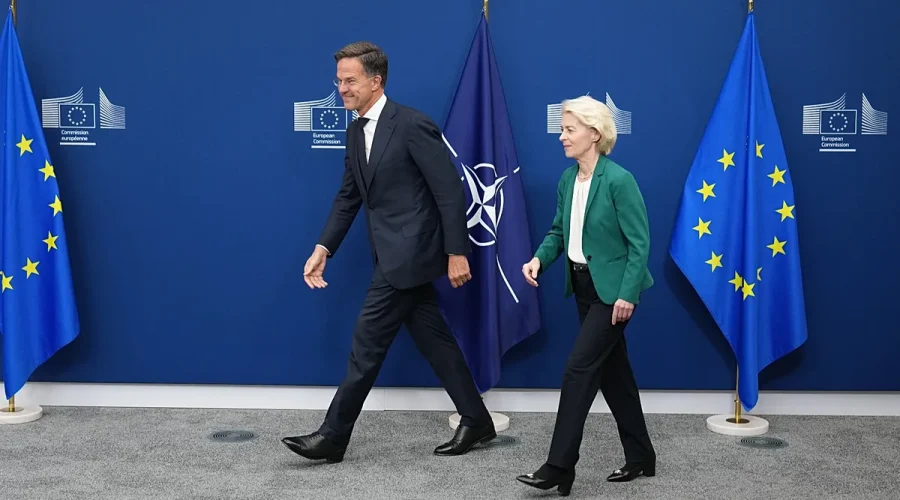
Usagevpn.com – The architecture of European security has shifted in ways that few policymakers predicted just a year ago. What was once confined to the eastern borders of the continent now reaches into the heartland of member states, and Brussels has made clear it will treat that reality as permanent rather than temporary. Speaking alongside NATO Secretary-General Mark Rutte at a joint press briefing in the Belgian capital, European Commission President Ursula von der Leyen framed the latest episode — a Russian-linked drone discovered at an airport in eastern Germany in early August — as evidence that hostile operations on EU territory have crossed a threshold from which there is no easy return.
“Leipzig marks a new escalation on European Union soil directly attributed to Russia, but it is part of a broader pattern of increasingly dangerous incidents.”
The drone, loaded with explosives and found at Leipzig’s airport on 4 August, had been formally attributed to Moscow by the German government the day before the Brussels briefing. Had the device detonated as intended, von der Leyen warned, the consequences could have been catastrophic.
“If the attack had succeeded, this would have resulted in enormous damage, and possibly even loss of life.”
A Hard Truth for European Citizens
Von der Leyen told audiences that Europeans must now accept a reality that was unthinkable a decade ago: infrastructure that once seemed invulnerable — airports, rail hubs, energy corridors — must be treated as potential targets. The Commission president argued that the bloc’s existing rapid-response teams are calibrated to handle such threats, and that additional sanctions layers are being prepared to tighten economic pressure on Moscow.
“Europeans are faced with a hard truth, that this is the new normal.”
She urged the bloc to answer Russian “recklessness, faster and better,” a phrase that signals a departure from the cautious, consensus-driven tempo that has characterised EU foreign policy since 2022. Foreign ministers gathered in Wicklow, Ireland, later that week to debate the proposed additional designations, though no formal vote was scheduled at the informal gathering.
NATO’s Parallel Warning
Rutte reinforced the Commission’s messaging from the alliance’s side of the table. The Dutch-born NATO chief described Moscow’s behaviour as growing more audacious as its full-scale invasion of Ukraine grinds on, with the operational threat now spilling beyond Ukrainian borders into NATO and EU territory.
“The danger Russia poses is clear.”
He dismissed any notion that recent provocations might fracture Western solidarity behind Ukraine.
“Our unity is unshaken.”
Moscow Pushes Back
The Kremlin rejected the German attribution outright. Deputy Foreign Minister Alexander Grushko, speaking through Kremlin-affiliated channels on Wednesday, accused Berlin of deliberately choosing a “path of escalation” and turned the blame back on European capitals, which he characterised as sponsors of Ukrainian “terrorism.” The Russian government has consistently maintained that no state actor was involved in the Leipzig incident, a position that German officials regard as untenable given the forensic evidence.
Berlin’s Formal Findings and Diplomatic Fallout
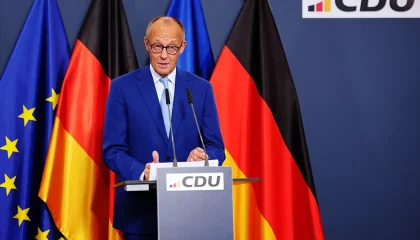
Germany’s Interior Minister Alexander Dobrindt laid out the government’s reasoning on Tuesday, stating that the methods employed in the 4 August sabotage matched techniques observed in other hybrid operations tied to Russia’s war effort.
“The German government therefore concludes that Russia is responsible for the hybrid attack in Leipzig on 4 August.”
Foreign Affairs Minister Johann Wadephul, speaking beside Dobrindt, placed the incident within what he called a “long series of attempts at destabilisation, disinformation, threats, sabotage and aggression directed at Europe.” The practical consequences followed swiftly: Germany ordered the closure of the Russian consulate in Bonn and terminated the operating agreement for the Russian House in Berlin. Moscow vowed reciprocal measures.
Kyiv Offers Support; Brussels Tightens the Sanctions Net
Ukrainian President Volodymyr Zelenskyy confirmed a telephone conversation with German Chancellor Friedrich Merz and pledged that Kyiv stands ready to assist “with expertise, experience, or in other areas where Germany may need.” He characterised the episode as yet another Russian escalation and commended Berlin’s response.
On the sanctions front, EU foreign-policy chief Kaja Kallas described the Leipzig drone as bearing “all the hallmarks of state sponsored terrorism” while attributing it to Russia. She noted that 1,600 individuals and entities linked to Russia’s military-industrial complex have been added to a proposed new sanctions list, adding that further names may follow. The measures are aimed principally at Moscow’s war economy, with particular focus on producers of long-range drones such as the Garpiya model — a class of weapon that mirrors the type discovered at Leipzig.
The 21st sanctions package, adopted in late July, had already targeted a broad swath of Russian military-industrial actors. The proposed additions represent a further tightening of that net, though Kallas stressed that nothing would be formally confirmed at the informal Wicklow meeting.
Diplomatic Summons Across the Continent
The incident triggered a coordinated diplomatic response. The EU and Belgium summoned Russia’s ambassador in Brussels. France called in the Russian chargé d’affaires, while the Netherlands summoned a Russian diplomatic representative. Kallas confirmed that Russian ambassadors had already been summoned in multiple member states and that the Wicklow discussions would explore what further steps are available.
“The question is what do we do about this?”
For European citizens, the practical implication is straightforward: the security environment that shaped defence budgets, energy diversification, and industrial policy since February 2022 has deepened. Airports, substations, and logistics nodes that once operated under assumptions of inviolability now sit within the operational calculus of a state that has demonstrated willingness to strike inside allied territory. The institutions of Brussels, Berlin, and NATO have signalled that they intend to meet that calculus with faster decision-making, heavier economic costs, and a posture that treats the next incident not as an anomaly but as a probability.
Related Reading
Frequently Asked Questions
What is Von der Leyen?
Von der Leyen is the main topic of this guide. The article explains the context, practical details, and next steps readers should understand.
Why does Von der Leyen matter?
Von der Leyen matters because readers are looking for a useful answer, not just a short summary. Good content should match search intent and help them decide what to do next.