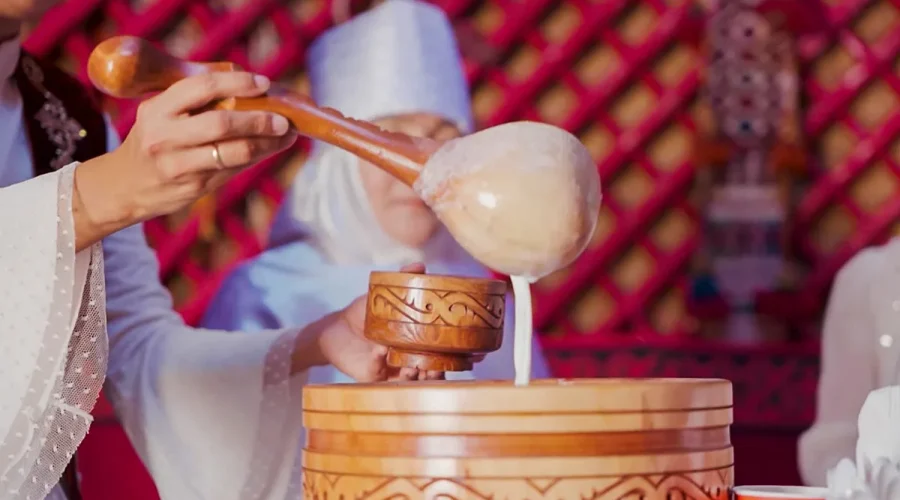
How Horse Milk Kymyz Became a Timeless Drink
Usagevpn.com – How horse milk kymyz became a daily ritual across Central Asia is a story that stretches back at least five millennia. In village courtyards, festival tents, and family kitchens from Kazakhstan to Mongolia, a frothy, tangy fermented beverage still flows from wooden vessels. Its lineage runs from steppe warriors of antiquity to modern herders in Kazakhstan’s Ulytau Region, surviving empire, industrialization, and the collapse of the Soviet system. Today the drink anchors regional identity festivals, attracts scientific scrutiny, and remains, for many households, an irreplaceable element of daily life.
Deep Roots: Who Drinks It and What the Record Shows
Ethnic communities across a vast geographic span — northern Han Chinese groups, Kazakhs, Bashkirs, Kalmyks, Kyrgyz, Mongols, and Yakuts — all trace ancestral ties to the fermented mare’s-milk preparation. The oldest Western textual reference appears in Herodotus’s Histories, composed in the fifth century BC, where the Greek historian describes Scythian methods of processing the milk. Archaeological evidence pushes the timeline far earlier: ceramic sherds from the Botai culture necropolis in present-day Kazakhstan, dating to the Copper Age, bear traces of the milk alongside markers of the world’s earliest known horse domestication. The very region that first tethered the horse also first turned its milk into a consumable product.
For nomadic riders on campaign, the beverage served as a portable source of calories and hydration, sustaining warriors through long marches and seasonal conflicts. Its nutritional density made it far more practical than plain water or grain porridge for people whose entire livelihood moved with the herd.
What Modern Science Finds in the Glass
Biochemical interest in the drink has accelerated over the past two decades. Gaukhar Konuspayeva, a professor of food biotechnology who has devoted twenty-six years to studying both camel and horse milk, describes a compound whose value extends well beyond simple vitamin content.
“According to our research, mare’s milk is very rich in vitamins A, B1, B2, B5 and B6. But what makes kymyz unique is its fatty acid composition and the presence of prebiotic bacteria.”
Those prebiotic microorganisms, introduced during the natural fermentation that transforms raw milk into the finished beverage, are the subject of ongoing inquiry into gut-health applications. Konuspayeva cautions that the full therapeutic potential remains largely unexplored, leaving substantial room for future clinical and nutritional research.
Soviet Stalls and Post-Soviet Revival
The drink did not vanish during the Soviet period, even as industrialization reshaped pastoral economies. State farms across the Kazakh steppe maintained herds numbering in the hundreds of thousands of mares, producing milk and dairy derivatives for both local consumption and state distribution. When those collective farms dissolved in the early 1990s, preparation knowledge passed back into private households, where it had always lived in parallel with official channels.
Today the beverage exists in a spectrum of forms. Taste varies with the pasture where the mare grazes, the seasonal grasses she consumes, and the particular fermentation technique employed by each household. The most prized variant is saumal, the freshly drawn, unfermented milk, which remains palatable for only a handful of hours. Supermarkets rarely stock it; to taste saumal one typically must travel to a rural village and drink it within minutes of milking.
A Day in Zhanaarka: Milking the Sacred Mare
In the village of Zhanaarka, situated in Kazakhstan’s Ulytau Region, Aiman Kutzhanova — a deputy principal at a local school who also raises horses alongside her husband — demonstrates the traditional milking sequence. The foal must nurse first; only after the young animal has fed is the remaining milk collected for human use. Unlike dairy cattle, which can be milked twice daily, a mare requires attention every one to two hours and yields roughly one litre per day.
“Horses are sacred animals. They choose the person who milks them. For example, my mares won’t let anyone else milk them. Even if I come wearing different clothes, they won’t let me milk them.”
That bond between handler and animal, Kutzhanova explains, is not merely practical but cultural: the mare’s willingness to accept a particular person is read as a sign of trust earned over years of shared daily life.
Frequently Asked Questions
What exactly is kymyz and how is it made?
Kymyz is a fermented mare’s-milk beverage. Raw milk is collected after the foal has nursed, then allowed to ferment naturally — often in a leather or wooden vessel — for several hours to several days, depending on the desired tartness. The unfermented version, called saumal, is consumed within hours of milking.
Where can I try the drink?
The most reliable way to taste freshly prepared kymyz is to visit a rural household or a regional cultural festival in Kazakhstan, Kyrgyzstan, or Mongolia. Urban supermarkets occasionally carry pasteurized commercial versions, but the flavor profile differs markedly from the traditional preparation.
Is the drink safe for people with lactose intolerance?
Because fermentation breaks down much of the lactose, many people who struggle with cow’s milk find the fermented mare’s-milk preparation easier to digest. However, individual tolerance varies, and those with confirmed dairy allergies should consult a physician before trying it.
How old is the tradition?
Archaeological evidence from the Botai culture in Kazakhstan places horse-milk use in the Copper Age, roughly five thousand years ago. Written references appear in Greek texts by the fifth century BC, but the practice predates any surviving written record.