Magyar Says EU Must Decide: Survive or Win
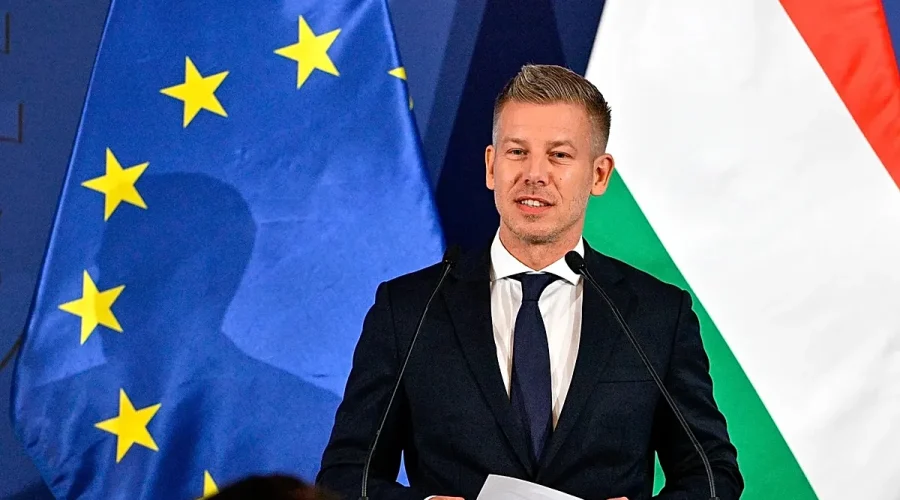
Usagevpn.com – At the Bled Strategic Forum in Slovenia, Hungary’s prime minister Péter Magyar told a room full of Central European leaders that the European Union faces a binary choice: it can drift through another decade of institutional inertia, or it can commit to competing at the highest level of global economic and industrial rivalry. Magyar says EU must decide which path it will take, and he argued that Brussels’ current leadership structure makes the second option nearly impossible without a fundamental overhaul of how decisions get made inside the bloc.
Leaders at the Eastern Flank Confront a Competitiveness Gap
The Bled session paired Magyar with Slovenia’s Janez Janša, Croatia’s Andrej Plenković, and Czech Prime Minister Andrej Babiš for a conversation about how states sitting at the junction of NATO’s eastern perimeter and the EU single market can coordinate policy while accelerating their own industrial output. The audience context sharpened Magyar’s message: these are governments that feel the latency of Brussels decision-making in every trade negotiation, every infrastructure bid, and every defence procurement cycle.
His description of what happens inside the Commission’s corridors was blunt. Magyar recounted a private exchange with a European Council member who, in his telling, advised him to stop engaging with the bureaucracy altogether.
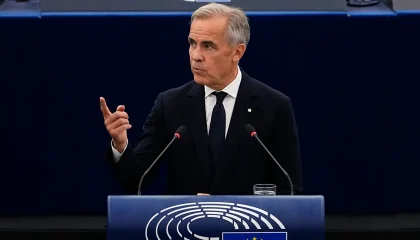
“There is a lack of political leadership, to be honest, in the European Union,” Magyar told the forum. “I was told by a member of the European Council not to deal at all with the bureaucracy, not to reply to them, because they will kill initiatives. They will eat them. And it’s not a good sign. I think we should concentrate again on the reality.”
The criticism carries added weight because Magyar sits inside the European People’s Party — the same centre-right family that supplies Commission President Ursula von der Leyen. His remarks therefore represent internal pressure from within the governing coalition rather than an external populist attack, suggesting that dissatisfaction with the Commission’s tempo may run deeper across EPP national delegations than public statements typically reveal.
Beijing’s Industrial Footprint as the Urgency Clock
Magyar contrasted the EU’s absorption in procedural disputes with what he characterised as Beijing’s deliberate industrial strategy on European soil. While Brussels litigates internal questions, he noted, Chinese state-linked capital is already being channelled into nuclear power projects and automotive assembly lines across the continent. The arithmetic, in his framing, is simple: every quarter consumed by governance friction is a quarter in which a state-backed competitor locks in supply-chain positions that are costly to reverse.
“There is a feeling already in We should decide whether the European Union would only like to survive or to win,” Magyar said, pressing the forum to treat the question as urgent rather than academic.
The Migration Fine That Anchors Budapest’s Grievance
Beyond the macro critique, Magyar returned to the specific penalty that has defined Hungary’s Brussels relationship for years. Following a 2020 European Court of Justice judgment finding that Hungary had breached EU law by denying asylum seekers fair procedural treatment, the Commission imposed in 2024 a lump-sum penalty of €200 million together with a daily charge of €1 million for continued non-compliance. Under the preceding Orbán government, Hungary had built a border fence along its Serbian frontier and required applicants to lodge claims at the Hungarian consulate in Belgrade, where most were refused. Cumulative fines have now approached €1 billion.
“It’s quite difficult to explain to Hungarians why Hungary is treated so unfairly in Brussels on these issues,” Magyar said. “We have a court ruling; we have to pay €1 million a day just for defending the common European borders. It’s not fair, and nobody is ready to resolve this issue.”
For Magyar’s own election campaign, the fine became a centrepiece of a broader pledge to reset Budapest’s posture toward its Western partners in both the EU and NATO — a rhetorical break from the confrontational register that had dominated Hungarian-EU relations through the previous decade while still insisting that the country’s border-management choices deserve a different legal treatment.
Frequently Asked Questions
What is the Bled Strategic Forum? It is an annual gathering held in Bled, Slovenia, that brings together heads of government, ministers, and senior officials from Central and Southeastern Europe to discuss regional security, economic competitiveness, and multilateral cooperation. The 2026 edition featured a panel with Magyar, Janša, Plenković, and Babiš.
How large is the migration fine Hungary faces? The Commission’s 2024 decision imposed a one-time €200 million penalty plus €1 million per day for ongoing non-compliance with a 2020 ECJ ruling. By the time of Magyar’s remarks, cumulative charges had approached €1 billion.
Why does Magyar’s EPP membership matter for his critique? Because the European People’s Party is the same grouping that supplies the Commission’s president, Magyar’s criticism comes from inside the governing coalition. That makes the complaint harder to dismiss as partisan opposition and signals that frustration with the Commission’s decision-making tempo may be shared across multiple centre-right national governments.