Search Continues as North Cyprus Mourns After Ferry Disaster Claims Eight Lives
Usagevpn.com – Eight days of national mourning have not yet begun, but the grief has already taken hold of northern Cyprus as rescue teams pressed on through Monday searching for survivors of a ferry that rolled over within minutes of leaving port. Eight passengers are confirmed dead, and eighteen more remain unaccounted for after the vessel departed the port of Girne bound for the Turkish mainland on Sunday afternoon. The scale of the catastrophe has stunned a small island community that depends on regular sea crossings to maintain its lifeline to the mainland.
A Catastrophe in Minutes
The ferry set sail from Girne at approximately midday Sunday, a routine crossing that had carried thousands of passengers over the years. Within roughly four nautical miles — about seven kilometres — of departure, witnesses say the vessel began flooding. Passengers described water rising through the deck before the ship listed violently and rolled onto its side. The entire capsizing unfolded in a matter of minutes, leaving those aboard with little time to react.
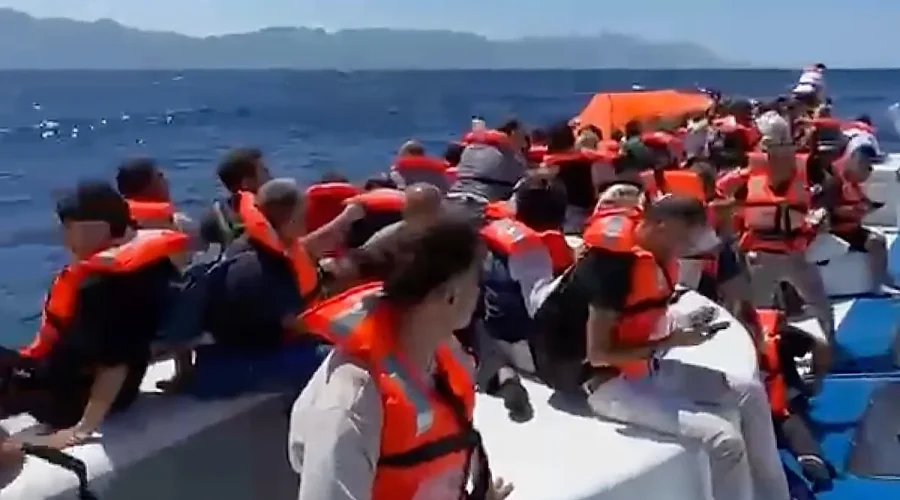
Footage aired on Turkish television captured the harrowing aftermath: the ferry lying on its orange hull, passengers clad in life jackets perched on the upturned structure, clinging to what remained of the vessel. That image lasted only briefly. The ship continued to take on water and ultimately sank completely, settling on the seabed at a depth of 514 metres, as confirmed by transport minister Erhan Arikli.
The Toll and the Rescue
Authorities tallied 241 survivors pulled from the water in the immediate aftermath. Eight people were pronounced dead. Eighteen passengers were listed as missing as of Monday’s continuing search operations. No details on the nationalities of the deceased or the missing had been released in the early hours following the disaster.
The rescue effort mobilised coast guard units, naval vessels, and civilian boats in a coordinated operation spanning the stretch of water between Girne and the Turkish coast. With the vessel now resting on the seabed more than half a kilometre down, recovering the missing has become a deep-water challenge that will require specialised diving teams and potentially submersible equipment.
Investigation Underway: Captain and Crew Detained
Police moved swiftly to secure those aboard the bridge. The captain along with more than a dozen crew members were detained at the scene. Early Monday morning, the captain and eight others appeared before a judge and were placed under formal arrest. The move signals that investigators believe there may be questions about the vessel’s seaworthiness, its loading, or the crew’s response to the flooding.
Multiple survivors told local media that they heard a loud blast — described by some as an explosion at the forward section of the boat — shortly before the vessel rolled. Whether that sound was a structural failure, a boiler rupture, or something else remains under investigation. Transport minister Arikli stated that recovering the ship’s “black box” from the seabed would be critical to establishing the sequence of events that led to the capsizing.
Survivor Accounts: Panic and Inadequate Safety Gear
Those who made it to safety described a scene of utter chaos. Several passengers said the vessel had begun taking on water well before it rolled, giving them only seconds to find life-saving equipment. Others complained that there simply was not enough safety gear for everyone aboard.
“Some people had to jump without lifebuoys or life jackets,” one young survivor, Efe Multici, told CNN Türk. “It was literally a fight for survival.”
Testimony of this kind will likely feed into both the criminal investigation and any subsequent civil proceedings. Questions about whether the vessel met safety certification requirements, whether life-jacket ratios were adequate for the number of passengers carried, and whether the crew followed protocol once flooding began will dominate the inquiry.
A Route Woven into Daily Life
The Girne-to-mainland crossing is far more than a tourist itinerary. For residents of the Turkish Republic of Northern Cyprus — a polity that declared independence in 1983 and is recognised solely by Ankara — the ferry represents one of two regular links (the other being air service) to the Turkish mainland. Goods, fuel, medical supplies, and family visits all depend on these crossings. A disruption of this magnitude therefore carries economic and social consequences well beyond the immediate tragedy.
The island itself has been divided since 1974, when Turkey intervened militarily in the northern third of Cyprus following a coup engineered in Athens that sought to unite the island with Greece. The result was a partition that endures to this day: the Republic of Cyprus in the south, a member of the European Union, and the self-styled TRNC in the north, whose international standing remains limited. The ferry accident lands in a context where the northern community already navigates a complex web of diplomatic isolation, making disasters of this scale feel especially acute.
What Comes Next
Three days of national mourning were declared across the north, as reported by the TAK news agency. Search operations for the eighteen missing continued through Monday, though the depth at which the vessel now rests complicates every hour of the effort. Families gathered at Girne harbour awaiting updates. The formal arrest of the captain and crew means that a judicial process will run parallel to the technical investigation into the black box and the vessel’s structural condition.
For a community of roughly 300,000 people whose maritime lifeline has been severed overnight, the coming days will test not only rescue capability but institutional resilience. The questions of how, why, and who is responsible will not be answered quickly. What is certain is that the orange hull resting at 514 metres will remain the focal point of both the investigation and the grief of those who lost someone aboard.
Related Reading
Frequently Asked Questions
What is Rescuers continue search for missing after?
Rescuers continue search for missing after is the main topic of this guide. The article explains the context, practical details, and next steps readers should understand.
Why does Rescuers continue search for missing after matter?
Rescuers continue search for missing after matters because readers are looking for a useful answer, not just a short summary. Good content should match search intent and help them decide what to do next.