Ceuta on Edge: Anti-Migrant Fury Meets Police as Spain’s Smallest Overseas Territory Grapples with a Migration Crisis
Usagevpn.com – Spain – Ceuta, a Spanish enclave perched on the North African coast and spanning barely 18 square kilometres, has descended into open confrontation as residents’ frustration over a sudden influx of migrants from Morocco boiled over into street-level violence. Within a single day, police were forced to break up demonstrations at two popular bathing spots, clear blocked roads from aid convoys, and respond to a stone-throwing ambush against a small military patrol — all while thousands of newcomers remain camped along the shoreline, awaiting identification and processing.
Beachfront Confrontation
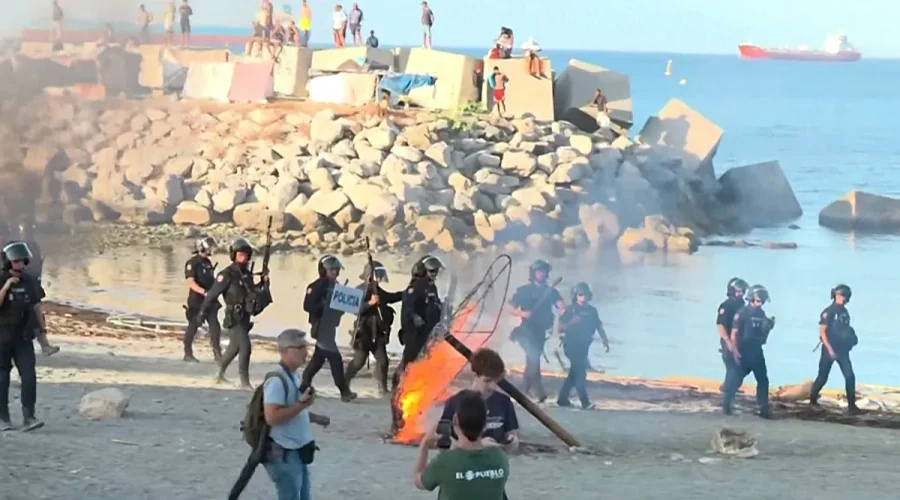
The most visible clashes unfolded at Trampolín and Benítez beaches, where demonstrators set fire to personal effects and improvised shelters that migrants had erected along the sand. Officers moved in to scatter the crowd after flames took hold. Broadcast imagery captured on Spanish public television showed protesters hurling debris into the burning piles while uniformed officers advanced to push them back. Migrants, caught between the two groups, fell back behind a police line established on a nearby pier.
The beach disturbance was not isolated. Hours earlier, a sit-in by dozens of locals had physically prevented Red Cross vehicles from reaching the migrant encampment to deliver food and drinking water. Four lorries carrying humanitarian supplies were brought to a halt when demonstrators sealed off the access road for more than two hours. Spanish flags were waved throughout the blockade, and the crowd chanted slogans demanding the newcomers depart:
“They should leave. Out with the Red Cross.”
After sustained pressure, officers carved a corridor through the blockade, and the routine daily handout of provisions resumed under a heavy security presence. A separate convoy of ambulances dispatched to offer medical care was also temporarily held up before being allowed through.
Ambush of a Military Patrol
Separate from the beach demonstrations, a more targeted episode of violence occurred in the early hours of Thursday. A vehicle carrying four soldiers was reportedly ambushed near the shoreline as individuals positioned on both sides of the roadway hurled stones and other projectiles at the convoy. One member of the patrol sustained injuries, and the vehicle’s windows were shattered. The soldiers abandoned the damaged vehicle, withdrew on foot, and radioed for backup. When police arrived on the scene, they detained twelve Moroccan nationals before the surrounding crowd dispersed.
Numbers, Pressure, and the Question of Scale
The incidents underscore how quickly Ceuta’s tiny landmass has been overwhelmed. Roughly a month ago, a mass crossing from Morocco brought thousands of migrants into the territory in a single wave. Official figures from Madrid place the current population of unprocessed arrivals between 3,500 and 7,000, yet local administrators contend the true count already surpasses 10,000 — a figure that would represent a substantial fraction of the territory’s resident population.
Ceuta’s geography compounds the problem. With no meaningful hinterland, limited housing stock, and a coastline that serves as the primary point of entry from Morocco, the enclave lacks the spatial and institutional capacity to absorb even a modest surge, let alone one measured in tens of thousands. The beaches where migrants have camped are also the territory’s principal tourist assets, meaning the humanitarian situation collides directly with local economic interests and daily life.
Madrid’s Response and Growing Scrutiny
On 27 August, Spain’s Interior Ministry announced a plan to deploy additional personnel to Ceuta specifically tasked with identifying and registering the arrivals. In parallel, the central government approved a €25 million allocation earmarked for the care of unaccompanied minors among the newcomers. Madrid also created a unified command structure for the territory, consolidating coordination between police, military, and civil authorities in an effort to present a single point of accountability.
Those measures have not quieted criticism. Opposition voices and segments of the local press have pressed questions about why the initial influx was not contained at the border, why identification and processing took so long to begin, and whether the government’s response has been proportionate to the scale of the challenge. The establishment of a single command, while intended to streamline decision-making, has itself become a symbol of how far the crisis has escalated from a routine border-management issue into a full-blown domestic-security and political event.
For the residents of Ceuta, the calculus is immediate and personal: their beaches, roads, and public services are being strained by a situation they did not choose and feel they were not consulted about. Until the identification process catches up with the numbers on the ground, and until a durable framework for either integration or orderly return is put in place, the territory’s narrow streets and crowded shorelines remain a powder keg waiting for the next spark.
Related Reading
Frequently Asked Questions
What is Spain?
Spain is the main topic of this guide. The article explains the context, practical details, and next steps readers should understand.
Why does Spain matter?
Spain matters because readers are looking for a useful answer, not just a short summary. Good content should match search intent and help them decide what to do next.