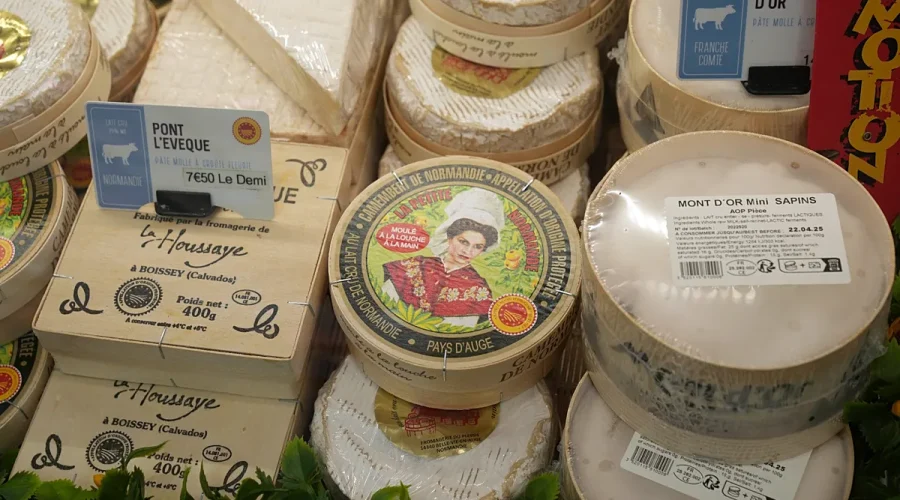
France Relaxes Strict Cheesemaking Rules Amid Record Drought
Usagevpn.com – Strict rules on French cheesemaking have been temporarily eased for the first time in modern regulatory history. In late August 2026, French authorities granted producers of three protected mountain cheeses — abondance, beaufort, and comte — permission to supplement their cows’ diets with externally sourced grain and fodder. The decision is an emergency measure, not a philosophical break with tradition: the summer’s unprecedented drought has stripped Alpine and Jura pastures of the green cover that origin-protection codes require for year-round grazing.
What the Origin-Protection Codes Demand
France administers one of the world’s most granular systems of food-origin protection. To carry the “appellation d’origine protégée” mark, a cheesemaker must comply with a dense catalogue of conditions covering grazing location, dominant pasture species, permitted supplemental-feed ratios, and even the altitude at which herds spend their summer months. The label functions as a legal contract among producer, terroir, and consumer; it is not a marketing flourish. Strict rules on French cheesemaking have long been a source of national pride and international admiration, yet the same rigidity now collides with a climate that no longer delivers the rainfall patterns those codes assume.
A Drought That Reached Nearly Every Department
By July 2026, roughly 95 per cent of mainland France had been classified under drought conditions. The Agriculture Ministry’s statistical service reported that, as of 10 August, growth on permanent grasslands sat a full third below the 1989-to-2018 average. In nearly every region surveyed, officials described the fodder situation as “highly degraded.”
“The fodder situation is highly degraded in almost all regions.”
On the ground, those statistics translated into pastures that turned brown and brittle weeks ahead of schedule. Cows that would ordinarily graze lush alpine meadow through July and August instead faced bare, sun-scorched slopes. Without intervention, producers risked thinning herds or producing cheese outside the compositional parameters the AOP specifications enforce.
The Specific Concessions Granted
The interim measure relaxes the ceiling on supplemental grain and imported fodder for abondance, beaufort, and comte producers. The National Institute of Origin and Quality (INAO), which administers and enforces origin-designation rules, confirmed that temporary relief would extend to several other products as well, including reblochon, cantal, bleu d’Auvergne, and fourme d’Ambert. The relief is framed as conditional and time-limited: it suspends specific feeding ratios for the duration of the drought episode, with normal grazing expected to resume once pasture recovery is confirmed. Every other element of the production specification — milk sourcing, aging duration, microbial cultures, geographic boundaries — remains fully in force.
A Broader Climate Picture
The cheese concession is one visible symptom of a summer that broke records across Europe. Thousands of excess deaths were attributed to sustained heat, wildfires consumed vast tracts of forest, and major river systems dropped to levels not previously documented. In France specifically, farmers entered autumn bracing for the smallest corn harvest since 1980, while winegrowers reported harvests beginning weeks earlier than any prior vintage on record.
Scientists have been explicit about the mechanism: extreme heat, amplified by human-caused climate change, is driving evaporation and soil drying even where precipitation totals remain near normal. The drought is therefore a thermal event as much as a rainfall event, meaning that simply waiting for a wetter season may not restore pasture growth on the timelines the production codes anticipate.
Why This Matters Beyond the Cheese Board
The relaxation of feeding rules for a handful of mountain cheeses may read as a small administrative footnote. In practice, it signals that France’s origin-protection framework — the very architecture that strict rules on French cheesemaking have built over decades — is being stress-tested by a climate that outpaces the assumptions baked into its regulations. How quickly and how permanently the codes adapt will shape not only what ends up on French tables, but how an entire category of protected agricultural heritage negotiates a warming world.
FAQ
Which cheeses are covered by the temporary feeding relaxation? Abondance, beaufort, and comte are the primary beneficiaries. INAO confirmed that reblochon, cantal, bleu d’Auvergne, and fourme d’Ambert also receive temporary relief.
How long will the relaxed rules remain in effect? The measure is framed as temporary and conditional. It suspends specific feeding ratios for the duration of the current drought episode; normal grazing requirements resume once pasture recovery is confirmed by authorities.
Does the relaxation change any other aspect of production? No. Milk sourcing, aging duration, microbial cultures, geographic boundaries, and all other elements of the AOP specification remain fully enforceable. Only the supplemental-feed ceiling is adjusted.
What percentage of France was under drought conditions by July 2026? Roughly 95 per cent of mainland France had been classified under drought conditions by that point, according to the Agriculture Ministry’s statistical service.