Europe’s Rail Network Gets a Live Dashboard, and Commuters Finally See the Full Picture
Usagevpn.com – Standing on a platform in Lyon, Madrid, or Brussels while watching the departure board flicker through yet another delay notification has long been a rite of passage for European rail travellers. What has been missing, however, is a bird’s-eye view of what is actually happening across the entire network at any given moment. That gap now has a solution. TrainTracker24, a live-mapping platform that went live in August, streams real-time rail data spanning France, Spain, and Belgium, giving passengers and enthusiasts an unfiltered look at the pulse of continental train operations.
What the Map Actually Shows
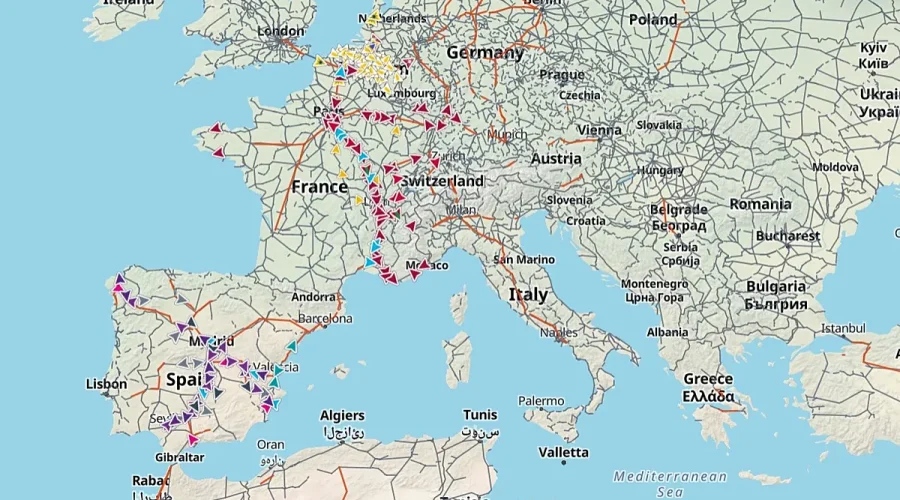
The interface presents a fully interactive cartographic view of the three-country rail web. Users can spin, zoom, and pan across the network without restriction. Overlaying the geography are live metrics: the total count of trains currently in motion, the mean delay measured in minutes, the share of services arriving within schedule tolerance, and the cancellation rate. These figures update on a rolling twenty-second refresh cycle, meaning a service disruption in one corridor becomes visible almost the instant it materialises.
Filtering options let users isolate a single national operator’s traffic, or pull in cross-border services such as Eurostar and Italy’s Frecciarossa high-speed brand. A separate set of toggles targets infrastructure rather than rolling stock: stations currently devoid of any rail service, nodes connected to high-speed lines, and platforms that remain operationally active yet are sealed off from public access. Dedicated widgets rank the worst-performing trains and stations in real time, producing a kind of live leaderboard of disruption.
Looking Up a Specific Service
For those who already know their train number, the platform opens a deeper layer of information. Scheduled itineraries, historical journey records, and a live position tracker are all accessible through a simple numeric query. Broader search tools cover departures, arrivals, punctuality percentages, and station amenities across France, Germany, Spain, and Belgium. A dedicated operators section lets users examine individual rail companies’ route maps and performance histories side by side.
As a concrete illustration, a snapshot of France’s SNCF high-speed fleet taken during the platform’s early days showed 601 trains in service at that moment. Of those, eighty were running fifteen minutes or more behind schedule, and twenty-two had been cancelled outright. Watching that number tick upward during a morning peak window is, in effect, watching a rail crisis develop in slow motion.
Free Tier Versus Paid Add-ons
The core map, basic filters, and the twenty-second refresh loop are available at no cost. A subscription tier unlocks additional capabilities: a personalised journey map that follows a user’s specific itinerary, live annotations of interrupted services plotted directly onto the map, the ability to sort visible trains by magnitude of delay, and expanded cartographic detail covering track classifications, infrastructure overlays, and what the platform terms an “expert reading” of network conditions.
Where the Data Comes From
TrainTracker24 does not collect its own telemetry. Every datum on the map is drawn from open-data feeds published by national operators, regional transport authorities, and infrastructure managers. Those feeds encompass published timetables, real-time position updates, and disruption advisories. The platform’s role is aggregation, visualisation, and near-instantaneous refresh rather than primary data collection.
Following its August launch focused on three countries, the team has signalled intent to extend coverage further across Europe, as noted in a public statement posted on X. The logical next steps would be additional continental networks, though no specific timetable for expansion has been confirmed.
A Crowded Competitive Field
TrainTracker24 enters a space that already hosts several established services. TrainTracker.live, also free, provides a comparable live map alongside timetable and punctuality statistics, and at the time of recent observation was displaying data for roughly eleven thousand trains simultaneously across four continents—Europe, the Americas, Asia, and Oceania. TrainsTracking takes a different angle, pairing live position data with fare comparisons and direct links to official booking pages across seventy-six countries, with its deepest analytical coverage concentrated in Europe, Japan, India, Pakistan, and the United States. SignalBox, by contrast, narrows its scope exclusively to Britain’s rail network.
The parallel to aviation is hard to miss. Flightradar24 turned flight tracking into a mainstream pastime by making an otherwise opaque system visible and interactive. Rail has lacked an equivalent single-purpose tool for continental Europe, and that absence is precisely the niche TrainTracker24 is designed to fill.
The Founder’s Rationale
Elric Battello, who founded the platform, explained the motivation to Luxembourg-based media outlet Virgule by drawing the comparison explicitly:
“When you’re flying, or waiting for someone at the airport, it’s easy to open Flightradar24 to track the flight live on a map; the same goes for shipping. With trains, it’s different. You’ll often see a display at the station or receive a notification in the event of a delay. But you don’t really know what’s going on.”
That last sentence captures the core frustration. A station announcement tells you your particular service is late; it does not tell you whether the delay is isolated or symptomatic of a network-wide failure, whether the next alternative departure is also compromised, or whether the disruption will clear in twenty minutes or two hours. A live, continuously refreshed map of the entire corridor transforms a single opaque notification into a comprehensible picture of cause and effect.
For the estimated hundreds of millions of passengers who rely on European rail each year, the shift from reactive station-board updates to proactive, network-wide situational awareness represents a meaningful change in how travellers plan, wait, and make decisions at the platform edge. Whether TrainTracker24 becomes the default reference point for continental rail—much as Flightradar24 became the default for flights—remains to be seen, but the August launch marks the moment the question “where is my train?” finally acquired a map-based answer.
Related Reading
Frequently Asked Questions
What is All aboard?
All aboard is the main topic of this guide. The article explains the context, practical details, and next steps readers should understand.
Why does All aboard matter?
All aboard matters because readers are looking for a useful answer, not just a short summary. Good content should match search intent and help them decide what to do next.