Ukraine’s Drone War on Russian Supply Chains Reaches St. Petersburg’s Periphery
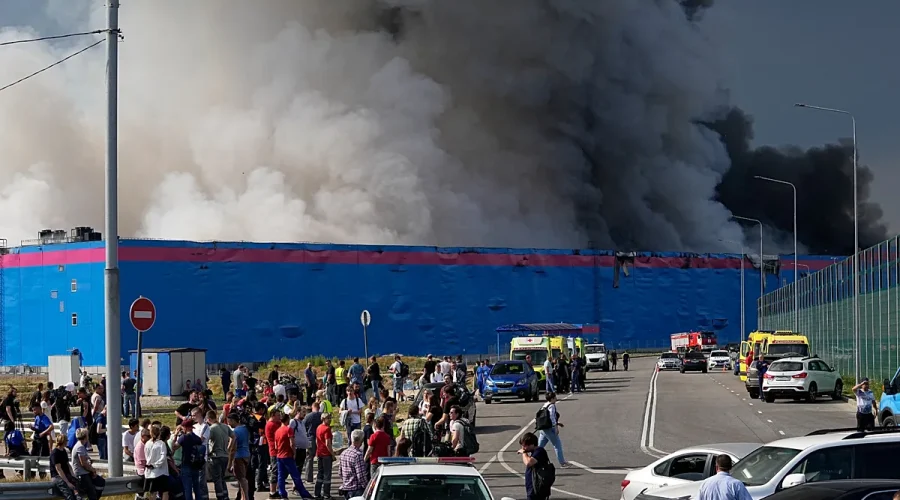
Usagevpn.com – Thick columns of smoke hung over the Kolpino district on Sunday morning as crews from Russia’s emergency services ministry hauled fire hoses through scattered wreckage at a logistics centre adjacent to an Ozon fulfilment facility. The blaze, which consumed part of the warehouse complex on the southern outskirts of St. Petersburg, was brought under control only after firefighters worked through the night. No personnel were injured, and authorities declined to specify a cause, leaving open whether the incident was accidental or connected to the broader pattern of strikes now targeting the country’s e-commerce infrastructure.
A Campaign That Has Shifted Targets
The Kolpino fire arrived at a moment when Kyiv had publicly declared a new phase in its aerial operations against Russian commercial logistics. On Saturday, Ukraine’s defence ministry stated that its drone units would redirect sustained pressure toward Ozon, the nation’s second-largest online marketplace by transaction volume, after several weeks of concentrated strikes aimed at its principal competitor, Wildberries. The announcement marked a deliberate escalation: where earlier sorties had focused on a single rival’s distribution network, the campaign now encompassed the full breadth of Russia’s parcel-delivery backbone.
Ozon, headquartered in Moscow and operating thousands of pickup points across the country, handles an estimated share of domestic e-commerce comparable to Wildberries’ own volume. Together, the two platforms account for the overwhelming majority of online retail fulfilment in Russia. Disrupting either one’s warehouse and last-mile infrastructure therefore has immediate consequences for millions of consumers who rely on next-day or same-day parcel delivery, as well as for the tens of thousands of couriers and warehouse workers employed by the networks.
Weekend Strikes Across Three Regions
The Kolpino incident was not isolated. Over the same weekend, two additional Ozon warehouses were struck in the Samara region and the Orenburg region, according to company statements and regional emergency-service updates. Ozon confirmed that operations at its Orenburg distribution hub had been suspended following the attack, though the company did not provide a timeline for resumption. The Samara facility’s status was not detailed in initial disclosures.
The geographic spread of the strikes — from the Volga basin in Samara to the southern Urals in Orenburg, and now to the immediate periphery of Russia’s second city — underscores the range and flexibility of the drone systems Kyiv has deployed. Each site represents a node in a national network that moves goods from regional consolidation centres to local pickup lockers and courier vans. Hitting multiple nodes simultaneously forces the platform to reroute shipments, extend delivery windows, and absorb costs that, in aggregate, strain margins already compressed by wartime logistics inflation.
What the Emergency-Services Footage Shows
Video released by the ministry responsible for civil emergencies captured crews advancing through debris-strewn aisles while dense grey smoke billowed above the roofline. The imagery was consistent with a structural fire of considerable intensity, though officials stopped short of describing the extent of damage or naming the specific Ozon sub-facility involved. The absence of a stated cause — whether electrical fault, fuel ignition, or external impact — has drawn scrutiny, given the timing relative to the defence ministry’s Saturday announcement.
“No injuries were reported,” officials said, without elaborating on the origin of the blaze.
Broader Implications for Russian Commerce
The targeting of e-commerce infrastructure represents a shift in the character of Ukraine’s long-range strike programme. Earlier phases concentrated on military-industrial plants, fuel depots, and air-defence installations. The pivot toward commercial logistics suggests an intent to degrade the domestic consumer economy’s functioning — to make everyday shopping slower, more expensive, and less reliable — while simultaneously imposing costs on two of Russia’s largest private employers.
For Ozon specifically, the suspension of the Orenburg hub means that parcels destined for Orenburg Oblast and surrounding territories must be rerouted through alternative consolidation points, adding transit days and increasing the likelihood of missed delivery windows. Ozon’s investor-facing disclosures in recent quarters have already flagged supply-chain fragility as a key operational risk; sustained disruption at multiple nodes would compound that exposure and could pressure the company’s delivery-time commitments, which form a core element of its competitive positioning against Wildberries.
Wildberries, which endured weeks of strikes before the campaign’s stated pivot, has similarly reported temporary service interruptions at affected sites. The cumulative effect across both platforms is a measurable degradation of the parcel-delivery experience for Russian consumers, a dynamic that intersects with broader wartime pressures on consumer spending, import substitution, and regional economic activity.
Questions That Remain Open
Authorities in St. Petersburg have not confirmed whether the Kolpino fire was linked to an aerial strike or to an independent industrial accident. Ozon’s corporate communications office did not issue a detailed statement on the specific facility involved or on expected downtime. The defence ministry’s Saturday briefing framed the Ozon targeting as a forward-looking operational decision, without specifying whether weekend strikes had already been executed under that new directive.
What is clear is the pattern: multiple logistics nodes, separated by hundreds of kilometres, struck within a compressed timeframe, following a public declaration of intent. Whether the Kolpino blaze fits that pattern or stands apart will depend on findings yet to be published. For now, the smoke over Kolpino adds another data point to a campaign that has moved, in a matter of weeks, from the periphery of Russia’s military economy into the everyday commercial infrastructure on which ordinary consumers depend.
Related Reading
Frequently Asked Questions
What is Warehouse burns near St Petersburg as Ukraine?
Warehouse burns near St Petersburg as Ukraine is the main topic of this guide. The article explains the context, practical details, and next steps readers should understand.
Why does Warehouse burns near St Petersburg as Ukraine matter?
Warehouse burns near St Petersburg as Ukraine matters because readers are looking for a useful answer, not just a short summary. Good content should match search intent and help them decide what to do next.