It’s Excruciating: Bavaria’s Finger Wrestling Championship
Usagevpn.com – Ask any competitor at the annual finger wrestling championships in Pflugdorf-Stadl, Bavaria, what a full-power pull feels like, and the answer is almost always the same: it’s excruciating. Set among the foothills of the Alps, this small village hosts Germany’s national championship in a discipline that reduces athletic contest to two middle fingers, a narrow leather loop, and the edge of a table. What looks like a parlor trick from the outside becomes, once you watch the competitors’ faces, a genuinely punishing test of grip strength, tendon endurance, and nerve. The villagers who organize the event treat it with the same solemnity they would bring to a harvest rite or a church procession.
How the Contest Actually Works
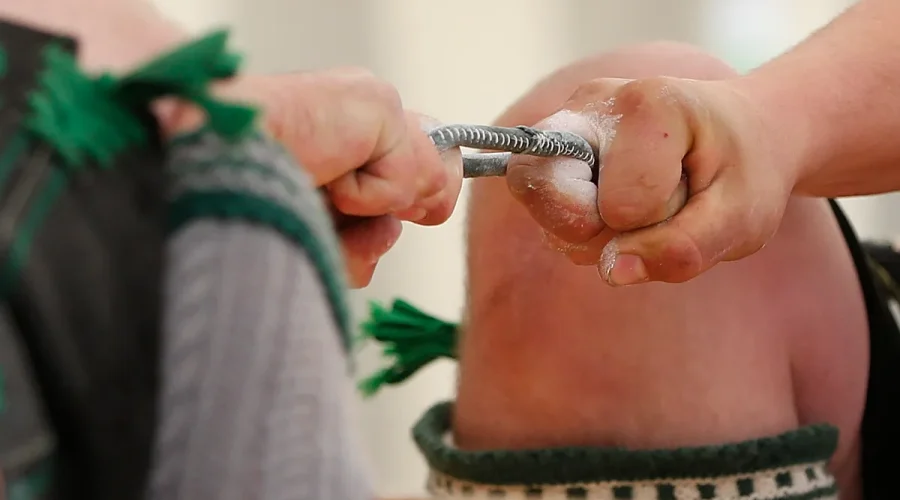
The rules fit into a single sentence: each athlete threads a middle finger through a small leather strap, locks it against the rival’s, and tries to drag the opponent’s hand past the table’s edge before being dragged past it himself. No grappling, no strikes, no leverage tricks exist in the rulebook. Every joule of force funnels through one digit, and the match is decided by wrist stability, sustained pull, and the split-second judgment of when to surge. Bouts range from a few seconds — when one competitor simply outmuscles the other from the opening tension — to the full sixty seconds, both athletes frozen in a silent, grinding contest of endurance while the leather creaks and knuckles bleach white.
For spectators packed along the tables, those long draws are the most electric moments of the day. The silence between two locked fingers, the slow tilt of a shoulder, the sudden snap of a hand crossing the boundary — it carries a tension that no televised sport replicates.
The Physical Toll Behind the Leather Loop
First-time observers are struck by the length of the warm-up ritual. Competitors arrive well before the first bout and spend considerable time stretching, massaging, and gradually loading the finger and wrist. The reason is practical: the strain concentrated on a patch of skin no wider than a coin during a full-power pull is intense enough to produce painful abrasions, micro-tears, and acute tendon irritation. Athletes who skip preparation risk injuries that sideline them for weeks. In a sport where your entire competitive apparatus is one digit, that risk is existential.
The aftermath extends well past the match. Competitors report soreness radiating up the forearm and into the shoulder for hours. Repeated bouts across a tournament day leave visible redness and swelling that athletes treat with the same matter-of-factness a marathon runner treats blistered feet. It’s excruciating, they will tell you, but it is a price they accept willingly because the contest itself — the focus, the silence, the single decisive surge — offers something no other activity provides.
The Champion’s Verdict
Ferdinand Seitz, the senior champion of the event, has spoken openly about what the sport does to the body. Pressed to characterize the sensation of a full-power pull, he offered a single word that has since become shorthand among fans of the discipline:
“Excruciating.”
Seitz quickly contextualized the discomfort. In his view, finger wrestling sits comfortably alongside other sports that demand athletes endure significant physical punishment. The pain is real, he stressed, but it is not unique, and it is outweighed by the singular intensity of the contest.
Rooted in Alpine Folk Tradition
Finger wrestling does not exist in isolation. It belongs to a broader family of Alpine folk pastimes transmitted through Bavarian and Austrian communities for generations. These events are organized at the village or municipal level, funded by local clubs and small sponsorships, and embedded in the seasonal calendar alongside folk-dance festivals, traditional archery days, and communal meals. There is no national governing body with a multi-million-euro budget, no televised broadcast circuit, no multinational sponsorship deals. What there is, instead, is a deep local identity attached to the event. For the residents of Pflugdorf-Stadl, hosting the championships is a point of civic pride comparable to putting on a village carnival.
The sport’s survival owes much to that community embedding. Because the knowledge of technique — how to angle the wrist, how to time the pull, how to protect the skin during a prolonged draw — is transmitted informally, often from older competitors to younger ones, the discipline resists the kind of institutional fragility that plagues niche sports elsewhere.
Frequently Asked Questions
Is it’s excruciating a fair description of the pain involved? Competitors and champions, including senior titleholder Ferdinand Seitz, consistently describe a full-power pull as excruciating. The sensation concentrates force onto a single digit and surrounding tendons, producing sharp, acute pain during the bout and lingering soreness afterward. Most athletes compare it to the discomfort of other endurance sports rather than to injury.
Where and when does the championship take place? The event is held annually in Pflugdorf-Stadl, a small village in the Bavarian foothills of the Alps. It is organized at the village level and embedded in the local seasonal calendar alongside other folk-tradition events.
What equipment is required? Each competitor uses only a middle finger and a small leather loop or strap. No additional apparatus, protective gear, or scoring technology is involved. The table’s edge serves as the boundary.
Can anyone compete, or is it restricted? The championships draw athletes who have trained specifically for the discipline. While the rules are simple, the physical demands — sustained single-digit force, tendon endurance, and skin tolerance — mean that competitors typically invest years of preparation before entering a national-level bout.