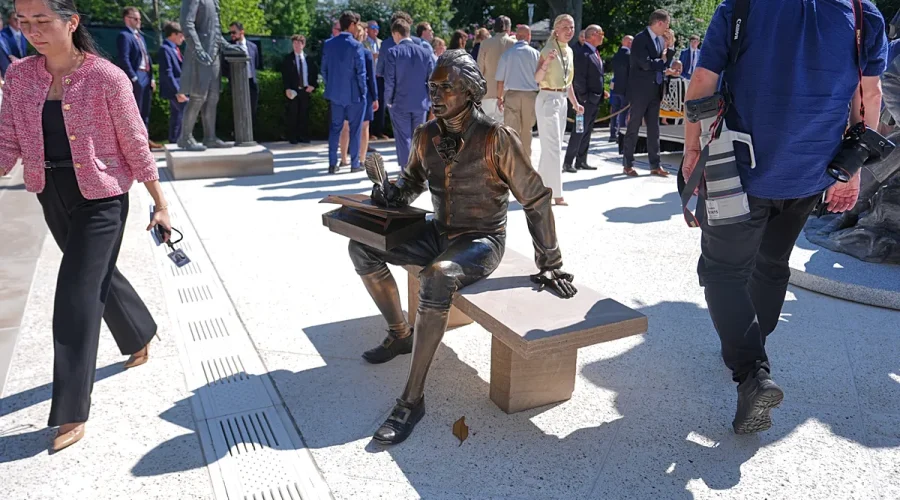
The Rose Garden Becomes a Sculpture Gallery: Jefferson Joins Washington, Hamilton, and Franklin in the White House Courtyard
Usagevpn.com – The White House Rose Garden, long associated with spring blooms and outdoor press briefings, now hosts a bronze likeness of Thomas Jefferson standing among the petals. The addition, sculpted by Colorado-based artist George Lundeen, marks the most recent chapter in a sweeping redesign of the South Lawn’s most photographed corner. What was once primarily a horticultural display has been steadily converted into an open-air gallery celebrating the architects of the American republic.
A New Figure Takes Its Place
Jefferson, the third president and principal author of the Declaration of Independence, now stands alongside existing sculptures of George Washington, Alexander Hamilton, and Benjamin Franklin. A separate monument honoring soldiers of the Revolutionary War also occupies the grounds. The Lundeen piece, cast in bronze, completes a quartet of Founding-era figures that collectively span the political, military, and intellectual pillars of the nation’s founding.
The choice of Jefferson carries particular symbolic weight. As the architect of the Louisiana Purchase, the author of the Kentucky Resolutions, and the founder of the University of Virginia, his legacy stretches across diplomacy, constitutional theory, and education. Placing his likeness in a space adjacent to the Oval Office corridor positions him within daily sight of the presidency itself — a proximity that earlier generations of gardeners would scarcely have imagined.
The Broader Redesign
The sculptural overhaul did not begin with Jefferson. It accelerated after Donald Trump assumed his second term in January 2025, when a wider program of alterations to the White House exterior and its surrounding grounds was set in motion. The Rose Garden sits at the heart of that program. Where previous administrations treated the space as a seasonal flower bed punctuated by occasional ceremonial use, the current administration has reoriented its purpose toward permanent commemoration.
The existing sculptures of Washington, Hamilton, and Franklin had already shifted the garden’s character well before the Jefferson casting arrived. Washington, the first president and commander of the Continental Army, anchors the collection with military authority. Hamilton, who never held the presidency but shaped the young nation’s financial architecture as its first Treasury Secretary, represents the administrative and economic dimension of founding. Franklin, the polymath diplomat and scientist, bridges the Enlightenment intellectual tradition into the political project. Together they form a narrative arc — military victory, economic institution, philosophical justification — that the Jefferson addition extends into the realm of constitutional governance and territorial expansion.
What the Rose Garden Was, and What It Is Becoming
The Rose Garden traces its origins to 1901, when Theodore Roosevelt converted a stretch of South Lawn into a formal flower bed. For more than a century it served as the White House’s primary outdoor venue for press conferences, birthday celebrations, diplomatic photo-ops, and the occasional impromptu address. Presidents from Franklin Roosevelt through Joe Biden used the space for briefings, Easter egg rolls, and garden parties. Its identity was horticultural and ceremonial, not monumental.
The current transformation inverts that identity. Permanent bronze figures, arranged with deliberate compositional spacing, now dominate the sight lines. Visitors and cameras that once framed tulips and peonies now frame patinated metal. The seasonal cycle of planting and bloom has been subordinated to a year-round sculptural program. Whether the garden retains any meaningful horticultural function during peak growing season remains an open question for the grounds-keeping staff tasked with maintaining both flowers and monuments in close proximity.
Context and Implications
The decision to populate a working garden with permanent statuary raises practical as well as aesthetic questions. Bronze sculptures require regular cleaning, drainage management, and structural anchoring to withstand wind loads. Their footprints reduce available planting area. Their visual mass can overwhelm the scale of a space originally designed for intimate floral arrangement. Yet the administration appears to regard these trade-offs as acceptable, prioritizing what it frames as a corrective to what it views as an insufficiently commemorative use of the grounds.
For readers tracking the evolution of the White House exterior, the Rose Garden’s trajectory offers a concentrated case study in how a single administration can reassign the symbolic function of a historic space within a single term. The garden’s two-century history as a site of seasonal beauty and informal statecraft has been compressed, in roughly eighteen months, into a permanent memorial complex. The Jefferson statue, arriving in August 2026, represents the latest installment in that compression.
The Rose Garden was never meant to be a museum. Yet here it stands, bronze by bronze, becoming one.
Whether future administrations will retain, expand, or reverse the sculptural program remains uncertain. What is certain is that the space as it exists today — Jefferson gazing southward over a reduced flower bed, flanked by Washington, Hamilton, and Franklin, with Revolutionary War soldiers completing the tableau — bears little resemblance to the garden that Theodore Roosevelt planted a century and a quarter ago. The petals still grow, but they now grow between monuments.
Related Reading
Frequently Asked Questions
What is Trump s Rose Garden is filling?
Trump s Rose Garden is filling is the main topic of this guide. The article explains the context, practical details, and next steps readers should understand.
Why does Trump s Rose Garden is filling matter?
Trump s Rose Garden is filling matters because readers are looking for a useful answer, not just a short summary. Good content should match search intent and help them decide what to do next.