Trump Threatens to Double Tariffs on Canadian Vehicles
Usagevpn.com – Trump threatens to double tariffs on Canadian automobiles, trucks, automotive components, and steel to 50 percent beginning January 2027, according to a Truth Social post published Monday. The declaration landed hours after bilateral negotiations — designed to narrow the scope of a broader 50 percent levy on Canadian exports — collapsed, with each delegation accusing the other of inserting final-minute revisions that shattered the tentative framework.
Under existing rules the United States levies a 25 percent duty on vehicles containing non-U.S. content. The schedule outlined in the post would push that rate to 50 percent across every Canadian-origin vehicle and associated input crossing the border.
“On January First, 2027, Tariffs on all Cars, Trucks, both large and small, Automotive Parts, and Steel, will be increased to 50%.”
Negotiation Breakdown and Ottawa’s Retaliatory Response
The talks broke down on Friday. Delegations walked away blaming one another for attempting to rewrite terms that had been tentatively agreed over preceding days. The resulting duties took effect Saturday and are estimated to touch roughly $20 billion in annual Canadian exports to the American market.
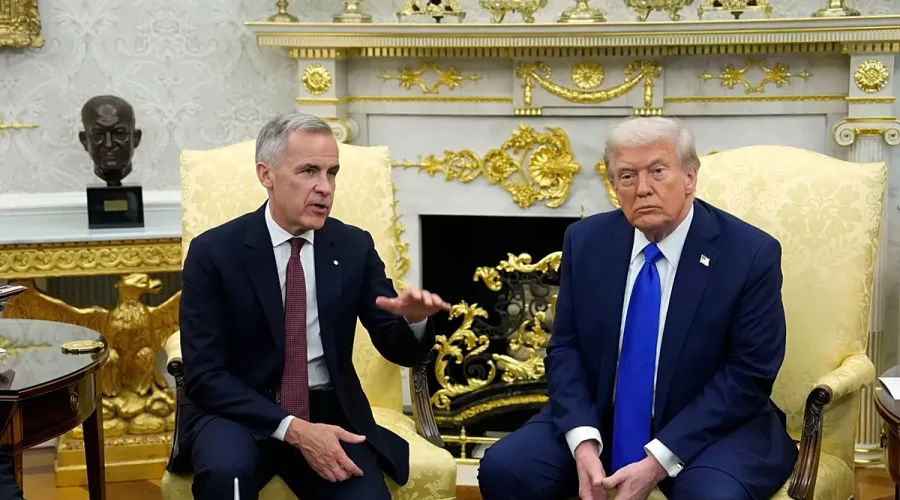
Prime Minister Mark Carney addressed Canadians on Saturday, explaining that his government had been compelled to abandon what he called a “bad” deal. He pledged retaliatory measures “dollar for dollar to protect our workers and businesses,” naming steel, dairy, household appliances, agricultural machinery, pulp and paper, and electronics among the sectors to be targeted.
“We cannot accept what they’ve offered, and we will not give what they’ve asked.”
Washington’s Account and Sovereignty Rhetoric
The Office of the U.S. Trade Representative framed the episode as a “missed opportunity” by Ottawa, alleging that Canada maintained “prolonged retaliation” against American goods while shifting its demands at the table. The agency stated that new Canadian requests and walk-backs of prior commitments had “upended the careful balance reached in the past days.” Carney’s office rejected that characterization, maintaining the Canadian delegation remained committed to a fair and reciprocal outcome.
Beyond the tariff mechanics, Trump extended his critique on Monday to what he called Canada’s “ridiculously high tariffs” on U.S. farm products. He declared that Canada would no longer be treated “like a state,” echoing his recurring suggestion that the country become the 51st state. Last week he had gone further, claiming Ottawa sought “the benefits of being a State, without being one.” The language underscores how the trade dispute has become entangled with sovereignty questions on both sides of the border.
The episode — in which Trump threatens to double tariffs on one of America’s closest trading partners — is the latest chapter in an aggressive tariff program that has defined the administration’s second term. Across multiple trading relationships, Washington has raised duties on partners worldwide, arguing that higher import costs will redirect production toward American factories and correct long-standing trade imbalances. Critics counter that the measures raise consumer prices and invite retaliatory spirals without delivering the promised manufacturing revival.
Frequently Asked Questions
When do the doubled tariffs take effect? The 50 percent rate on Canadian vehicles, trucks, automotive parts, and steel begins January 1, 2027, per the presidential announcement.
What products are covered? All cars (large and small), trucks, automotive components, and steel originating in Canada fall under the increased duty. Canadian retaliatory measures target steel, dairy, household appliances, agricultural machinery, pulp and paper, and electronics.
How much trade is affected? The levies are estimated to impact roughly $20 billion in annual Canadian exports to the United States.
What caused the talks to collapse? Each side accused the other of inserting last-minute revisions to the negotiating text. Washington called it a “missed opportunity”; Ottawa said it would not accept an unfair deal and would retaliate in kind.